

A Japanese engineer has proposed a new way to get rid of space debris without contacting it directly. This is possible with the use of a bidirectional plasma engine. The device with it will be able to slow it down before it falls just by being nearby for a hundred days.
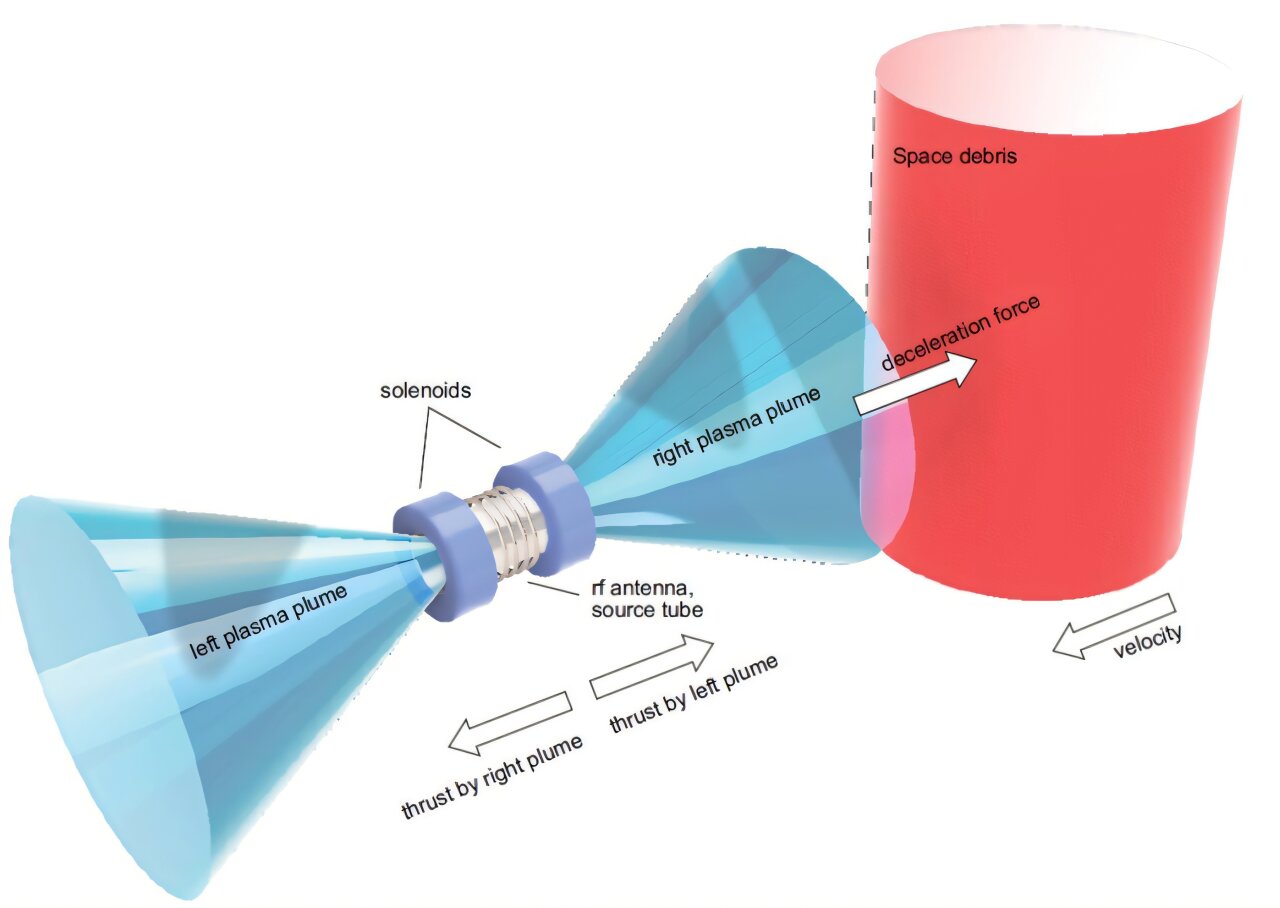
Space debris problem
Space debris consists of various non-functional satellites, spent rocket stages, and simply pieces of metal orbiting our planet. They pose a significant danger to active spacecraft, and scientists around the world are therefore looking for ways to effectively deorbit them.
Kazunori Takahashi from the Graduate School of Engineering at Tohoku University in Japan devoted his research to solving this problem. After all, no development has been brought to a stage suitable for serial use.
The fact is that, according to the developers’ plans, the debris collector should somehow dock with its target and only then remove it from orbit. But that’s technically very difficult. A Japanese engineer proposed a solution that would make it possible to do without it.
Plasma engine
According to Takahashi, it simply requires using a device that is placed in front of the debris and slows it down with the jet stream of a plasma engine. Such movements already exist; they have low power but are extremely economical, since gas accelerated by a magnetic field moves faster than a chemical reaction can accelerate it.
However, no matter how quiet a jet engine is, it cannot defy physics: a device that slows down debris with a jet stream will simultaneously begin to accelerate itself. Therefore, Takahashi’s design incorporates two engines — one at the front and one at the rear. Working together, they balance each other’s actions.
As a result, the device can slow down space debris without accelerating. The developer conducted laboratory research and demonstrated that the concept works.
According to phys.org

