

Australian researchers from RMIT University have proven that bacteria beneficial to humans can survive the rigors of space travel: rocket launch, several minutes of microgravity, and harsh deceleration upon return. During a suborbital flight on a two-stage SubOrbital Express 3 – M15 rocket, Bacillus subtilis spores were accelerated to ≈13g, endured ~6 minutes of microgravity at an altitude of about 257 km, and peak overloads during the return stage. After their return, their viability and morphology did not differ from the control group, which indicates a high margin of safety for microbes in real flight conditions.
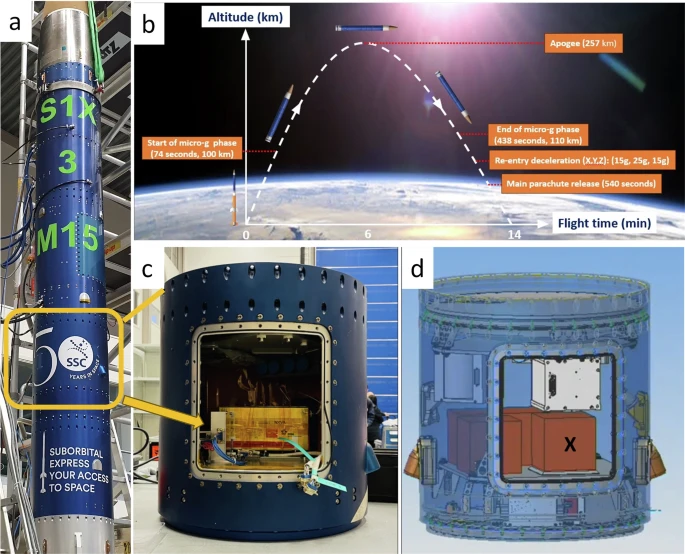
The team emphasizes that stable microbiological support for the crew’s bodies is critically important for long-term missions, from the Moon to Mars. The result gives reason to believe that key probiotic organisms will withstand the most extreme stages of the journey — from takeoff to landing. The study was conducted in collaboration with ResearchSat and Numedico, and detailed flight parameters (including an angular velocity of ~220°/s upon entry) and colony-forming unit counts (≈9.7×10⁷ versus 9.2×10⁷ in the control) are provided in the publication.
How does it work? The secret is simple: it is not delicate living bacteria that are sent into space, but their spores — a natural state of hibernation. The spores are dried, consume almost nothing, and within them, the DNA is tightly packed with protective proteins and covered with a strong multilayered shell. Therefore, it almost doesn’t care about vibrations, sudden overloads, and a few minutes of weightlessness during launch and return. In the laboratory, the spores are placed in small capsules with an inert carrier and secured in a container that partially absorbs shocks and temperature fluctuations. After the flight, it’s simple: add a nutrient medium and heat, and the spore reabsorbs water, wakes up, and begins to grow as if nothing had happened. In other words, the trick lies not in the heroic endurance of ordinary cells, but in the right form — spores, which nature created specifically to survive extreme conditions.
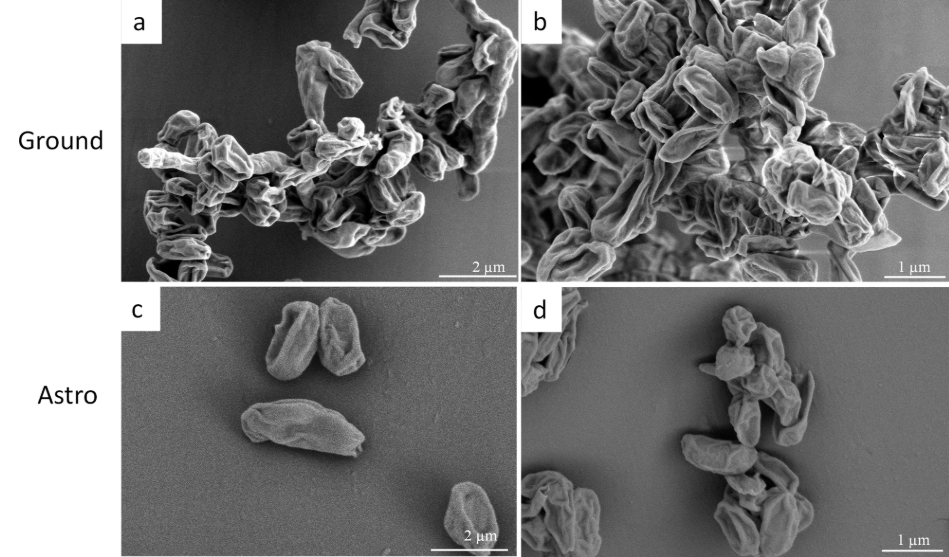
Why is this important? The health of the crew is the foundation of future space exploration. If probiotic spores reliably withstand launch/return, this opens the way to simpler and more reliable life support systems: from stable probiotics in nutrition to closed-loop bioreactors. For astrobiology, the result sets an important baseline: if Earth spores are so resilient, missions to search for life have to consider both their possible transportability and the risks of introducing contamination. At the same time, information about the limits of microbial survival will help to more accurately calibrate instruments for detecting traces of life in harsh environments — from the surface of Mars to the subglacial oceans of moons.
Want to understand why the survival of Earth spores in flight strengthens hopes of finding microbial life on the Red Planet? Which Martian shelters—dry deltas, salt deposits, subsurface ice—best preserve biosignatures, and how do rovers and orbital spectrometers search for them? Read about the main arguments, search methods, and upcoming missions in the article “Why are we looking for life on Mars?”
According to nature

