

Physicists at the U.S. National Institute of Standards and Technology (NIST) have released new data on the gravitational constant: the mystery remains.
Why is the “big G” so capricious?
Scientists have completed a decade-long experiment to measure the gravitational constant—a fundamental quantity that determines the force of gravity at any point in the universe. The result, published on April 16, 2026, in the journal Metrologia, did not solve the mystery: the new value differs from the previous reference measurement by 0.0235%. In metrology, this is a significant discrepancy, sufficient to leave the question open.
The gravitational constant, which physicists refer to as the “big G,” is the least precisely known of all the fundamental constants of nature. Gravity is the weakest of the four fundamental forces: even a small magnet can overcome the Earth’s gravitational pull, holding a paperclip in the air.
In the laboratory, this weakness becomes a real nightmare for measurements: researchers are forced to detect gravitational interactions between masses that are quadrillions of times lighter than Earth, and consequently, the gravitational pull between them is correspondingly minuscule. Scientists have been trying to measure G for over 225 years—ever since Henry Cavendish conducted his first experiment in 1798.
The envelope method
To avoid unconsciously influencing the results, physicist Stephan Schlamminger used a “blind data analysis” method: he asked a colleague to conceal a key part of the data from him by writing a secret number on a piece of paper and sealing it in an envelope.
It was only after publicly revealing it—on July 11, 2024, at a conference in Colorado—that Schlamminger discovered the true significance of what his team had measured. This method was intended to eliminate the expectation effect, whereby researchers subconsciously adjust the results to fit generally accepted figures.
What the experiment showed
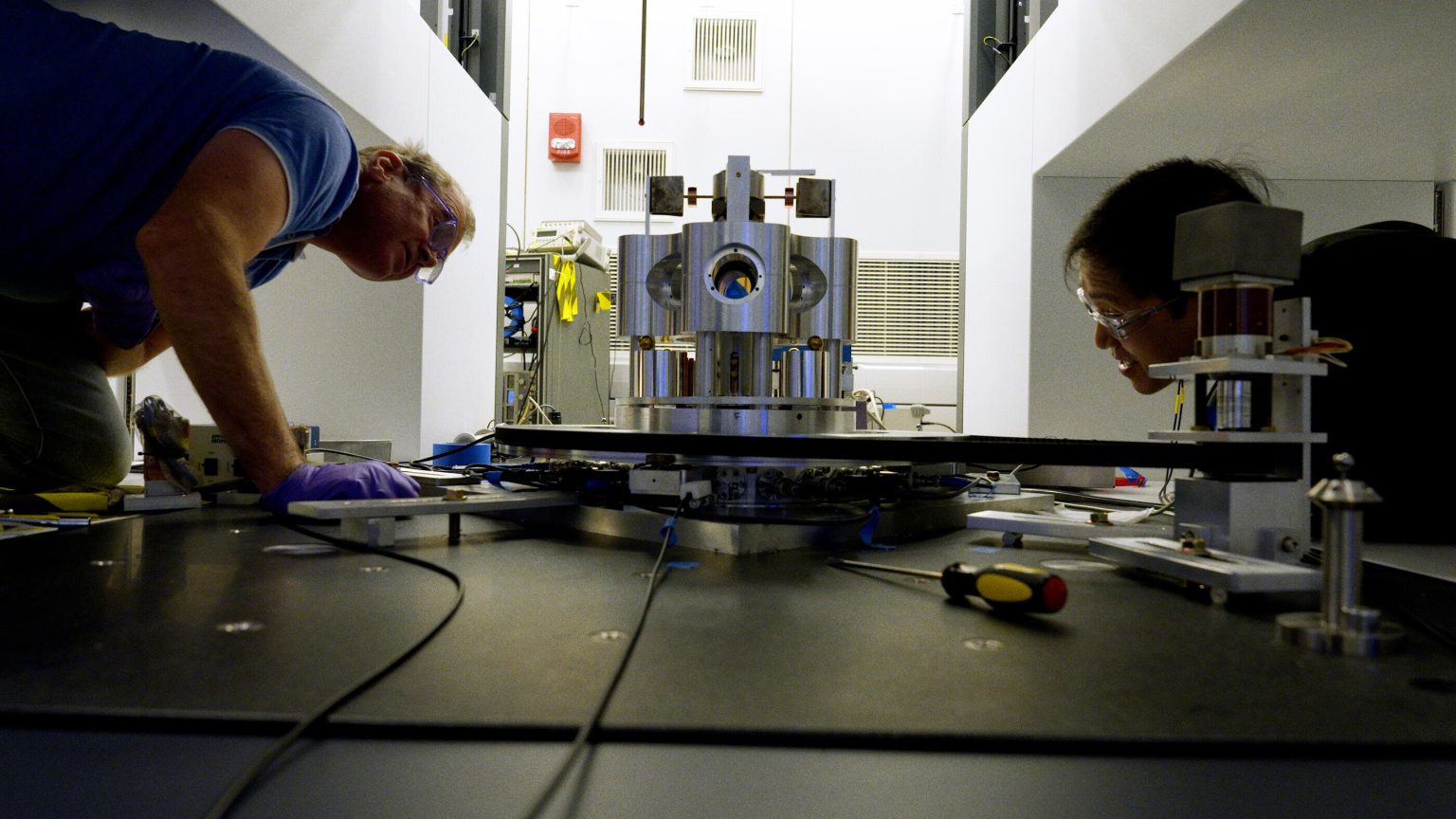
The team used a torsion balance—a device in which the gravitational force between masses causes a thin metal strip, as thin as a human hair, to twist. The equipment, borrowed from the International Bureau of Weights and Measures (BIPM, France), was replicated at the NIST laboratory in Maryland.
To verify their findings, the scientists repeated the measurements twice: first with copper weights, then with sapphire weights. The results were consistent with each other but did not match the French data from 2007. The G value obtained was lower than previous figures.
What does “discrepancy” mean?
In everyday life, the difference is imperceptible: it will not affect either the readings on a scale or the calculations of satellite orbits. However, all other fundamental constants of nature are known to many significant digits—while G still exhibits the greatest uncertainty.
The main question still remains unanswered: does the problem lie in methodological errors that have not yet been identified, or in something deeper—in the very nature of gravity? “Every measurement matters, because the truth matters,” said Schlamminger said. After all, following a decade of work, he admitted that he was passing the torch to his younger colleagues.
According to phys.org

