

Nvidia and SK Hynix have announced a multi-year partnership to develop and manufacture memory chips for artificial intelligence. The agreement covers design and manufacturing, including memory for the company’s most powerful graphics accelerator to date.

Next-generation memory
A key area of collaboration involves fourth-generation HBM4 high-bandwidth memory chips, which are used in server systems for AI training and operations. Nvidia has already confirmed that SK Hynix, Samsung Electronics, and Micron Technology have been selected to supply HBM4.
These chips will form the foundation of “Vera Rubin,” Nvidia’s most powerful graphics accelerator to date, built on clusters of processors and graphics cores with terabytes of memory in each server system. Shipments are scheduled for the third quarter of 2026, and production has already begun.
The “Vera Rubin” accelerator is named after the astrophysicist who also lent her name to the ground-based Vera Rubin Observatory in Chile. Rubin’s observations of galactic orbits were among the first compelling pieces of evidence for the existence of dark matter.
Competition for the most profitable market
Three memory manufacturers—SK Hynix, Samsung, and Micron—dominate the global market and are fiercely competing for contracts with Nvidia. Memory remains one of the most critical challenges in the development of AI infrastructure, according to Arm Holdings CEO René Haas.
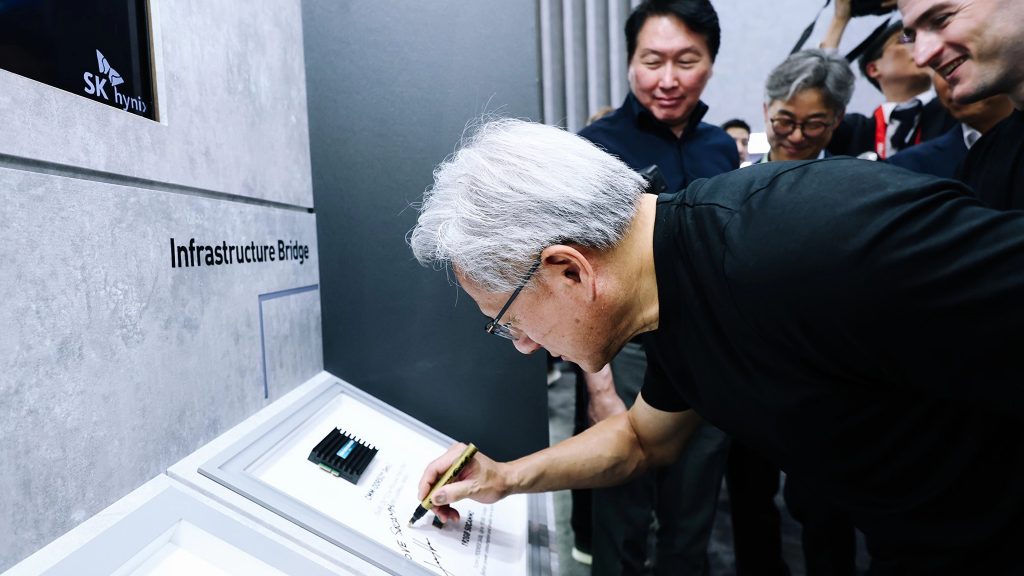
SK Hynix will supply Nvidia with a full range of products. These include RAM for system operation, HBM chips for ultra-fast data transfer between the processor and memory, and solid-state drives for long-term data storage.
More than just a memory
The collaboration extends beyond the production of memory chips to include AI infrastructure and physical AI—that is, the field where artificial intelligence controls robots and autonomous systems in the real world.
Together with SK Telecom and Naver, the company will develop cloud-based AI services. Its collaboration with Doosan Group will focus on robotics.
According to bloomberg.com

