

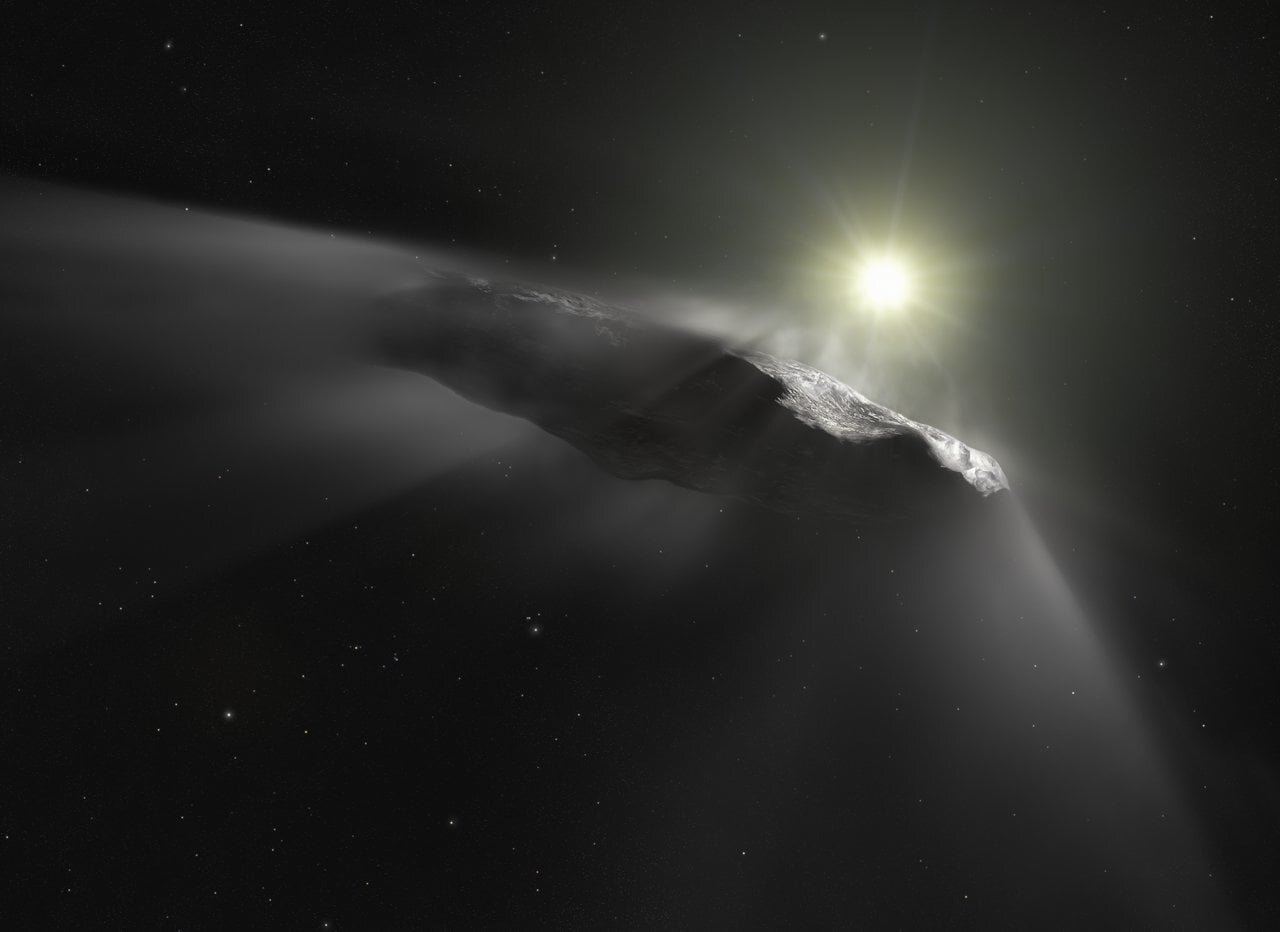
The appearance of the interstellar object 3I/ATLAS prompted researchers to ask an unexpected question. If billions of such objects are wandering through the galaxy, could they account for some of the Milky Way’s hidden mass, which has so far been attributed to dark matter? Scientists at the University of Hamburg have attempted to find the answer.
Invisible Mass
The galaxy rotates faster than can be explained by the mass of all visible stars. To account for this excess velocity, astrophysicists have introduced the concept of dark matter—that is, matter that cannot be observed directly because it interacts only through gravity.
Dark matter isn’t the only thing that has mass. Interstellar objects also have mass, and there could be billions of such objects in the galaxy; it’s just that no telescope has detected them yet.
What did the researchers find?
According to statistical estimates, interstellar objects the size of 3I/ATLAS could account for between 13% and 45% of the mass currently attributed to dark matter. The main limitation of this study is that the entire extrapolation is based on a sample of only three known objects.
The authors admit that the upper limit of 45% assumes an overly optimistic estimate of the amount of matter that star systems would release into space. However, the mathematical calculations are correct.
When will the answers be available?
The next generation of survey telescopes is capable of detecting dozens or even hundreds of new interstellar objects. Once the sample size exceeds three objects, the estimates will become much more reliable.
It will then become clear whether they actually make a significant contribution to the galaxy’s invisible mass and whether the current model of dark matter needs to be revised.
According to phys.org

