

Why doesn’t dark matter compress galaxies into a single point, but instead gives them a more complex shape? Scientists believe that this is because it does not surround star systems uniformly, but rather forms subhaloes—that is, distinct clusters.
Mystery of Dark Matter
A group of researchers from American universities and laboratories recently published a paper on the interaction between galaxies and dark matter. The latter is believed to account for most of the mass of the universe, but manifests itself only through gravity.
However, there is a long-standing issue associated with it. If dark matter forms continuous halos around galaxies, then its gravity should be concentrated at their centers, and the dark matter itself should accumulate there, forming sharp peaks of density. In that case, the star systems would have to collapse into a single point.
In practice, however, nothing of the sort is observed. Only the most ancient spherical galaxies—those from which the evolution of the observable universe once began—partially exhibit such features; similar characteristics are also observed among the most ancient spherical dwarf galaxies.
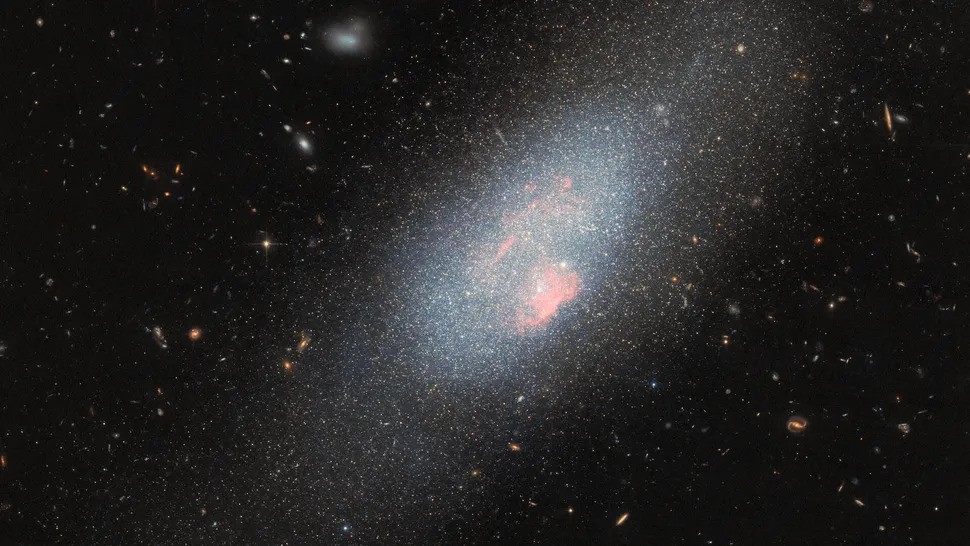
As they evolve, rather than contracting uniformly, they expand, often in a single plane. Scientists didn’t know how to explain this phenomenon, but now they have a new theory.
Subhaloes of dark matter
At the heart of the new theory of galactic evolution—which always follows the same pattern and guides the development of star systems in a specific direction—lies the idea that the dark matter halo is not a single, unified entity.
Whatever this mysterious substance may be, if we accept the “cold” hypothesis, it could form individual clumps smaller than even a dwarf galaxy. But they interact with visible matter differently than a solid halo does.
If we accept this hypothesis, it can explain the evolution not only of associated galaxy groups, such as the Milky Way, which in the past actively absorbed its dwarf neighbors. It also becomes clear why even isolated systems behave according to a certain pattern.
According to www.space.com

