

The European Southern Observatory (ESO) has published a striking image taken by the Atacama Large Millimeter/submillimeter Array (ALMA). It shows the center of the Milky Way.
The most extreme region of the Milky Way
The area captured in the image spans more than 650 light-years. It contains dense clouds of gas and dust surrounding the compact radio source Sagittarius A*, whose mass is more than 4 million times that of the Sun. According to most astronomers, it is a supermassive black hole — an object whose gravity is so strong that even light cannot escape its vicinity.
“This is a place of extreme conditions, invisible to our eyes, but now revealed in extraordinary detail,” said Ashley Barnes, an astronomer at ESO who was part of the team that obtained the image. ALMA observations have provided unique insights into cold gas (the “raw material” from which stars form) in the Milky Way’s Central Molecular Zone (CMZ). It was studied in such detail for the first time. Dozens of different molecules were found in the gas, ranging from simple ones such as silicon monoxide to more complex organic compounds such as methanol, acetone, and ethanol.
Cold molecular gas flows along filaments, feeding clumps of matter from which stars can form. Scientists are well aware of how this process occurs at the edges of the Milky Way, but conditions are much more extreme at its center. CMZ is home to some of the most massive stars known to us. They live fast and end their lives in supernova explosions. By studying the center of the Milky Way, astronomers hope to better understand how such events affect star formation and whether theories of star formation in extreme conditions are confirmed.
Record-breaking ALMA image
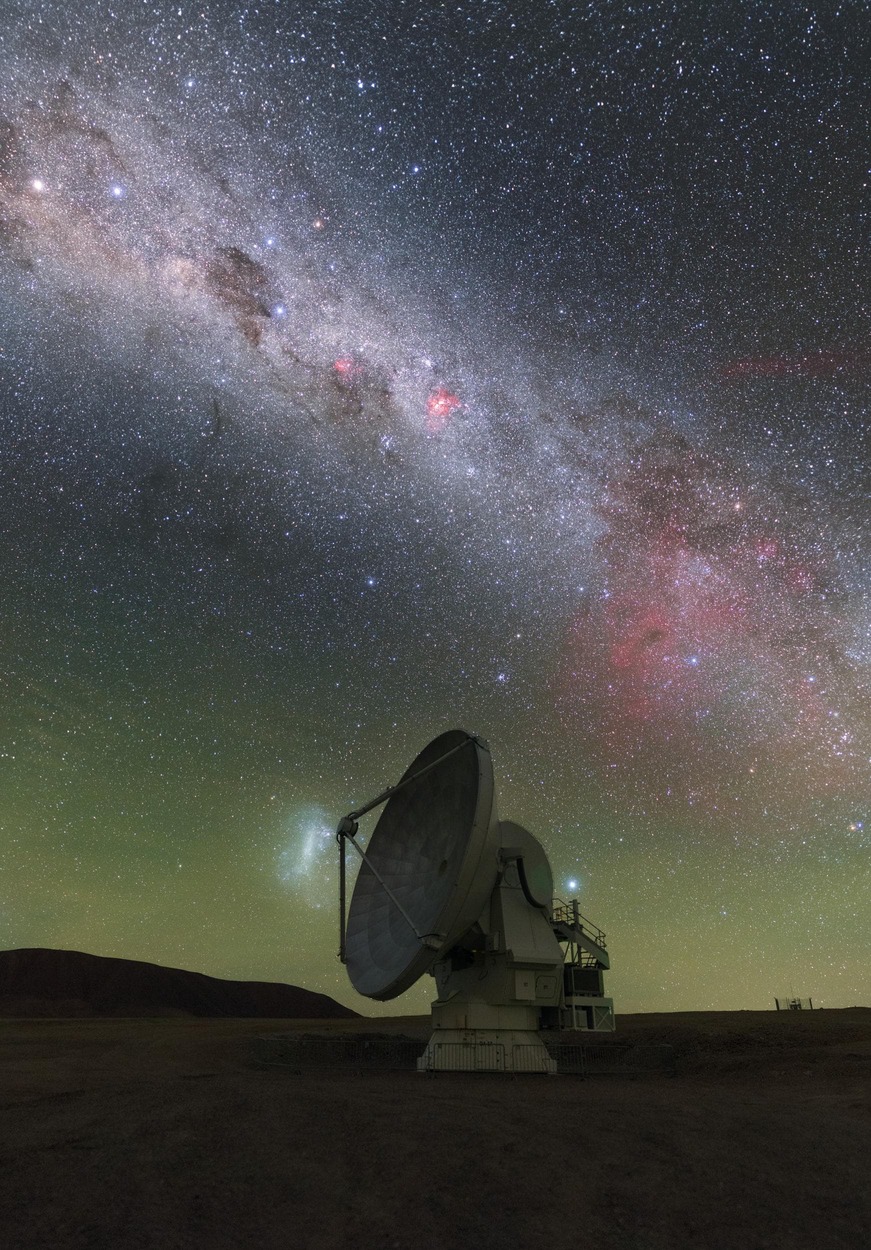
The ALMA complex, which captured the image of the center of the Milky Way, is located on the high-altitude Chajnantor Plateau in Chile. It consists of 66 mobile antennas, which are moved using special transporters. Astronomers can change their configuration by moving the antennas up to 16 km apart.
The image of the center of the Milky Way became the largest image in ALMA’s history. discs. The image was assembled from a multitude of individual observations.
ALMA will be upgraded in the near future. This will allow astronomers to see even smaller structures in the center of the Milky Way, as well as track complex chemical processes and interactions between stars, gas, and black holes.
According to ESO

