

Astronomers have witnessed a unique event: one of the largest known stars in the Universe, located outside the Milky Way, is rapidly changing color. The giant star with the modest name WOH G64 appears to be shedding its outer shell in preparation for an impressive finale — a supernova explosion that could be a real intergalactic spectacle.
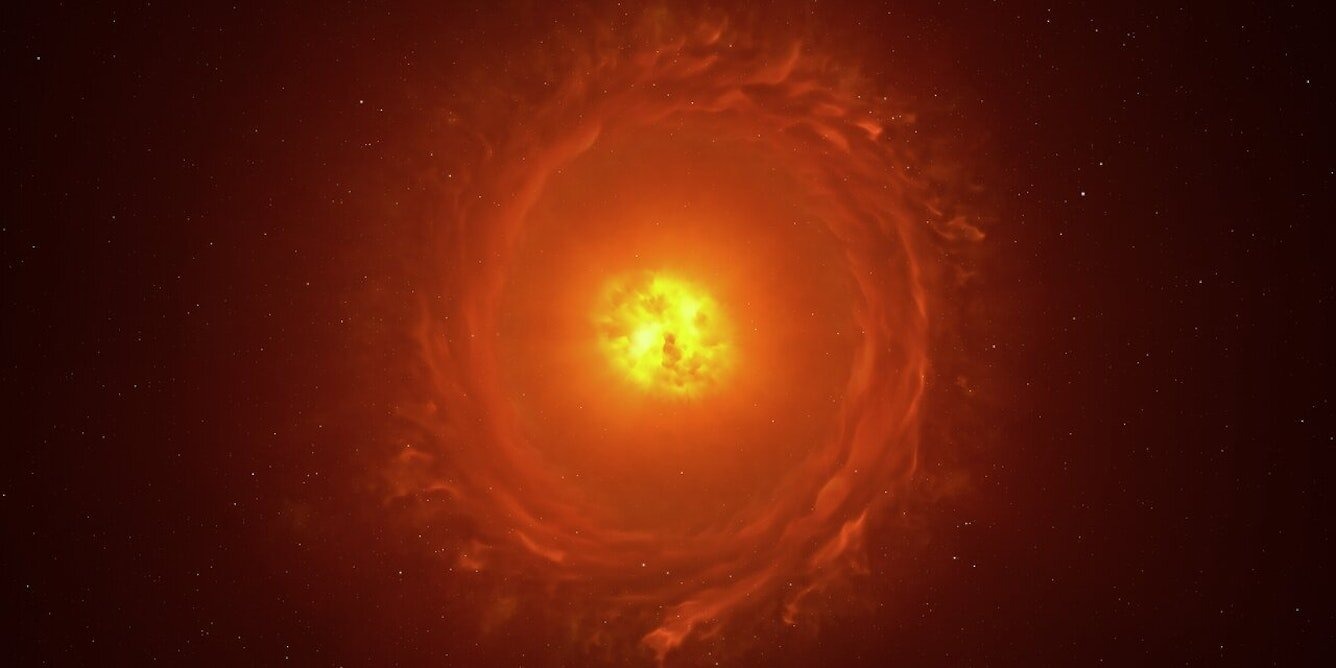
WOH G64 was discovered back in the 1970s in the Large Magellanic Cloud, a dwarf galaxy that orbits our Milky Way. Then it immediately attracted the attention of scientists: this star turned out to be a real monster. Its size exceeds that of our Sun by 1,500 times, making it one of the largest stars ever discovered by astronomers.
And last year, WOH G64 set another record: it became the first star outside our galaxy to be photographed in high detail. Thanks to the powerful interferometer of the Very Large Telescope, scientists have obtained an image that clearly shows a giant star surrounded by a dense cocoon of dust.
Dramatic color change
WOH G64 is a young star by astronomical standards. It is only a few million years old, whereas our Sun is 4.6 billion years old. But the life of such massive stars is bright but extremely short. They quickly burn up their thermonuclear fuel and die young.
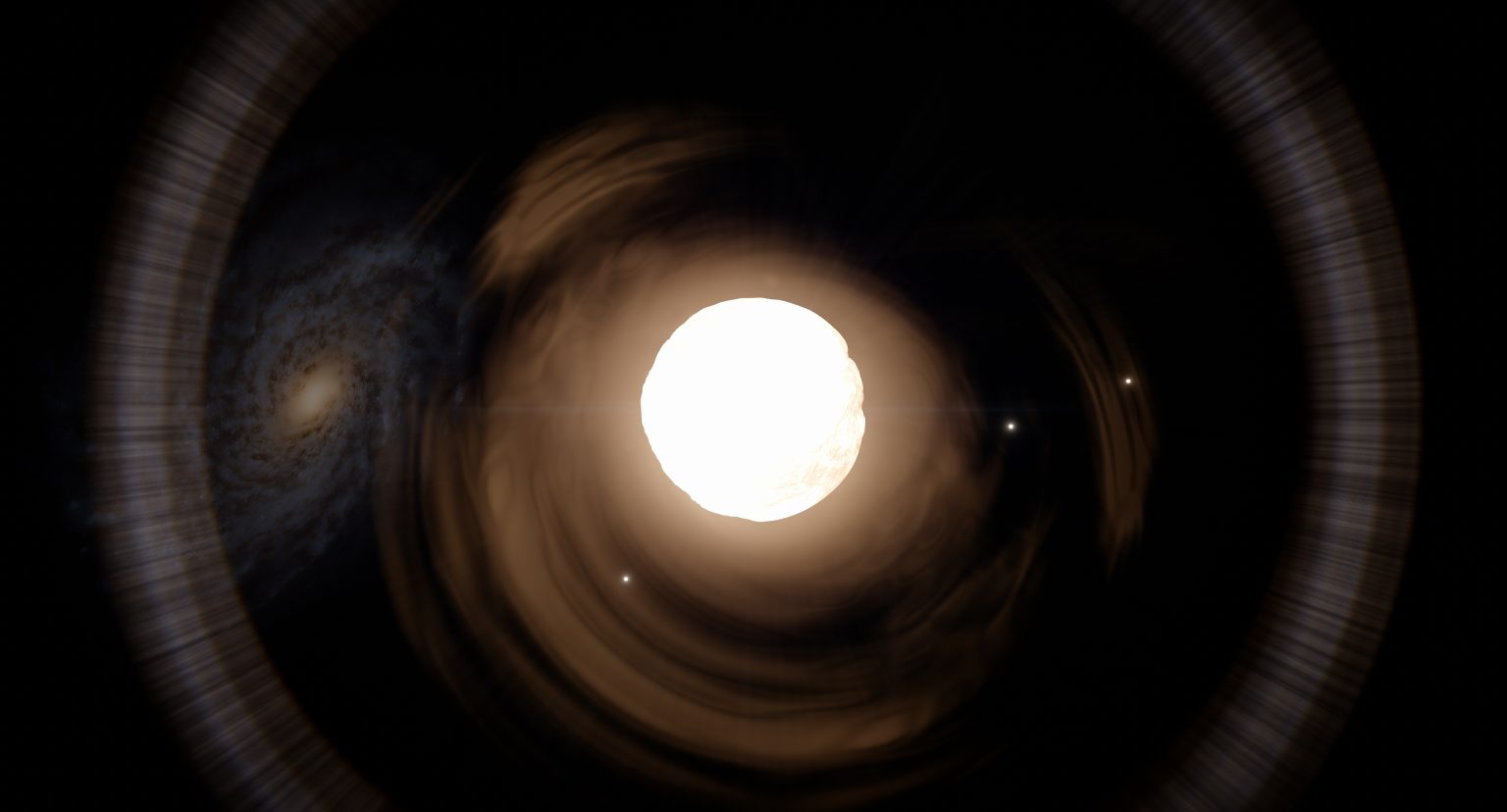
Until recently, WOH G64 was considered a red supergiant — a typical stage in the evolution of large stars. However, a new study published in Nature Astronomy, led by Gonzalo Muñoz-Sánchez of the National Observatory of Athens, shows radical changes. Over the past year, the star has turned into a yellow hypergiant.
This is not just a change in color. Hypergiants are a rare and highly unstable type of star. It is believed that they are formed from the most massive red supergiants, which begin to rapidly lose their matter. When the core of a star contracts, it sheds its outer layers, and its surface glows yellow. This is a transitional stage, after which, in theory, the collapse of the core and the explosion of a supernova are almost inevitable.
What caused the transformation?
The main question that concerns researchers is: what exactly caused such a rapid metamorphosis? By analyzing the spectrum of light coming from the star, astronomers noticed traces of the loss of a huge amount of matter. It appears that a significant portion of the outer atmosphere of WOH G64 has been ejected into space. This may be the result of powerful pulsations in the core that occur when the fuel supply is running low. Such a “superwind” is characteristic of the death throes of massive stars.
There is another, equally interesting hypothesis. Perhaps WOH G64 has a companion star, whose gravitational interaction is “blowing off” the giant’s outer layers. Researchers have indeed found indirect evidence of the existence of such a companion.
When can we expect an explosion?
No one can say for sure when exactly the WOH G64 will reach the end of its life cycle. In astronomy, “soon” can mean tomorrow or 10,000 years from now. Stars live for millions and billions of years, so observing their changes in real time is an incredible opportunity for science.
If an explosion actually occurs during our lifetime, it will be an impressive event. The supernova explosion in the Large Magellanic Cloud will be visible even from Earth with the naked eye as a new bright star in the southern sky. And for astronomers, it will be an invaluable source of data that will help unravel the last mysteries of the life of cosmic giants.
Earlier, we reported on the death of the largest star in the Milky Way, which may turn into a black hole.
According to hys.org

