

Mars is known as a planet that has almost completely lost its original atmosphere over millions of years. However, scientists have found that for certain types of stars, such as red dwarfs, this process may have occurred even more rapidly.
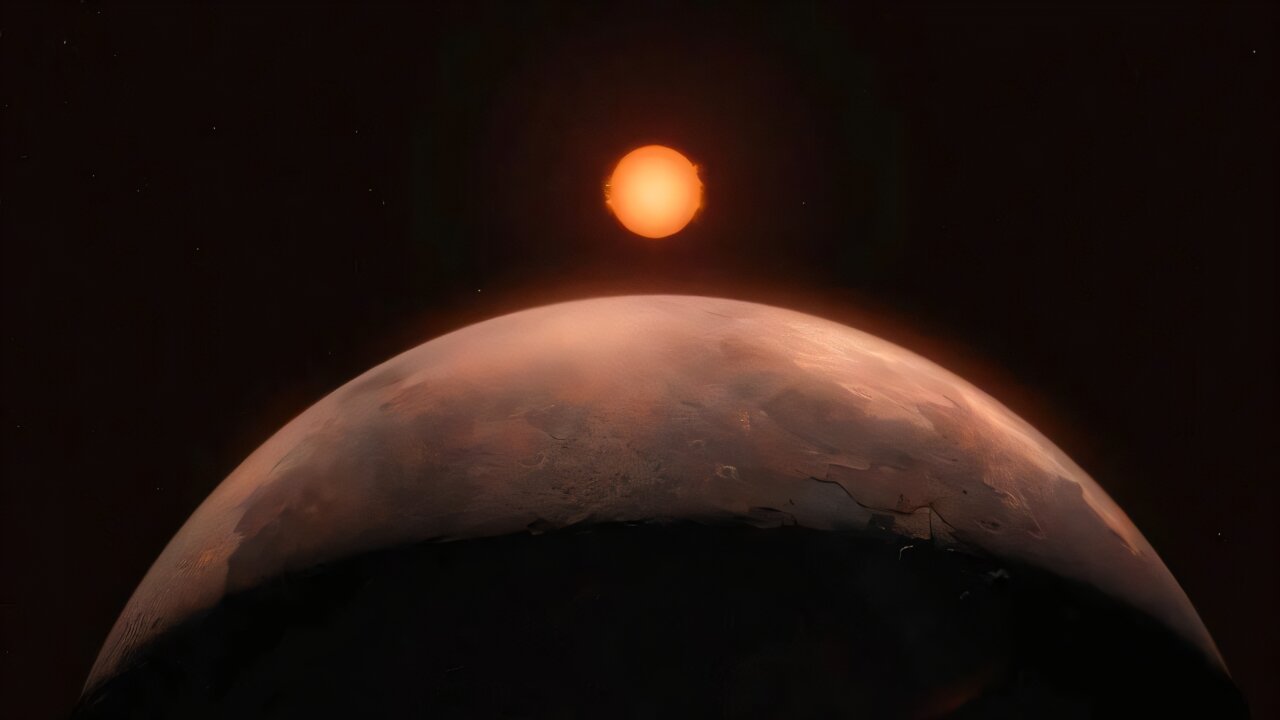
Atmosphere of planets and red dwarfs
A large group of scientists recently published an article in The Astrophysical Journal in which they examined a hypothetical scenario in which one of the red dwarfs closest to us would have a planet similar to Mars. How quickly it might lose its charm.
Generally, when astronomers discuss a planet’s habitability, they refer to the concept of the Goldilocks Zone, where it is neither too hot nor too cold for liquid water to exist. However, stars such as red dwarfs defy this simple picture because they combine relatively low luminosity with powerful flares.
In theory, over hundreds of millions or even billions of years, these processes could deprive the worlds orbiting these stars of all their atmosphere and water. However, this also depends on many other factors, and the debate over what might actually be happening has been going on for years.
Mars near Barnard’s Star
That is precisely why, in this new study, the scientists refrained from speculation and instead focused on a real red dwarf star—Barnard’s Star—located 6 light-years away from us. This star has a mass of only 14% that of the Sun and is between 7 and 10 billion years old.
And this last fact is particularly interesting. Typically, bursts of activity are observed on red dwarfs mainly during their first few million years. And observations of Barnard’s Star have shown that it has indeed already passed this stage of its life cycle. But this also means that the planets in its orbit were exposed to extremely intense, destructive radiation.
Next, they took a real planet, Mars—for which the mass, radius, magnetic field strength, and atmospheric conditions are known—and placed it in similar conditions in the orbit of Barnard’s Star. Certainly, in order to receive the same amount of heat that Mars receives from the Sun, the planet would have to be located not 1.52 AU from the Sun, but only 0.087 AU away, if we were to model its existence in the orbit of a red dwarf.
What will happen to the atmosphere?
Using these parameters, scientists modeled Mars in the orbit of Barnard’s Star and then calculated how long its atmosphere would last under the conditions of the flares. Calculations have shown that the thin shell surrounding it will last only 350,000 years. And even if it had an atmosphere as dense as Earth’s, it would still dissipate in about 50 million years.
And all of this is particularly interesting given that Mars’ atmosphere has been rapidly dissipating into space for billions of years. It used to be much denser, warmer, and more humid. In other words, we’ve actually been relatively lucky; in red dwarfs, this process would have gone much further.
On the other hand, modeling of Mars just beyond Barnard’s Star’s habitable zone—which showed that it should not retain an atmosphere—is also important for understanding this star. The point is that it has four small rocky planets, and all of them are closer to it than the model predicted. This means that the atmosphere is unlikely to remain the same there either.
According to phys.org

