

Astronomers have simulated the consequences of a possible collision between asteroid 2024 YR4 and the Moon. It poses risks to spacecraft, but it will also open up new scientific opportunities for planetary scientists.
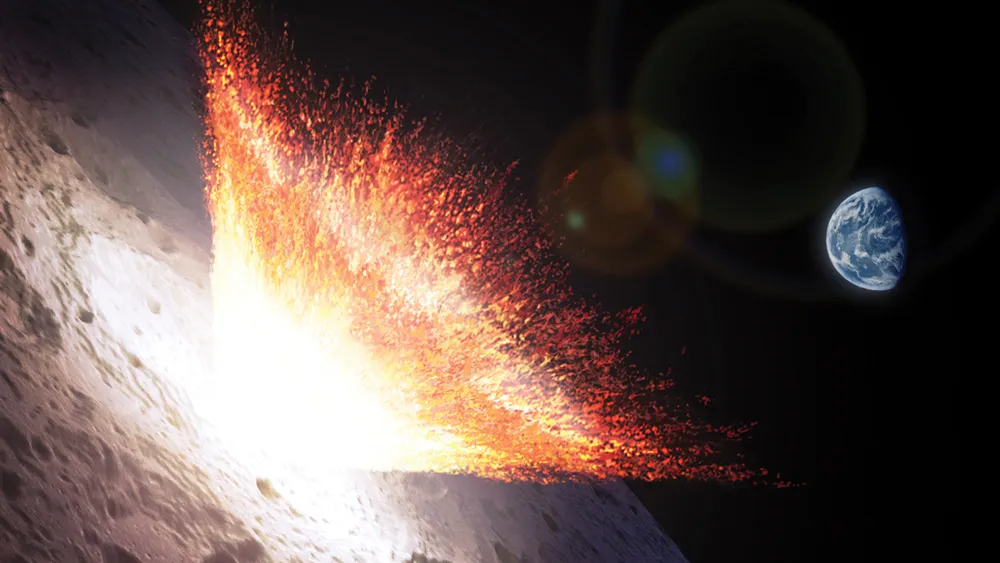
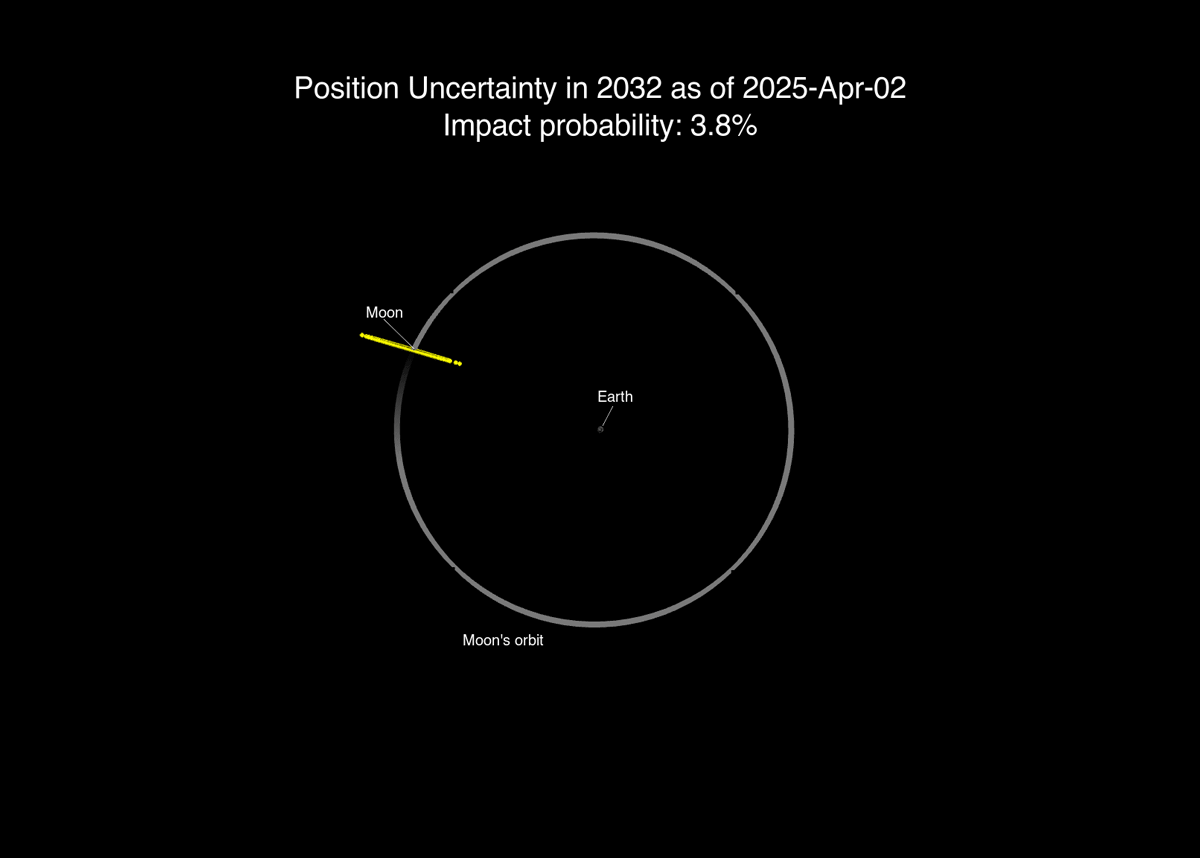
Asteroid 2024 YR4 caused a lot of excitement in early 2025 when astronomers’ calculations showed that there was a small chance it could hit Earth in 2032. Further observations involving ground-based observatories and the James Webb Space Telescope (JWST) ruled out such a scenario. However, although the asteroid does not pose a threat to our planet, there is currently a 3.8% chance that it will collide with the Moon on December 22, 2032.
The results of observations indicate that the asteroid’s diameter is approximately 60 meters. Its rotation period is 20 minutes. Spectrometric studies indicate that 2024 YR4 consists of chondrite, which is typical for most asteroids. At the same time, according to JWST data, it is colder than expected. This suggests that 2024 YR4 is a solid object rather than a loose pile of debris held together by gravity.
What consequences will a potential collision between 2024 YR4 and the Moon have? The results of the simulations conducted by scientists indicate that the impact will form a kilometer-wide crater in the southern part of the visible side of the Moon. During the collision, a large amount of debris will be ejected, some of which will gain enough speed to escape into space forever. They could pose a threat to spacecraft in the vicinity of the Moon, as well as to lunar infrastructure that may have been deployed by the US, China, and other countries by that time. Some of the debris may also enter Earth’s gravitational influence, resulting in a temporary meteor shower.
In addition to the risks, a potential collision also brings new scientific opportunities. The Moon has experienced impacts of this magnitude many times throughout its history, but none of them have ever been observed in real time using modern instruments. According to scientists’ estimates, asteroids of this size collide with the Moon on average once every 4,000 to 5,000 years.
If 2024 YR4 actually hits the Moon, it will provide an opportunity to:
- Explore the Moon’s internal structure and refine the dimensions of its core by studying the seismic waves caused by the impact.
- Improve our understanding of the evolution of celestial bodies’ surfaces. Observing how emissions from the newly formed crater change will provide a way to calibrate models of space weathering, which are used to date the surfaces of celestial bodies.
- Obtain new data on impact physics. Comparing the measured shape, mass, and velocity of the approaching asteroid with the resulting crater will make it possible to test current models of their formation.
Currently, 2024 YR4 is too far away from our planet for Earth-based telescopes to see it. In 2028, it will once again come close to Earth, which will allow us to calculate its orbit much more accurately and either confirm or rule out its collision with the Moon in 2032.
According to Seti.org

