

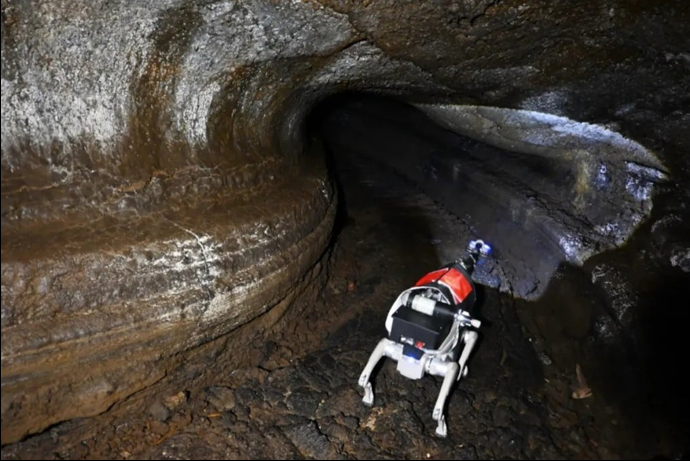
A team from Peking University tested two prototypes of the “robot dogs” in a cave near Jingbo Lake (Heilongjiang Province) – an environment that mimics lunar lava tubes. The goal is to develop autonomous reconnaissance of subsurface cavities, which are considered natural shelters for future settlements on the Moon.
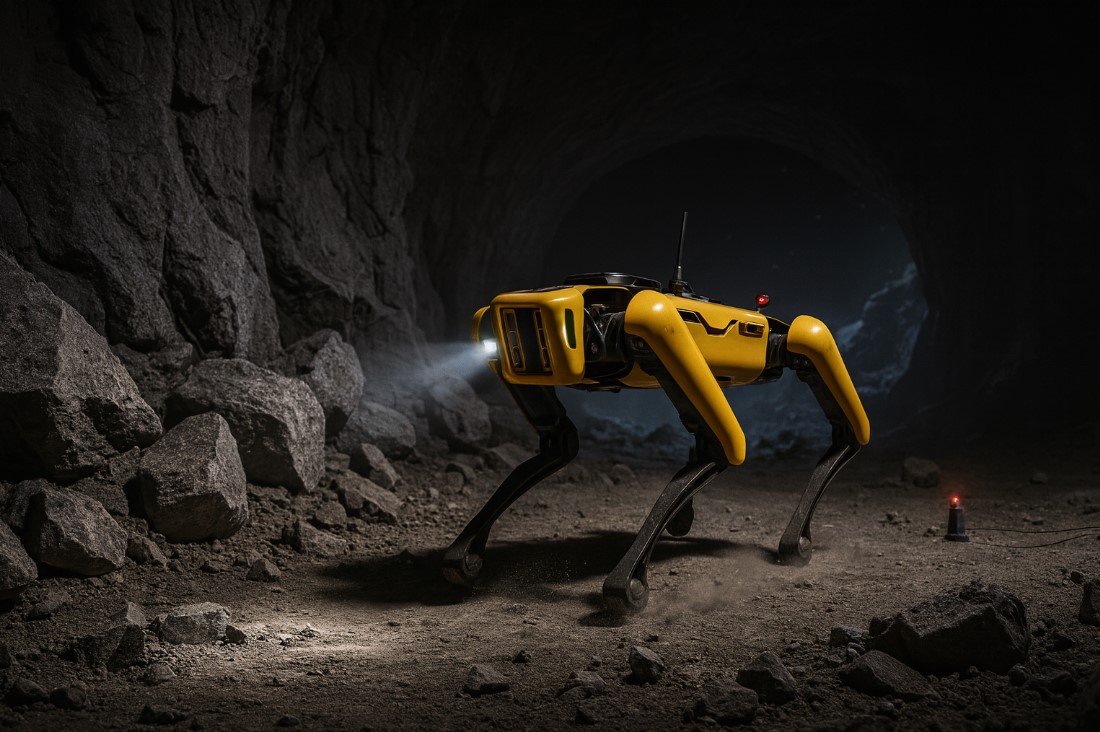
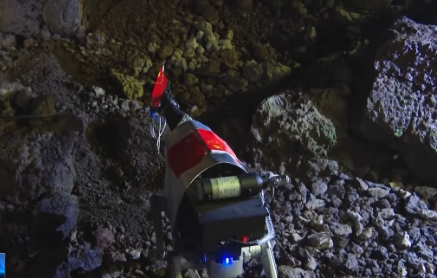
Two prototypes have been developed: “anteater” – a mobile robot with a flexible manipulator for multifunctional operations in narrow passages, and “salamander” – an adaptive, soft wheeled-legged device for moving over difficult terrain and rapid reconnaissance. The systems are capable of autonomous navigation, obstacle avoidance, lidar scanning, and building high-precision 3D maps of underground structures.
A lava cave near Jingbo was chosen as the test site — it was here that Peking University and its partners created China’s first quasi-lunar underground training and testing ground. Such natural tunnels are considered promising for bases: they shield against radiation and micrometeorites and have more stable temperature conditions than the open surface.
Why is this important? Automated scouts allow lava tubes to be safely mapped, samples to be collected, and seismometers and other scientific equipment to be placed in locations that wheeled vehicles cannot reach, before humans arrive. This speeds up the search for safe landing sites and modules, reduces the logistical risks of missions, and expands the program of research into the interior of the Moon — from its thermal regime to the geological history of volcanism.
How does it work? Explorers enter the cave and constantly scan the space with a laser rangefinder (like a tape measure made of light) and cameras. The computer inside combines these measurements with data about its own movements, creates a live 3D map, and immediately plans a safe route, avoiding rocks, cliffs, and narrow passages. One robot has a flexible arm that can pick up a pebble, reach into a crack, or install a sensor; the second has a soft chassis that deforms slightly and can climb through places where a conventional rover would get stuck.
The secret lies in the combination of three things: simple, reliable sensors; smart software that instantly draws a map to avoid getting lost; and a body shape that adapts to complex terrain. On the Moon, such a combo will quickly and safely scout out lava tubes for future bases.
Do you imagine comets as stars with tails? In reality, their nuclei are dark chunks of ice and dust that come to life near the Sun: jets of gas burst out of cracks. Want to see what it looks like and debunk the most popular myths? Click here to read our article “Icy ambassadors from deep space: what comets really look like” for a concise, clear overview with vivid examples of these icy messengers from deep space.
According to scmp, pku, interestingengineering

