

California-based startup Circularity Fuels announced the successful demonstration of its compact electric-powered Ouro reactor, which converts biogas from dairy farm manure storage facilities into synthesis gas — a key precursor to jet fuel and a potential component for rocket fuel synthesis. The device operates from a standard power supply, does not require costly gas pre-treatment stages, and can withstand typical contaminants that usually disable traditional reformers. The company claims that the capital costs for such a plant are only 1/100th of the cost of conventional methane reformers, paving the way for fuel production directly on the farm.
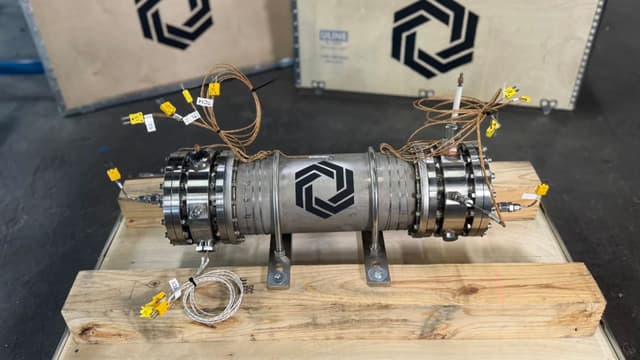
According to an official release, Ouro has electrically converted “raw” biogas into jet fuel components for the first time. The resulting synthesis gas can be converted into jet fuel using the Fischer-Tropsch process. Against the backdrop of growing mandates for SAF, current production meets less than 1% of the aviation industry’s demand. Circularity Fuels also emphasizes that the absence of gas pipelines allows liquid fuel to be produced on site and transported by road or rail.
There are two ways to obtain rocket fuel from biogas/syngas:
Kerosene (KeroLOX): Use the Fischer-Tropsch process to synthesize a fraction similar to RP-1 (highly refined rocket kerosene for liquid oxygen engines) and bring it up to rocket standard requirements. Regular SAF (aviation kerosene for aircraft turbojet engines) for turbojet engines does not comply with RP-1 and is usually approved only as an additive (up to 50%) to Jet-A; rockets require a more stringent approval (MIL-DTL-25576, RP-1/RP-2). There are companies that are already promoting “bio-RP-1” as a drop-in for rockets (CleanJoule SpaceSAF).
Methane (MethaLOX): synthesis gas/biogas can be methanated (Sabatier reaction) to produce high-purity methane and liquefied to LCH₄ – this is what many new rockets are currently burning. There are already pioneers in biomethane for launches (Interstellar Technologies/Air Water, Japan).
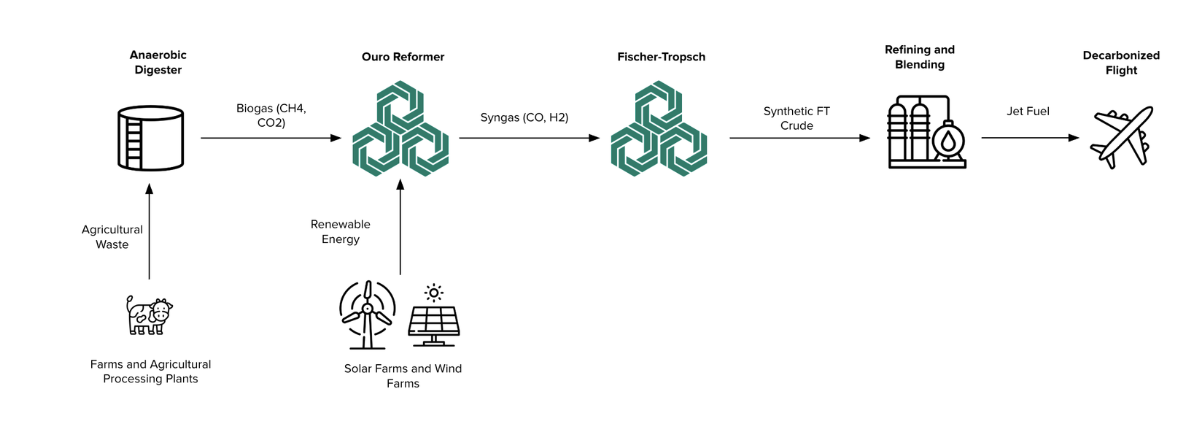
The company estimates the technology’s large-scale potential at 42 million gallons (159 million liters) per day, if deployed at suitable sites in the US (farms, landfills, treatment facilities), which corresponds to about 70% of domestic demand for jet fuel. There are more than 20,000 large livestock farms in the country, but less than 6% of them currently collect biogas – this is precisely the lost raw material that Ouro is able to monetize.
Decentralized fuel production from waste is a critically important technology for remote, energy-isolated sites where observatories, stratospheric missions, and scientific aviation operate. Compact electric reformers such as Ouro can reduce the carbon impact of balloon launch logistics and service flights, and serve as an engineering prototype for closed fuel loops for future lunar/Martian bases: converting life support waste into energy sources reinforces the concepts of ISRU and sustainable autonomy beyond Earth.
Inspired by the idea of turning biogas into fuel for space travel? Take the next step — turn your idea into a real space project. In the article “How your idea can go into space: NASA’s open challenges,” you will learn how to submit an idea to NASA’s open challenges: what areas they support, how to prepare a strong application, where to find mentoring and funding, and where to start for engineers or students.

