

For more than a decade, scientists have claimed that beneath the thick icy crust of Saturn’s largest moon, Titan, lies a vast ocean of liquid water. This idea, backed up by data from NASA’s Cassini-Huygens mission, has made Titan one of the main targets in the search for extraterrestrial life. However, a new analysis of the same data, published in the journal Nature, has proved disappointing for supporters of this promising theory.
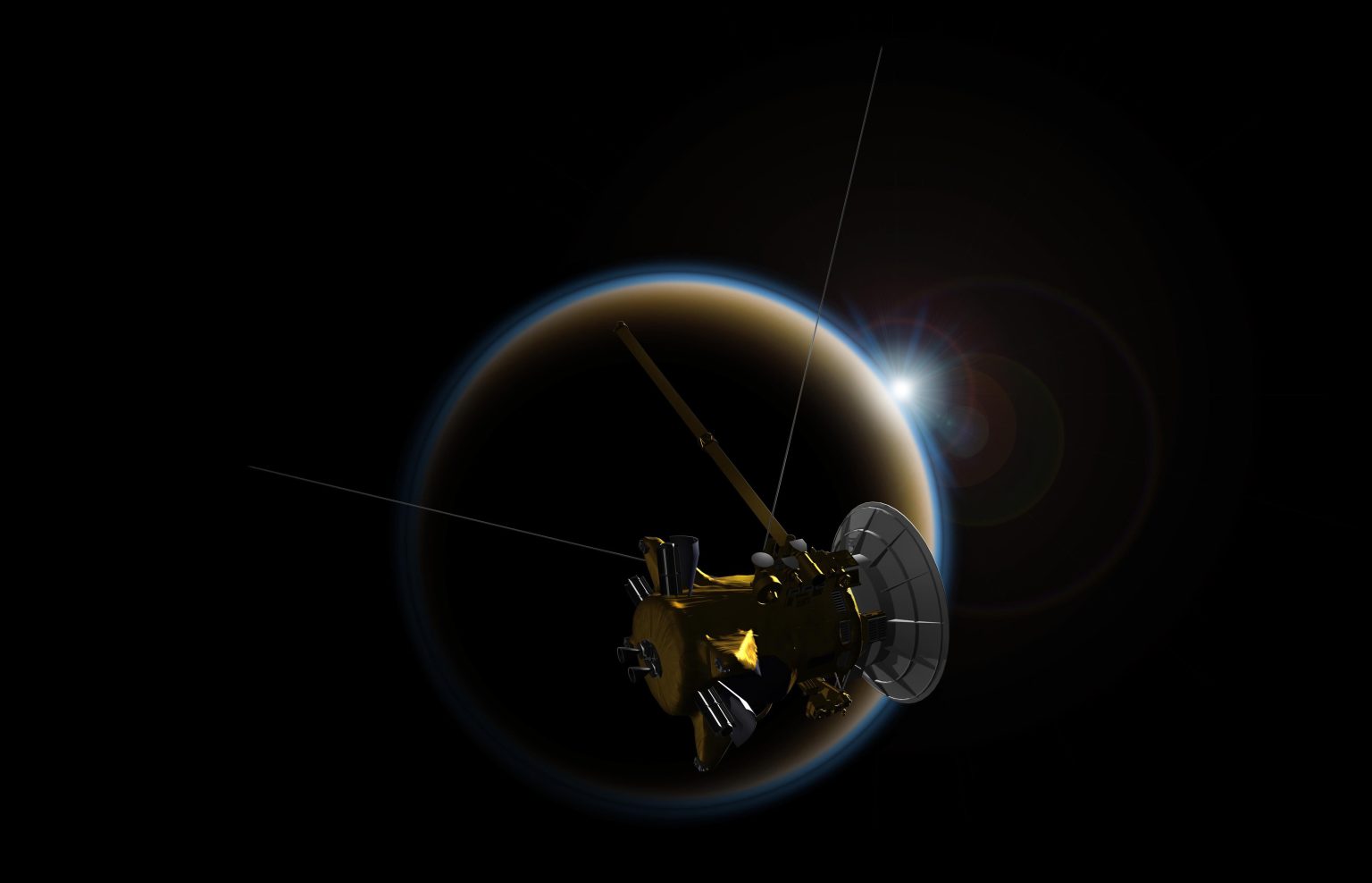
There is no ocean on Titan
Research led by Flavio Petricca, a graduate student at NASA’s Jet Propulsion Laboratory, shows that Titan most likely does not have a subsurface ocean. Instead, its 100-kilometer-thick icy crust transitions into a deep layer of “snow slush” or slushy ice. This layer is permeated by numerous pockets, channels, and reservoirs of meltwater that surround the moon’s rocky core.
“Working on this data, I woke up more than once thinking I couldn’t believe my eyes: Titan may not have an ocean,” Petricca admitted.
Mystery of the tides
The key to the discovery was the study of Titan’s tidal bends under the influence of Saturn’s gravity. If the moon had a deep liquid ocean, its surface would instantly respond to gravitational forces, forming a clear “bulge.” However, Cassini’s data showed a delay in this response of as much as 15 hours.
This delay can be explained by the layer of slushy ice. Internal friction and energy dissipation in this viscous mass slow down the surface’s response to gravitational shocks. This effect is impossible in the case of free liquid water. This discovery radically changes the approach to the search for life on Titan.
“At first, we thought about an ecosystem similar to the open ocean, but it turned out that it is probably much more like ice sheets or aquifers on Earth,” explains study co-author Baptiste Journaux of the University of Washington.
Instead of one large body of water, life, if it exists, may be scattered across a multitude of isolated liquid “oases” within the ice. Methods and equipment for future missions will have to be adapted to this new reality.
The moon becomes more interesting
Despite the surprise, the new model makes Titan an even more exciting scientific target. Modeling shows that areas of warm liquid water with temperatures up to +20°C may exist in the rain layer, circulating nutrients from the rocky core to the surface.
“I think our findings make Titan more interesting,” concludes Flavio Petricca. “This opens up a whole new avenue for research.”
Thus, instead of the dark depths of the global ocean, the most promising environment for life on Titan may be the deep, viscous, geothermally heated “snow porridge” hidden in its icy subsurface shell.
We previously reported on how Titan may be unsuitable for life.
According to NASA

