

Scientists have conducted a new study of the mysterious rock carried back to Earth by the Apollo 17 astronauts. It shows that the history of our moon in ancient and eventful times was not quite as we imagined it.
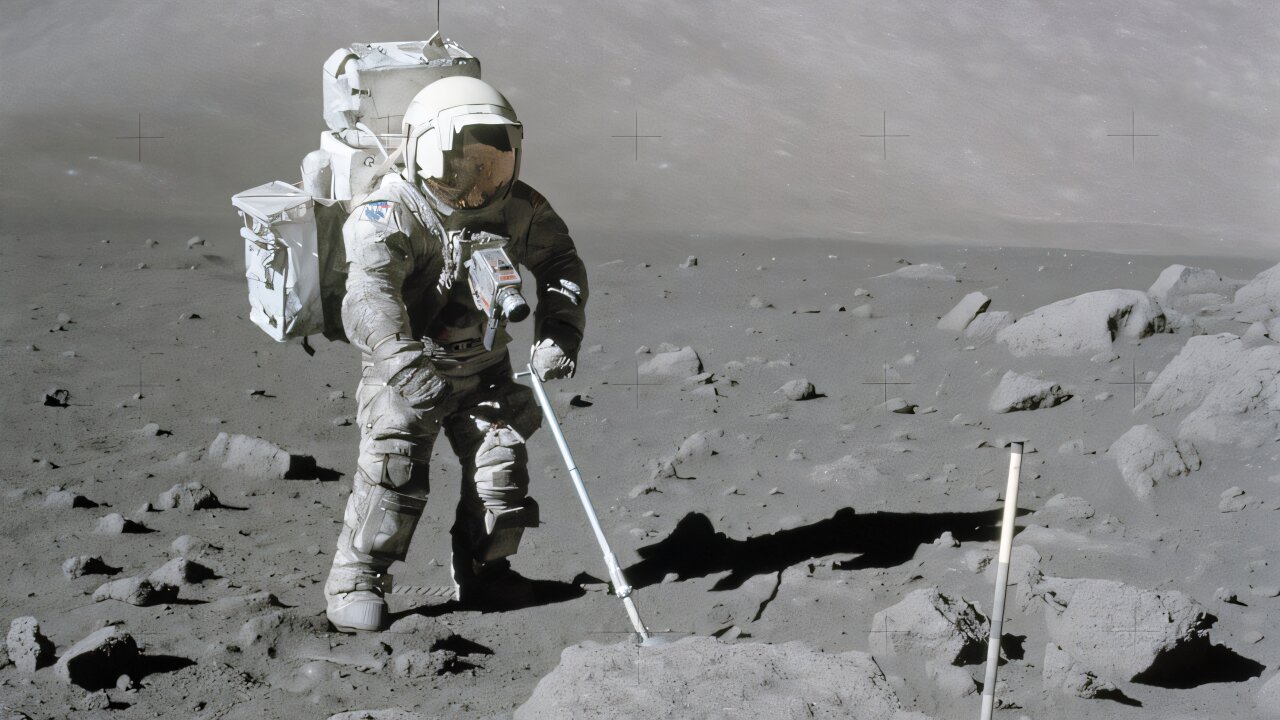
Mysterious rock from the Moon
When the Apollo 17 astronauts collected a small rock from the Moon more than 50 years ago, they could not have known that it would continue to challenge scientists’ understanding of the Moon’s history.
The fragment, known as sample 76535, was formed at a depth of nearly 50 kilometers below the surface, but there are almost no signs of the strong impacts that are usually expected when deep rocks are brought to the surface. This mystery has intrigued scientists for decades, and many believed that the rock was brought to the surface by a powerful impact that formed the largest crater on the Moon, the South Pole–Aitken Basin.
A new study led by planetary scientist Evan Bjonnes of Lawrence Livermore National Laboratory (LLNL) offers a simpler explanation with broad implications. Using modern computer simulations of giant lunar impacts, the team showed that the impact that formed the Serenitatis Basin, a huge impact basin on the near side of the Moon, could have lifted the rock to the surface in the late stages of its formation.
The results of the study indicate that the collision occurred approximately 4.25 billion years ago, which is about 300 million years earlier than previously thought, pushing the time frame of lunar collisions even further back into the past. This change also affects scientists’ understanding of the history of bombardment of Earth and other inner planets.
How did the rock get on the surface?
Scientists have long agreed on two key facts about the Apollo sample: its chemistry and texture indicate its formation deep within the lunar crust, and it lacks the strong shock features typically associated with a violent journey to the surface. Earlier studies suggested that only a massive impact, such as the one that created the South Pole–Aitken Basin, could have extracted rock from such depths. But there was one obstacle: transporting rock from this distant basin to the Apollo 17 landing site would likely require an additional impact, while avoiding a shock sufficient to leave traces.
Bjonnes and his team found a more direct route. Using computer models of large impacts on the Moon together with models of the lunar crust, they showed that during the late stage of “collapse,” the formation of a giant crater tens of kilometers below could be lifted up gently enough to preserve sample 76535. In these scale impact models, Serenitatis could lift deep material several kilometers from the surface, precisely at the stage that could have placed the sample where the Apollo 17 mission found it.
Sample that changes the history of Earth
If sample 76535 dates the impact on Serenitis to approximately 4.25 billion years ago, other large lunar basins may also be older than currently indicated on the map. This is making scientists rethink how fast the Moon cooled and how often big impacts happened in the inner Solar System.
Since the early surface history of Earth has been largely erased by plate tectonics and geology, scientists often calibrate Earth’s impact history using the Moon. “By revising the date of one of the fundamental impacts on the Moon, we recalibrate our understanding of early Earth, including how other inner planets may have evolved,” said Bjonnes.
Significance of the Apollo samples
The results emphasize the enduring value of the Apollo collection and the power of modern instruments for gaining new insights from historical materials.
“It’s amazing that more than half a century later, Apollo samples are still revealing brand-new insights,” Bjonnes said. “They continue to provide valuable new clues about the moon’s past.”
The study also offers practical recommendations for future missions. Astronauts exploring large lunar basins, according to Bjonnes, should pay attention to rocks that appear to be “out of place” on the surface. Since crater collapse lifts deep rocks upward in many basins, such samples may be available to help fill gaps in the early history of the Moon.
According to phys.org

