

Analysis of lunar rock samples delivered by China’s Chang’e-6 mission from the South Pole-Aitken Basin (SPA) suggests that an ancient colossal impact could have reshaped the Moon much more profoundly than previously thought. A team from the Institute of Geology and Geophysics at the Chinese Academy of Sciences studied the basalts on the far side and discovered an unusual chemical fingerprint of an early catastrophe that formed the largest known impact basin on the Moon.
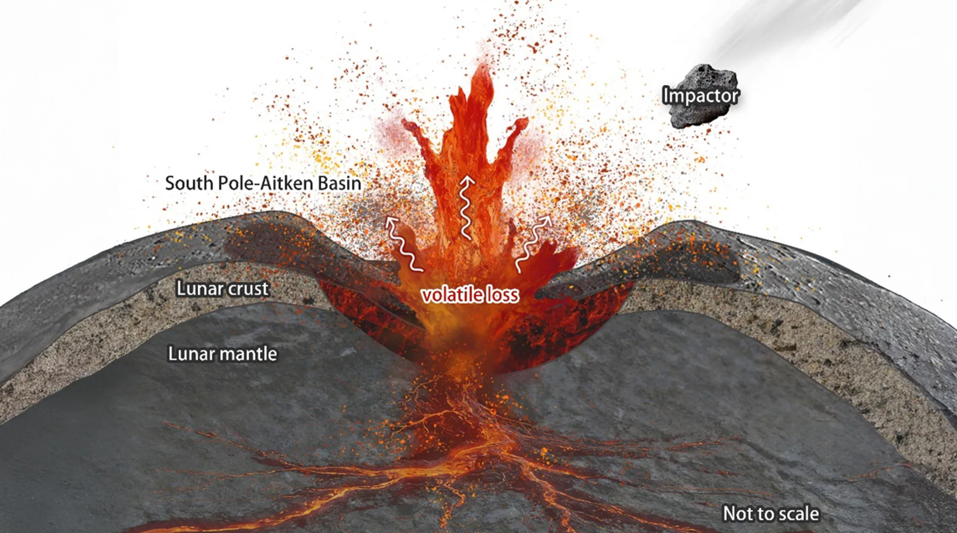
The key turned out to be potassium, a moderately volatile element that partially evaporates at extreme temperatures, causing its isotopes to separate. Fragments of basalt from Chang’e-6 were found to have a heavier isotopic composition of potassium than samples from Apollo and lunar meteorites. The researchers tested alternative explanations (the influence of cosmic rays, magma evolution, meteorite impurities) and concluded that this is best explained by the massive loss of volatile components during the SPA impact — essentially the evaporation of part of the material at extremely high temperatures.
This scenario could explain the long-standing asymmetry of the Moon: why volcanism was more active on the visible side than on the far side. Modeling also indicates that the impact not only deeply reworked the crust (and likely affected the mantle), but also generated enough heat to trigger convection in the interior and leave a long-term chemical signature.
Why is this important? These results provide a benchmark for models of the Moon’s evolution: isotopic markers help to interpret spectral data from orbital spacecraft more accurately, select better landing sites for future missions, and assess where and in what form volatile substances may have been preserved (important for ISRU — the use of local resources). And for planetary science as a whole, this is a clue as to how giant collisions change the chemistry and internal structure of rocky bodies — that is, how to correctly read the history of the early Solar System from the composition of rocks.

