

Scientists have once again found evidence that life may exist somewhere in the Solar System other than Earth. This time, scientists’ attention was drawn to Saturn’s moon Enceladus.
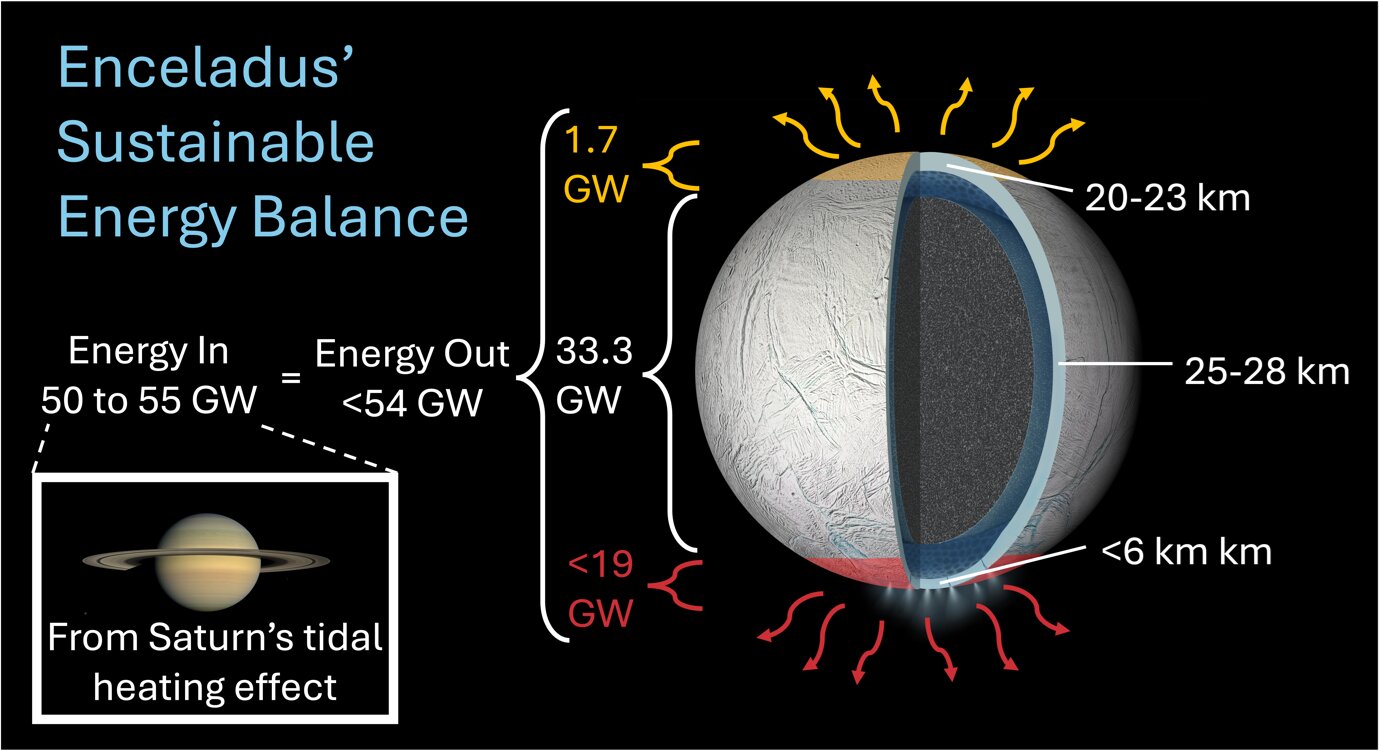
Discovery of heat flow on Saturn’s moon
New research conducted by scientists from Oxford University, the Southwest Research Institute, and the Planetary Science Institute in Tucson, Arizona, has provided the first evidence of significant heat flow at Enceladus’ north pole, refuting previous assumptions that heat loss was limited to its active south pole.
This discovery confirms that the icy moon emits much more heat than would be expected if it were simply a passive body, reinforcing the suspicion that it may support life.
Subsurface ocean and heat balance
Enceladus is a highly active world with a global subsurface ocean of salt water, which is believed to be the source of its heat. The presence of liquid water, heat, and the necessary chemical elements (such as phosphorus and complex hydrocarbons) means that its subsurface ocean is considered one of the best places in our Solar System for the possible emergence of life outside Earth. But this subsurface ocean can only support life in a stable environment, when energy losses and gains are in balance. This balance is maintained by tidal heating: Saturn’s gravity stretches and compresses the moon during its orbit, generating heat inside it. If Enceladus does not receive sufficient energy, its surface activity will slow down or cease, and the ocean may eventually freeze. Excess energy, on the other hand, could lead to increased ocean activity, changing its environment.
“Enceladus is a key target in the search for life beyond Earth, and understanding the long-term availability of its energy is key to determining whether it could support life,” said Dr. Georgina Miles, lead author of the study.
Until now, direct measurements of heat loss from Enceladus had only been taken at the South Pole, where spectacular jets of water ice and steam erupt from deep fissures on the surface. By comparison, the North Pole was thought to be geologically inactive.
Measurement of heat flows at the North Pole
Using data from NASA’s Cassini spacecraft, researchers compared observations of the northern polar region in deep winter (2005) and summer (2015). This data was used to measure how much energy Enceladus lost from its “warm” (0°C, 32°F) subsurface ocean as heat passed through its icy shell to the moon’s icy surface (–223°C, –370°F) and was then radiated into space.
By modeling expected surface temperatures during the polar night and comparing them with infrared observations from Cassini Composite InfraRed Spectrometer (CIRS), the team found that the surface at the north pole was about 7 K warmer than expected. This discrepancy could only be explained by heat escaping from the subsurface ocean.
The measured heat flux (46 ± 4 milliwatts per square meter) may seem insignificant, but it is approximately two-thirds of the heat loss (per unit area) through the Earth’s continental crust. Across Enceladus, these heat losses through conduction amount to about 35 gigawatts.
Combined with the previously estimated heat emanating from Enceladus’ active South Pole, the moon’s total heat loss increases to 54 gigawatts, which closely matches the expected heat input from tidal forces. This balance between heat production and loss suggests that Enceladus’ ocean may remain fluid over geological timescales, providing a stable environment where life could potentially arise. According to researchers, the next key step will be to determine whether Enceladus’ ocean existed long enough for life to develop. At this point, its age is still unknown.
Ice thickness assessment
The study also showed that thermal data can be used to independently estimate the thickness of the ice layer, which is an important indicator for future missions planning to explore Enceladus’ ocean, for example, using robotic landers or underwater vehicles. The results show that the ice thickness at the North Pole ranges from 20 to 23 km, and the global average is between 25 and 28 km, which is slightly deeper than previous estimates obtained using other remote sensing and modeling methods.
“Detecting subtle fluctuations in surface temperature caused by Enceladus’ heat flow through its daily and seasonal temperature variations was not easy, and it was made possible by Cassini’s extended missions,” added Dr. Miles. “Our study highlights the need for long-term missions to ocean worlds that may harbor life.”
According to phys.org

