

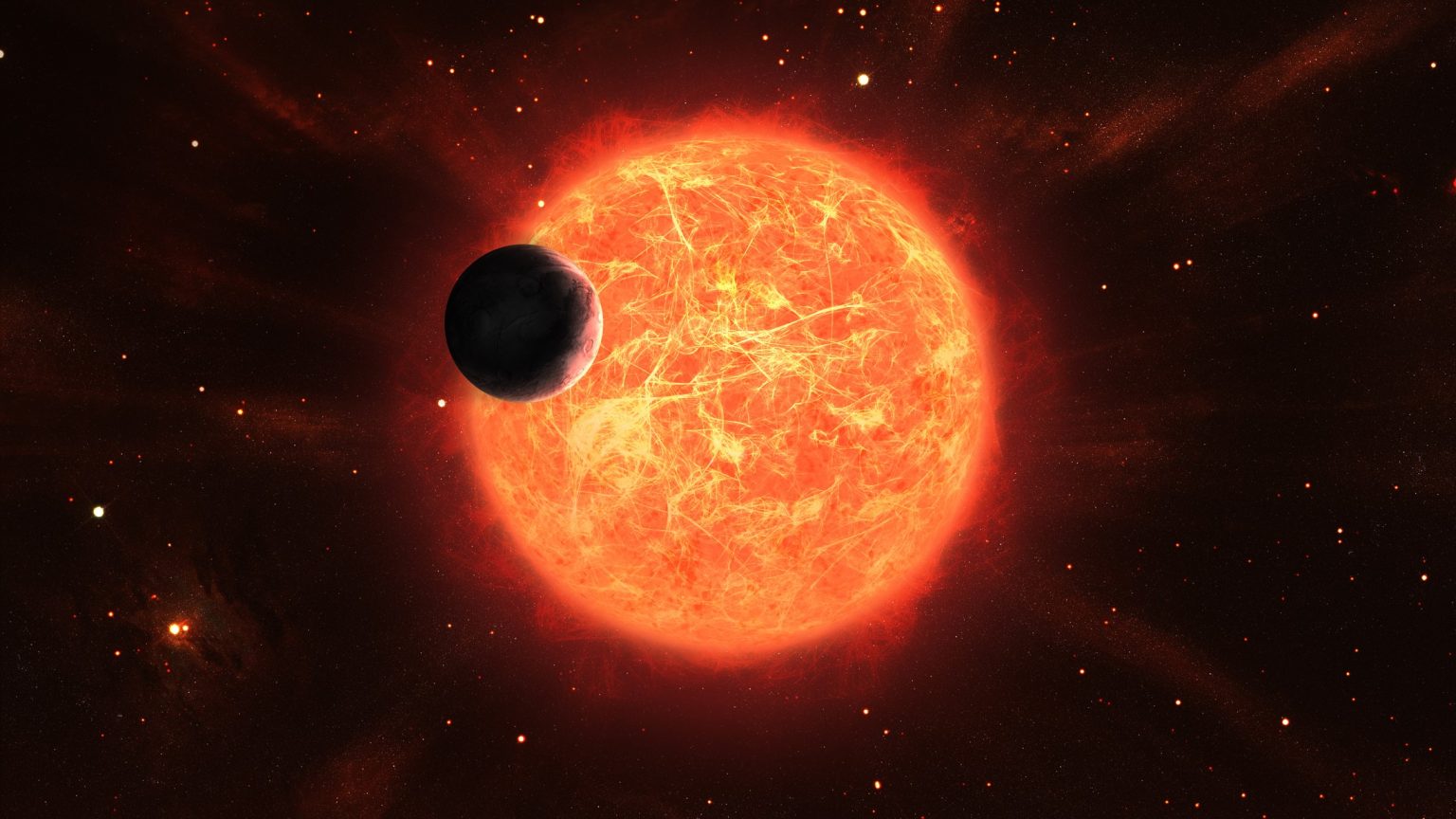
Scientists measured the mass of the red giant KIC 10001167 using two completely independent methods, one of which was experimental. Thanks to this, it was possible to determine its age with great accuracy.
Weight and age
Everything is interconnected in astrophysics. The mass of a star and its environment determine its luminosity at a certain age and how it will evolve. A group of astronomers from Keele University recently published a study in Astronomy & Astrophysics that could potentially help us better understand the evolution of stars.
It reviews the measurement of the mass of the star KIC 10001167 using two completely independent methods. The first of them is fairly traditional — an analysis of the bodies orbiting it. It is quite familiar to astronomers and follows from an understanding of Kepler’s laws describing the motion of objects in orbit.
The problem with this method is that it requires something to be orbiting around the red giant, and it also requires observing the system for a sufficiently long period of time. The study also used another method — measuring the pulsations of the star.
This is known as asteroseismology, the study of a star’s own oscillations, which are a consequence of resonance phenomena related to its size. It does not require the presence of other bodies in the system.
Promising method
The main result of the study: the mass estimate obtained by two independent methods was approximately 1%. Thanks to this, the age of the star could be determined with an accuracy of 10%, which was previously impossible.
The authors say that the method has a promising future, as it can be applied to other red giants. Accurate assessment of their mass and age will reveal how they evolved.
John Southworth, co-author of the study and senior lecturer in astrophysics at Keele University, said: “Science is our description of reality, and astrophysics provides our description of the universe. Checking different methods against each other to confirm that they agree is the basis of the scientific method and vital for our understanding of stars, the universe they are in, and the planets they host.”
According to phys.org

