

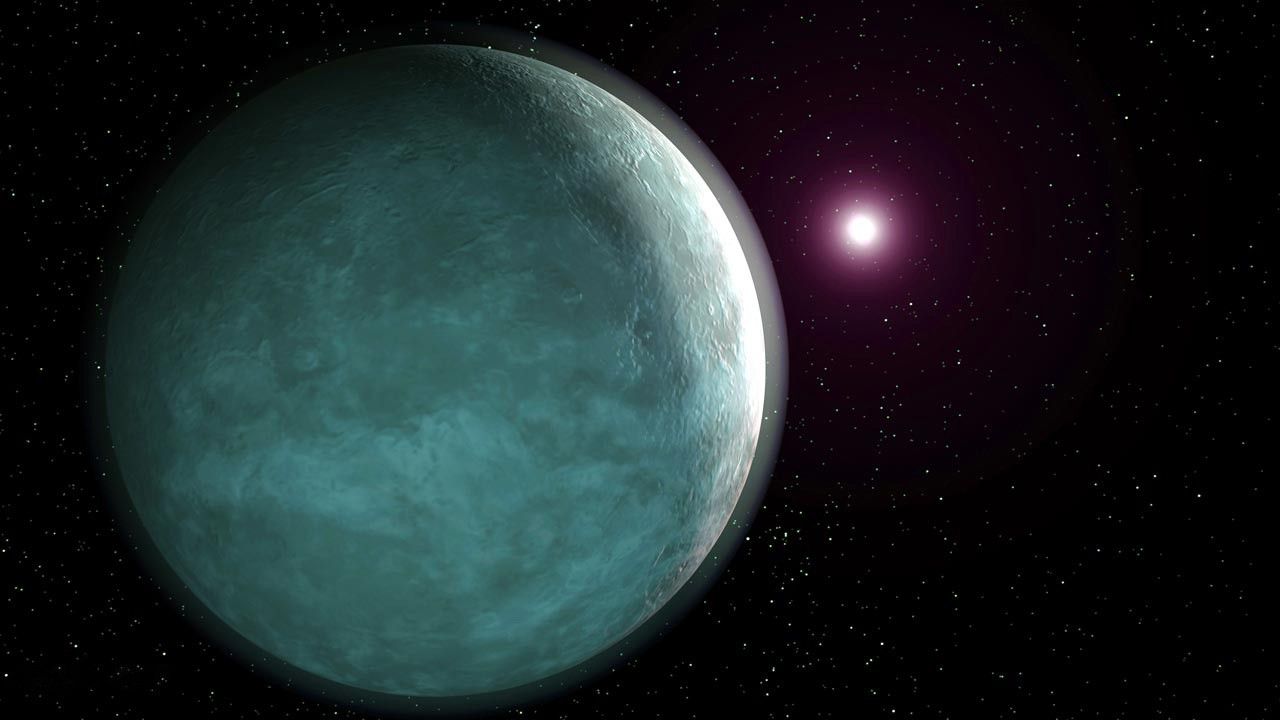
Scientists have determined that the previously discovered planet TOI-1883 b is an incredibly bloated super-Neptune. At the same time, it orbits its star at a distance that falls within the so-called Neptunian Desert, parameter regions where planets of this type are unexpectedly rare. This raises questions about where this world actually originated.
Fluffy super-Neptune
A team of researchers from the University of Tokyo used the Subaru Telescope to study the exoplanet TOI-1883 b. The paper, published on the arXiv preprint server, contains many interesting details about this unusual planet, which stands out among its peers for its extraordinary “fluffiness.”
TOI-1883 b itself, which orbits a red dwarf 383 light-years away from us, was discovered back in 2024. At that time, scientists determined that it completes one orbit around the star in 4.5 days and has a radius five times larger than our planet. This placed it somewhere between classical Neptunes and full-fledged gas giants. However, its mass remained unknown.
The researchers’ new paper is dedicated to studying this feature, as well as refining a number of other parameters of the planet. They determined that the mass of TOI-1883 b is 13.7 times that of Earth. Combined with the refined radius—5.65 times that of Earth—this yields an average density of just 0.4 g/cm³, which is significantly lower than the density of water. The planet is quite similar in its characteristics to Saturn, but the study’s authors prefer to call it a super-Neptune.
“Ridge” in the “Desert”
The planet TOI-1883 b has a record-low density among its peers. In fact, it is extremely bloated. But that’s not what makes it so interesting; rather, it’s the distance at which it orbits its star. The fact is that scientists have already compiled a substantial body of data on exo-Neptunes and have discovered an interesting pattern.
Of course, all stars have different luminosities. However, if we compare the orbits of discovered planets while accounting for this parameter—that is, by normalizing them to the same energy input from their host stars—three distinct zones clearly emerge: farther from the star lies a “savanna,” where Neptune-like planets are quite common; near the star lies the “desert,” where they are almost nonexistent, and between them stretches the “ridge”— a region characterized by orbital periods in the range of 3.2–5.7 days, with an increased concentration of such worlds.
So, TOI-1883 b is located on the border between the “desert” and the “ridge.” This has led scientists to speculate that it formed in the much cooler “savanna,” but then migrated closer to the star. There, the star’s radiation stripped it of a significant amount of mass while preserving its volume.
According to phys.org

