

Italian astronomers conducted a large-scale spectroscopic observation of a recently discovered nova known as Vulpeculae 2024, also known as V615 Vul. The results of new observations shed more light on its nature, indicating that it belongs to a rare class of hybrid novae.
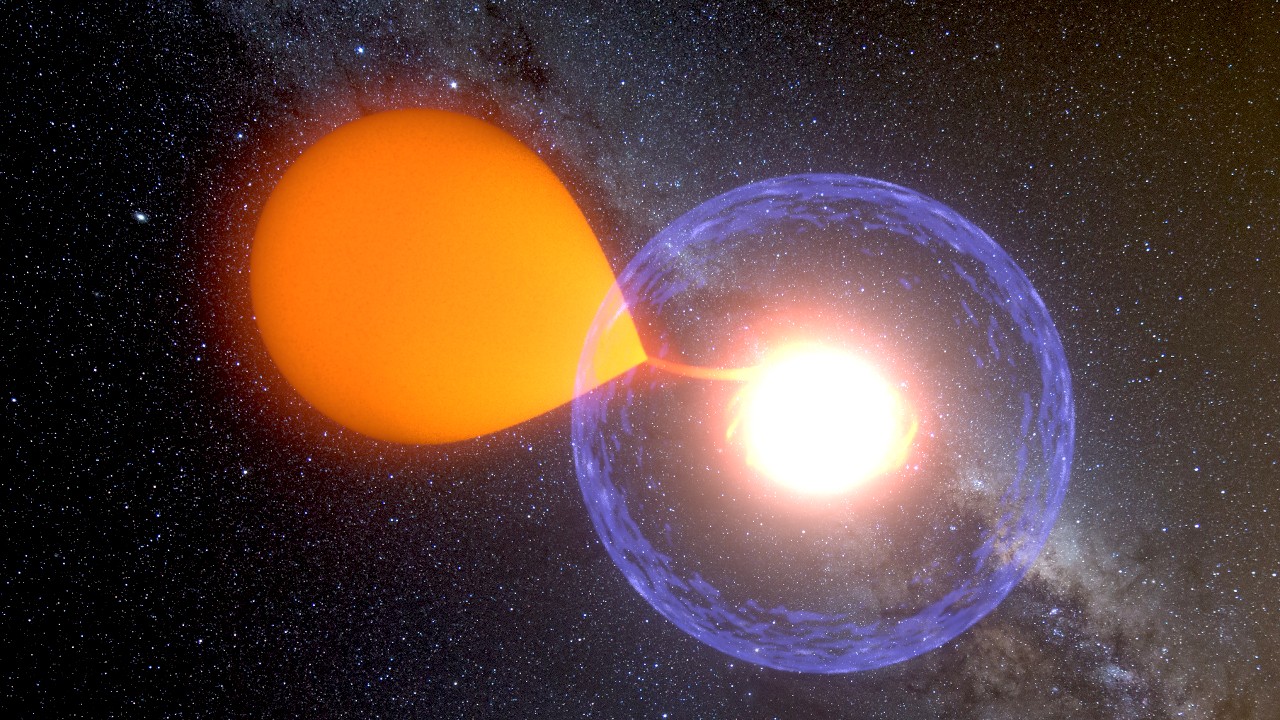
Discovery of nova known as Vulpeculae 2024
Vulpeculae 2024 was discovered on July 29, 2024, a few hours before reaching its photometric maximum. Based on its optical spectrum, astronomers initially classified it as a reddened classical nova.
A team of astronomers led by Paolo Valisa from the Asiago Astronomical Observatory in Italy began observing Nova Vulpeculae 2024, covering the period from its discovery to its hazy new phase. For this purpose, they obtained spectra of this new object using the Varese Schiaparelli Observatory. Their research was supplemented with data from the American Association of Variable Star Observers (AAVSO) database and the Zwicky Transient Facility (ZTF) Observatory.
Origin and classification of novae
A nova is a star that experiences a sudden increase in brightness and gradually returns to its original state, a process that can last for many months. Such a flare, releasing enormous amounts of energy, is the result of the accretion process in a close binary system containing a white dwarf and its companion. Studying new phenomena is important for deepening our understanding of fundamental astrophysical processes, including stellar evolution.
Classic novae are powered by a sudden thermonuclear explosion of water-containing material accumulated on the surface of a white dwarf from a low-mass companion in a close binary system. They are divided into two main spectroscopic classes: those characterized by prominent iron (Fe II) emission lines and those dominated by helium/nitrogen (He/N) emission lines. However, observations show that a small fraction of classical novae exhibit hybrid behavior, evolving from the Fe II class to the He/N class.
Features of Nova Vulpeculae 2024
Observations showed that Vulpeculae 2024 is a fast nova, as the time it took to reach maximum brightness was less than two days, while the time required for its brightness to decrease by two and three magnitudes from its maximum was five and 10.7 days, respectively. In general, the light curve of this nova seems to resemble oscillatory novae — with an initially smooth decline and quasi-periodic oscillations of approximately 1.0 magnitude amplitude.
The distance to Vulpeculae 2024 has been calculated to be approximately 16,000 light-years, placing it about 390 light-years below the galactic plane and in the Orion-Cygnus spiral arm. Astronomers suggest that the star designated GAIA DR3 1825912166611947136 may be the progenitor of this nova.
Most importantly, observations showed that the spectrum of Vulpeculae 2024 near maximum brightness was typical for the Fe II class, with very broad emission lines and P-Cygni-type velocity absorptions reaching terminal velocities of about 3500 km/s.
However, when the nova decreased by three magnitudes from its maximum brightness, it began to experience photometric oscillations, mainly due to changes in the continuum and the appearance of hard X-rays, while emission lines typical of the He/N class began to develop in parallel with the Fe II class lines. According to the authors of the study, this behavior confirms that Vulpeculae 2024 is a hybrid nova.
According to phys.org

