

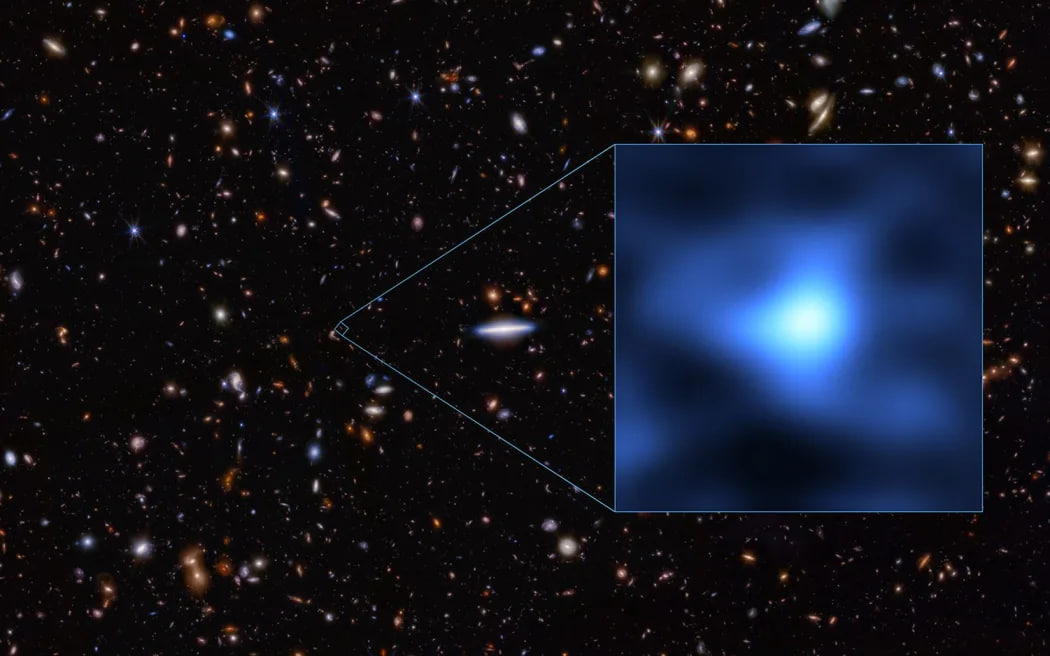
Astronomers using the Atacama Large Millimeter/submillimeter Array (ALMA) have detected traces of oxygen in the extremely distant and ancient galaxy JADES-GS-z14-0, whose light has been traveling toward us for 13.4 billion years. This means that we see it as it was when the Universe was less than 300 million years old. Previously, it was believed that heavy elements such as oxygen could not have appeared at that time.
The discovery indicates that at least two generations of stars have already been born and died in this galaxy, scattering “metals” (as astronomers call all elements heavier than helium) throughout space. This is very fast by cosmic standards and contradicts older models, which assumed that such enrichment would take hundreds of millions of years.
ALMA was able to determine the distance to this galaxy very accurately, with an error of only 0.005%. It turned out that the gas in it contained about 20% of the “metals” found in the Sun, and the movements of the ionized gas hinted at a large halo of dark matter.
“I was amazed by the unexpected results, because they opened up a new perspective on the early phases of galaxy evolution,” said Stefano Carniani from the Scuola Normale Superiore University in Pisa.
This discovery is forcing scientists to rethink their theories about the formation of the first galaxies. Perhaps the star systems of that time formed and exploded much faster and more energetically than researchers had assumed.
Scientists plan to study this galaxy using the James Webb Telescope and the future Very Large Telescope to understand whether it was a cosmic “wunderkind” or whether there were many such early and mature galaxies in the Universe.
According to The Astrophysical Journal.

