

Scientists have studied the protoplanetary disk around the red dwarf TWA 20, which is located 261.5 light-years away from us. This star is interesting because it is very young and a planetary system is forming around it.
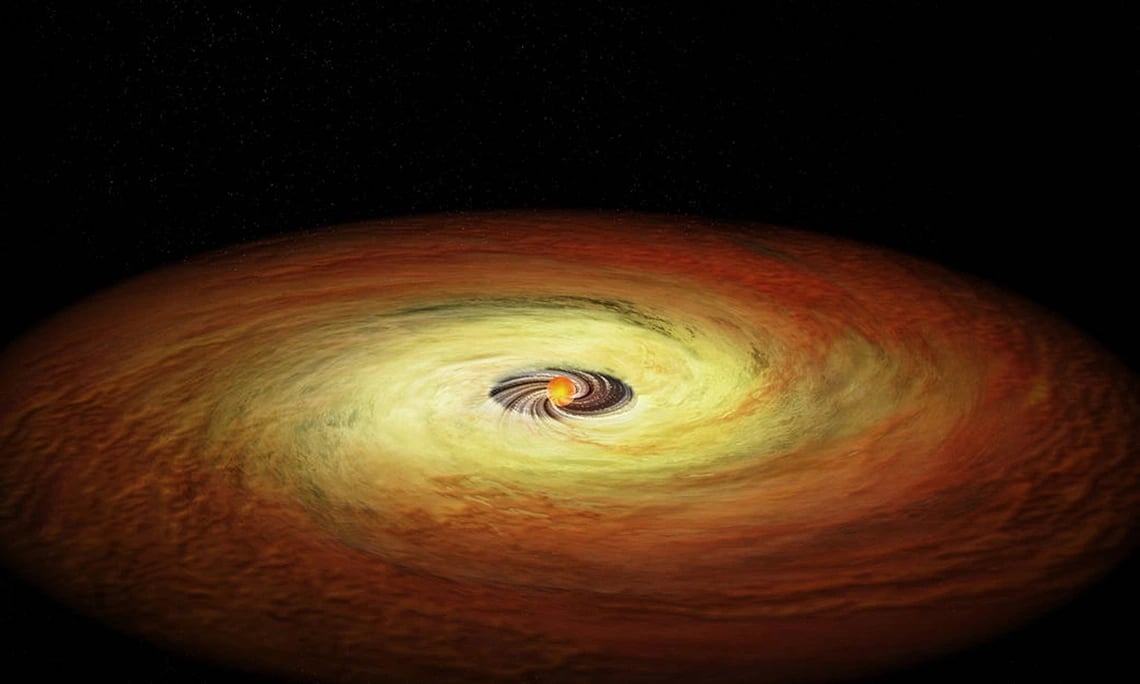
Red dwarf
On October 23, an article devoted to the study of the red dwarf TWA 20 appeared on the arXiv preprint server. Scientists have discovered a gas and dust disk around this star and are now using the James Webb Space Telescope to understand the processes taking place within it.
The star TWA 20 is not very close to us. It is 261.5 light-years away. Under normal circumstances, it would not receive such attention, as it belongs to the small stars of spectral class M. The only problem is that they are all old, hundreds of millions or even billions of years old.
TWA 20 is a very young star. It is only 10 million years old, with an effective temperature of 3560 K. Therefore, everyone is interested in the size of the disk forming around the red dwarf and what is happening there. For this purpose, scientists used a near-infrared camera mounted on the James Webb Telescope.
Protoplanetary disks
It turned out that the protoplanetary disk around the star is not so small. Its diameter is 64.7 AU, and it is tilted at an angle of 70.1° to the star’s axis of rotation. At the same time, the system does not exhibit the strong infrared radiation characteristic of such structures.
However, scientists compared TWA 20 with five other protoplanetary disks around red dwarfs located in this region. They found similar differences in some of them. Therefore, it is likely that some unknown dependence is at work here.
Much more interesting is the fact that at a distance of 48 AU from the center of the disk, some kind of disturbance was detected. It has a mass similar to that of Jupiter. It seems that a gas giant is forming here. Scientists still do not know exactly how such large worlds appear around such small stars.
According to phys.org

