

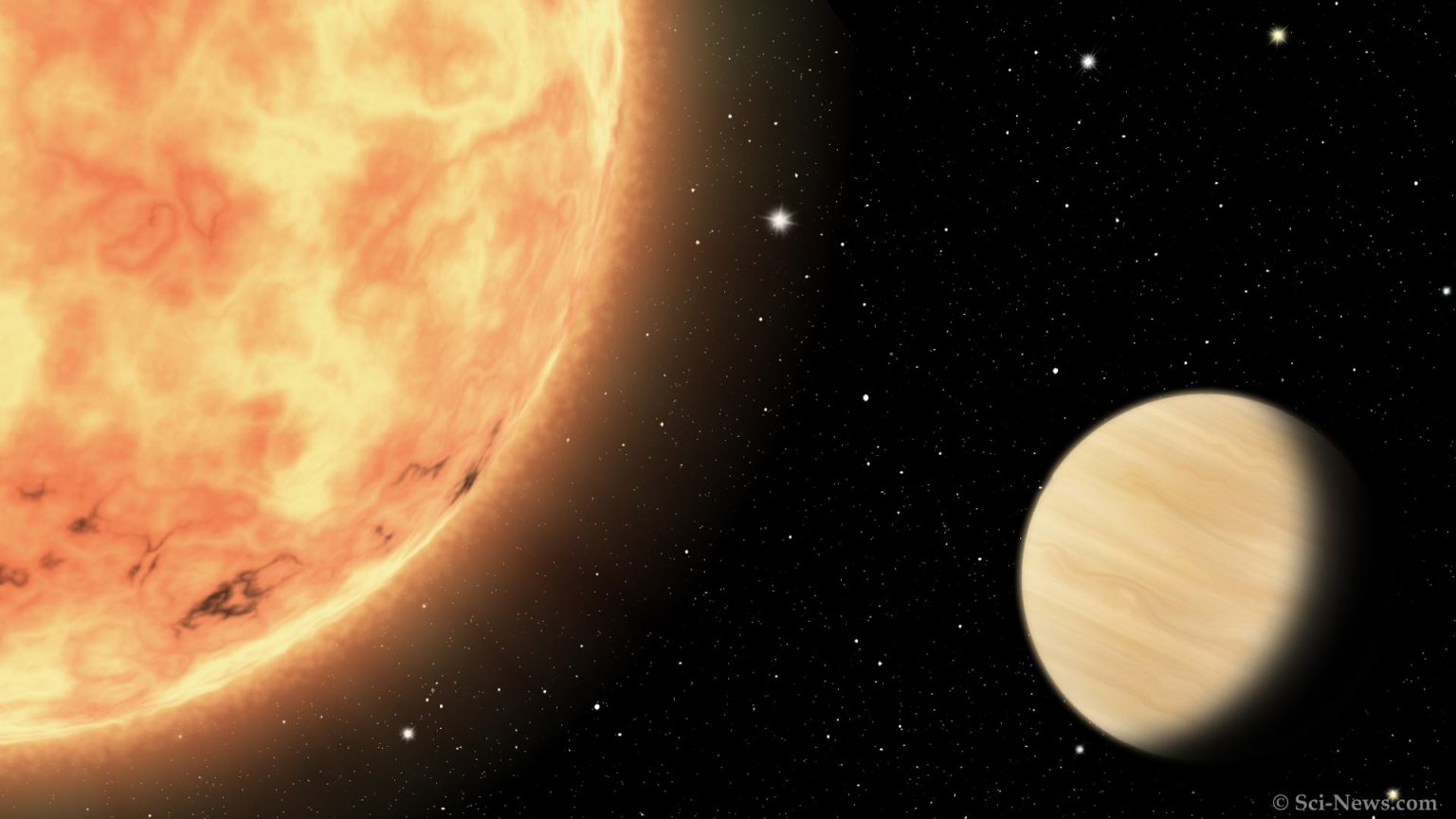
Scientists have discovered an exoplanet orbiting the star TOI-3862. It is a large, very dense, and hot “Neptune.” The TESS space telescope helped identify it.
New exoplanet
Scientists from the Turin Observatory report the discovery of a new planet, TOI-3862b. The TESS space telescope helped identify it. This relatively small device has already identified 7,800 exoplanet candidates, 733 of which have been confirmed.
The star around which the newly discovered planet orbits is located 800 light-years away from us. It is approximately 6% smaller and lighter than our sun, with a surface temperature of 5300 K. Its age is estimated at 7.5 billion years.
TESS determined the planet’s parameters using two methods: transit and radial velocity. The first involves measuring the drop in brightness of a star when a planet passes between it and us, allowing its radius to be measured. The second, based on the shift in the star’s spectral lines caused by its wobble under the influence of the planet’s gravity, is used to determine the latter’s mass.
Dense gas giant
Thanks to TESS research, scientists know that TOI-3862 b has a mass of 0.169 Jupiter masses and a size approximately half that of the largest planet in the Solar System. Therefore, its average density is 1.75 g/cm3. This is quite high, 75% greater than that of water.
Another interesting feature is its extreme proximity to the star. TOI-3862 b completes one orbit around its star in just 1.56 days, at an average distance of 0.025 AU. On the one hand, this makes it very convenient to observe, but on the other hand, it means that its temperature is 1539 K, which is incredibly hot.
Researchers were even able to determine the probable distribution of mass: 38–41% is accounted for by the metallic core, 40–45% by the silicate mantle, and the remainder by the atmosphere of hydrogen and helium. In other words, it is actually more rocky than gaseous.
This fact leads scientists to believe that the planet was much larger in the past but lost most of its atmosphere. Given how close it is to its star and the latter’s venerable age, this does not seem implausible.
According to phys.org

