

Astronomers from the Center for Computational Astrophysics(CAA) at the Flatiron Institute have published an article on the “impossible” merger of black holes. In the paper, they explain how these black holes could have formed.
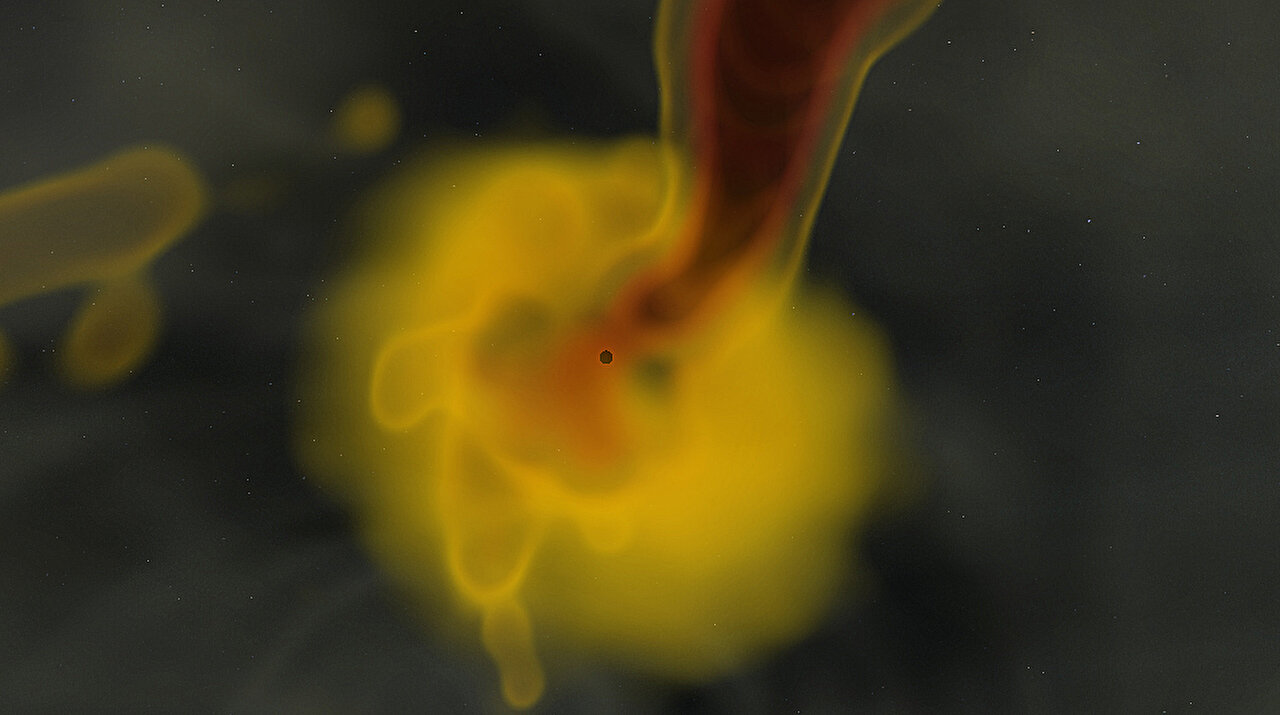
In 2023, the LIGO-Virgo-KAGRA collaboration detected gravitational waves caused by the merger of two black holes 7 billion light-years from Earth. The event attracted the attention of scientists due to the characteristics of the objects involved. The masses of the black holes were 140 and 100 times greater than the mass of the Sun, and they rotated at speeds close to the speed of light. According to current understanding, such black holes should not exist.
When massive stars reach the end of their lives, many of them collapse and explode as supernovae, leaving behind a black hole. But if a star falls within a certain mass range, a special type of supernova occurs. This explosion, called a pair-instability supernova, is so powerful that the star is destroyed, leaving nothing behind.
“As a result of these supernovae, we do not expect black holes with masses approximately 70 to 140 times greater than the mass of the Sun to form,” says Ore Gottlieb, an astrophysicist at CCA. “Therefore, it was puzzling to see black holes with masses within this range.”
The only possible scenario for the formation of a black hole of this mass is the merger of two smaller black holes. However, in the case of GW231123, scientists considered this unlikely due to their very rapid rotation. It is believed that black hole mergers disrupt their rotation, which was not observed in the case of GW231123.
To find the answer to this mystery, scientists conducted a series of simulations. They modeled a giant star whose mass was initially 250 times greater than that of the Sun. By the time of its death, it had shrunk to 150 times the mass of the Sun due to the burning of hydrogen fuel and the ejection of matter.
After that, researchers focused on the influence of magnetic poles on the cloud of matter formed as a result of a supernova explosion. Previously, it was believed that all of it would be quickly absorbed by a black hole, resulting in its final mass corresponding to the mass of the star. But simulations showed something different.
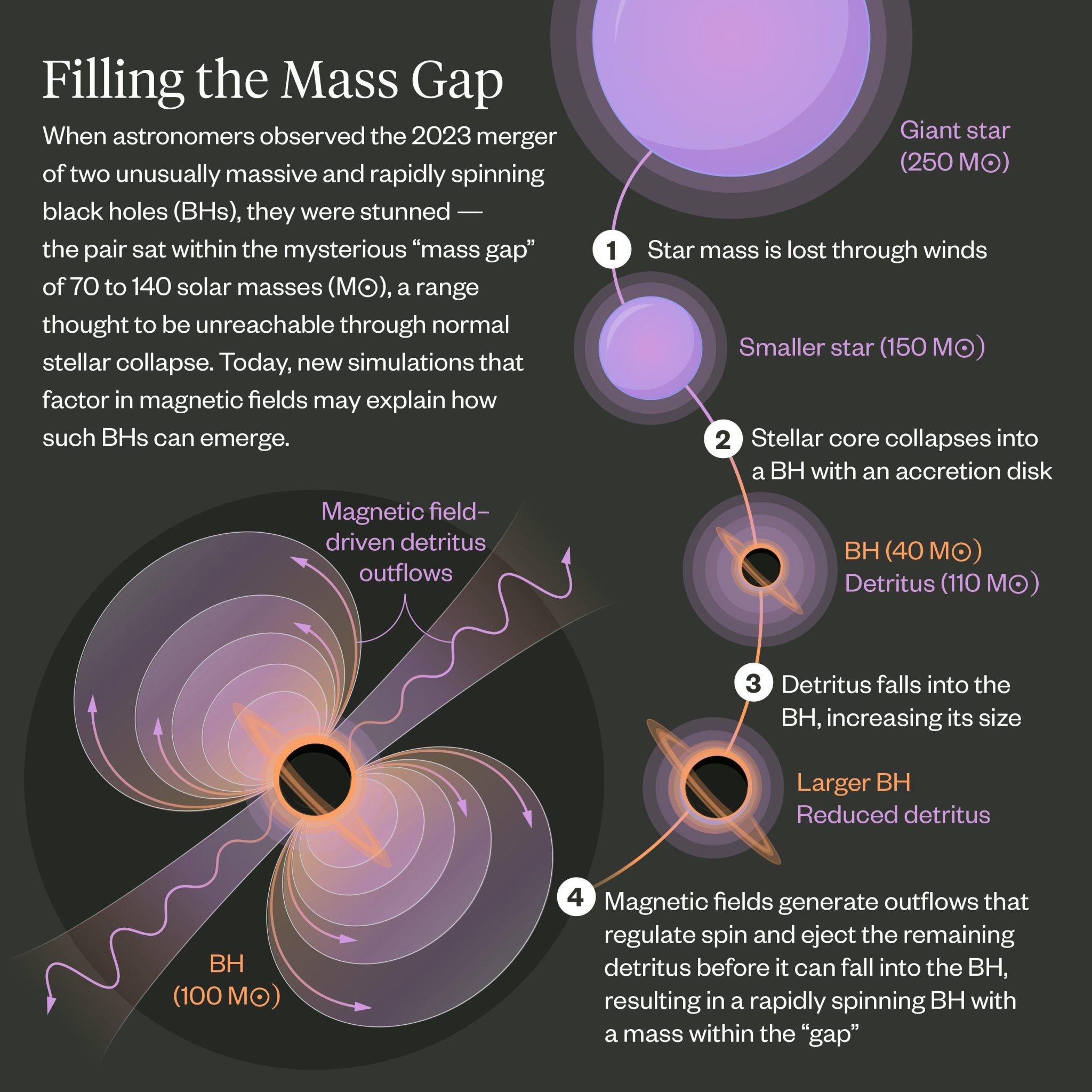
If a non-rotating star collapses to form a black hole, the cloud of remaining debris quickly falls into the black hole. However, if the original star was spinning rapidly, this cloud forms a rotating disk that causes the black hole to spin faster and faster as matter falls over the event horizon. If magnetic fields are present, they exert pressure on the debris disk. This pressure is strong enough to eject some of the matter from the black hole at speeds close to the speed of light.
These emissions reduce the amount of material in the disk that ultimately falls into the black hole. The stronger the magnetic fields, the stronger this effect. In extreme cases with very strong magnetic fields, up to half of the original mass of the star can be ejected through the black hole’s disk emissions. This process can result in the formation of a black hole with characteristics similar to those involved in the GW231123 merger.
According to Phys.org

