

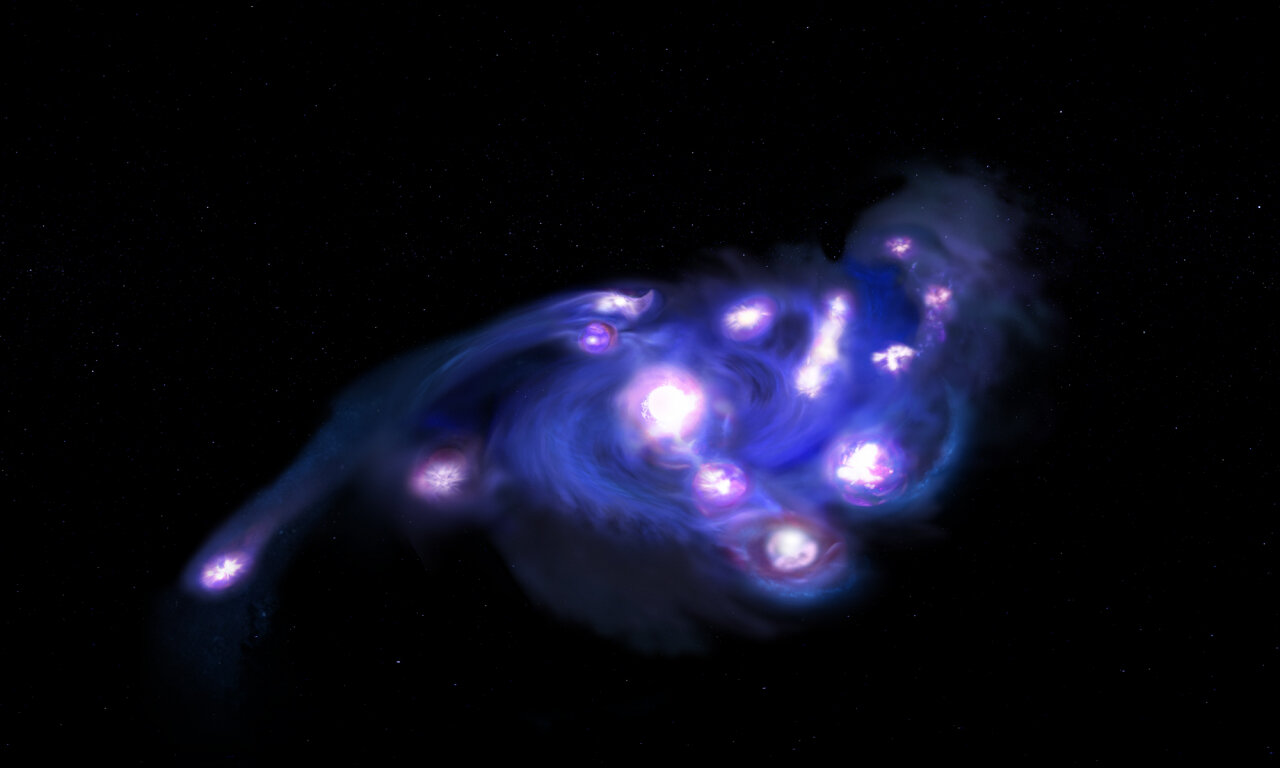
Scientists have discovered an amazing galaxy in space that resembles a cluster of grapes. This fairly ordinary spiral star system is made up of 15 massive star-forming regions.
Notable galaxy
Astronomers have discovered a spiral galaxy that appears very clumpy and existed only 900 million years after the Big Bang. It sheds new light on how star systems grew and evolved in the early Universe.
Dubbed the “Cosmic Grapes,” the galaxy consists of at least 15 massive clumps in which intense star formation is taking place. It is significantly larger than predicted by modern theoretical models for spiral systems that existed in such early stages of the Universe’s development.
The discovery, published in Nature Astronomy, was made possible by an extraordinary combination of observations from the Atacama Large Millimeter/submillimeter Array (ALMA) and the James Webb Space Telescope, focused on a single galaxy that happened to be perfectly magnified by foreground galaxy clusters. In total, more than 100 hours of telescope time has been devoted to this single system, making it one of the most intensively studied galaxies from the early Universe.
A true view of the galaxy
Although previous images from the Hubble Telescope show the galaxy as a flat, continuous disc-like object, the powerful resolution of ALMA and JWST, enhanced by gravitational lensing, has revealed a radically different picture. It turned out that it was swarming with huge clusters resembling a cluster of grapes. This discovery is the first time astronomers have linked small-scale internal structures and large-scale rotation in a typical galaxy at cosmic dawn, achieving a spatial resolution of just 10 parsecs (about 30 light-years).
This galaxy is not a rare or extreme system. It is located exactly on the “main sequence” of galaxies in terms of its star formation activity, mass, size, and chemical composition — meaning that it is likely representative of the wider population. If this is the case, many other galaxies that appear flat at first glance, observing modern objects, may in fact consist of similar invisible substructures hidden beyond the current resolution.
Since existing models cannot reproduce such a large number of clusters in spiral galaxies in their early stages, this discovery raises key questions about how galaxies form and evolve. This suggests that our understanding of feedback processes and structure formation in young galaxies may require significant revision.
“Cosmic Grapes” now offer a unique window into the birth and evolution of galaxies, and may be only the first of many. Future observations will be crucial in identifying whether such clumpy structures were common in the early Universe.
According to phys.org

