

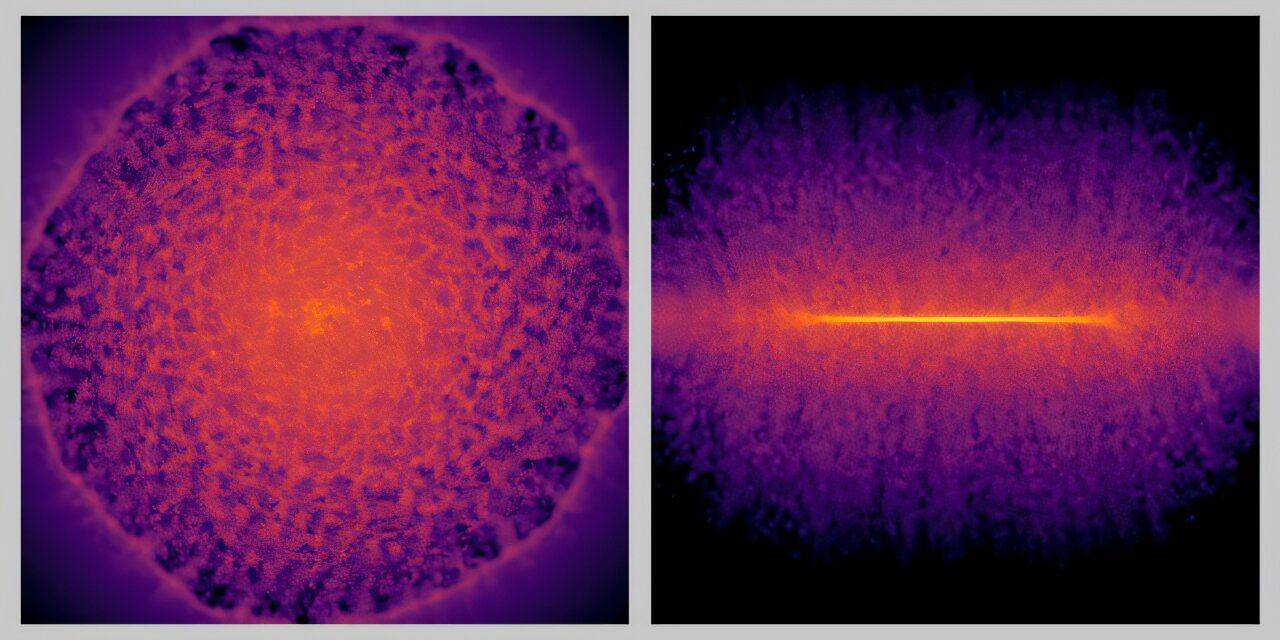
Researchers have successfully conducted the world’s first simulation of the Milky Way, accurately reflecting more than 100 billion individual stars over 10,000 years. This feat was achieved by combining artificial intelligence (AI) with numerical simulations. The simulation not only depicts 100 times more individual stars than previous state-of-the-art models, but was also created 100 times faster.
Challenges of modeling the Milky Way
Astrophysicists are attempting to create a model of the Milky Way down to individual stars, which could be used to test theories of galaxy formation, structure, and stellar evolution based on real observations. This work is extremely difficult because accurate models of galaxy evolution must take into account gravity, fluid dynamics, supernova explosions, and element synthesis – processes that occur on completely different spatial and temporal scales.
Until now, scientists have been unable to model large galaxies such as the Milky Way while maintaining high resolution at the stellar level. The most advanced simulations have an upper mass limit of about a billion suns, while the Milky Way has more than 100 billion stars. This means that the smallest “particle” in the model is actually a cluster of stars with a mass of 100 suns. What happens to individual stars is averaged out, and only large-scale events can be accurately modeled.
The main problem is the number of years between each modeling stage – rapid changes at the level of individual stars, such as the evolution of supernovae, can only be observed if the time between each image of the Galaxy is sufficiently short.
Computational limitations and a new approach to modeling
However, processing smaller time intervals requires more time and computing resources. Without taking into account current mass limitations, if the best physical simulation available today attempted to simulate the Milky Way down to individual stars, it would take 315 hours for every 1 million years of simulation.
At this modeling rate, even one billion years of the Galaxy’s evolution would require more than 36 years of real time. However, simply adding more and more supercomputer cores is not the answer. Not only do they consume enormous amounts of energy, but increasing their number does not always speed up calculations, as the efficiency of the system inevitably declines.
In response to this challenge, Keiya Hirashima from the RIKEN Center for Interdisciplinary Theoretical and Mathematical Sciences (iTHEMS) in Japan, together with colleagues from the University of Tokyo and the University of Barcelona in Spain, has developed a new approach that combines a deep learning surrogate model with physical simulations.
The replacement model was trained on high-resolution simulations of supernovae and learned to predict how the surrounding gas expands over 100,000 years after the explosion without using the resources of the entire model. Thanks to this artificial intelligence, the simulation can simultaneously reproduce the overall dynamics of the galaxy and small-scale processes, such as supernova explosions.
To verify the effectiveness of the simulation, the team compared the results with large-scale tests using the RIKEN Fugaku supercomputer and the Miyabi supercomputer system at the University of Tokyo.
Breakthrough modeling results
This method not only allows us to distinguish individual stars in large galaxies containing more than 100 billion stars, but also simulates 1 million years in just 2.78 hours. This means that the desired 1 billion years can be simulated in just 115 days, rather than 36 years.
Beyond astrophysics, this approach could transform other large-scale modeling efforts, such as in meteorology, oceanography, and climatology, where modeling requires a link between small-scale and large-scale processes.
The scientists who conducted the modeling believe that the integration of artificial intelligence with high-performance computing represents a fundamental change in how we solve large-scale, multiphysics problems in computational science.
Provided by phys.org

