

An international team of scientists has made a breakthrough in the study of one of the most mysterious objects in the Universe—black holes. Thanks to a unique telescope lifted into the stratosphere by a balloon, researchers have obtained the most accurate data to date on how matter behaves at the edge of absorption and where the incredible energy of these cosmic “monsters” comes from.

The main task of the scientists was to understand the physics of the processes occurring directly at the event horizon of a black hole—the boundary beyond which even light cannot escape its gravitational embrace. It is there that matter heated to millions of degrees, absorbed by the black hole, forms a so-called accretion disk and releases a tremendous amount of energy in the form of X-rays.
“Our observations will be used to test increasingly realistic computer models of physical processes near black holes,” explains Henric Krawczynski, principal investigator for the project at the University of Washington.
“Magic” of polarization
The XL-Calibur telescope was a key tool in the research. Its uniqueness lies in the fact that it measures not only the brightness of light, but also its polarization—that is, the direction in which its electromagnetic waves oscillate.
Imagine light as a wave “running” along a rope. If you shake the rope up and down, that is one polarization. If you shake it from left to right, that is another. By analyzing this “vibration” of X-rays from a black hole, scientists can understand the shape of the hot gas disk and how it rotates around the abyss.
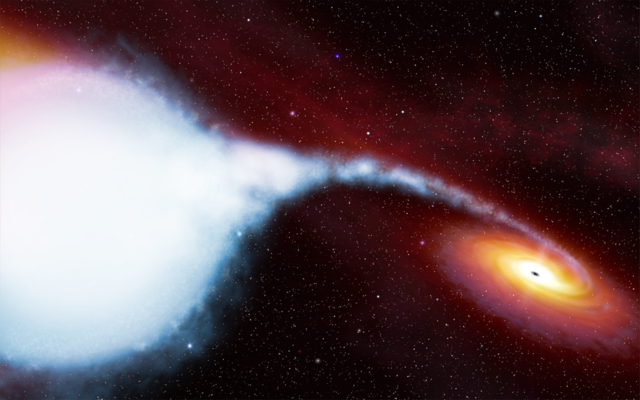
“If we try to find the black hole Cygnus X-1 in the sky, we will only see a very small dot of X-ray light,” says graduate student Ephraim Gau. “That’s why polarization is incredibly useful. It gives us clues about what’s happening around the black hole when we can’t take normal pictures.”
First results and future discoveries
The telescope was pointed at the well-known black hole Cygnus X-1, which is located 7,000 light-years away from us. The data collected during the flight from Sweden to Canada in July 2024 has already been published in the scientific journal The Astrophysical Journal and contains the most accurate polarization measurements.
But this is just the beginning. The team is planning a new mission in 2027, this time from Antarctica, to study even more black holes and neutron stars.
This research brings us closer to the moment when we will be able to not only imagine, but also know exactly what is happening in some of the most extreme environments in space.
We previously reported on how “quantum caterpillars” can connect black holes to each other.
According to phys.org

