

Stars revolve around the center of the Milky Way at different speeds. Some of them move so fast that they will soon leave our galaxy. Scientists are closely monitoring them to find out how dark matter is distributed in space.
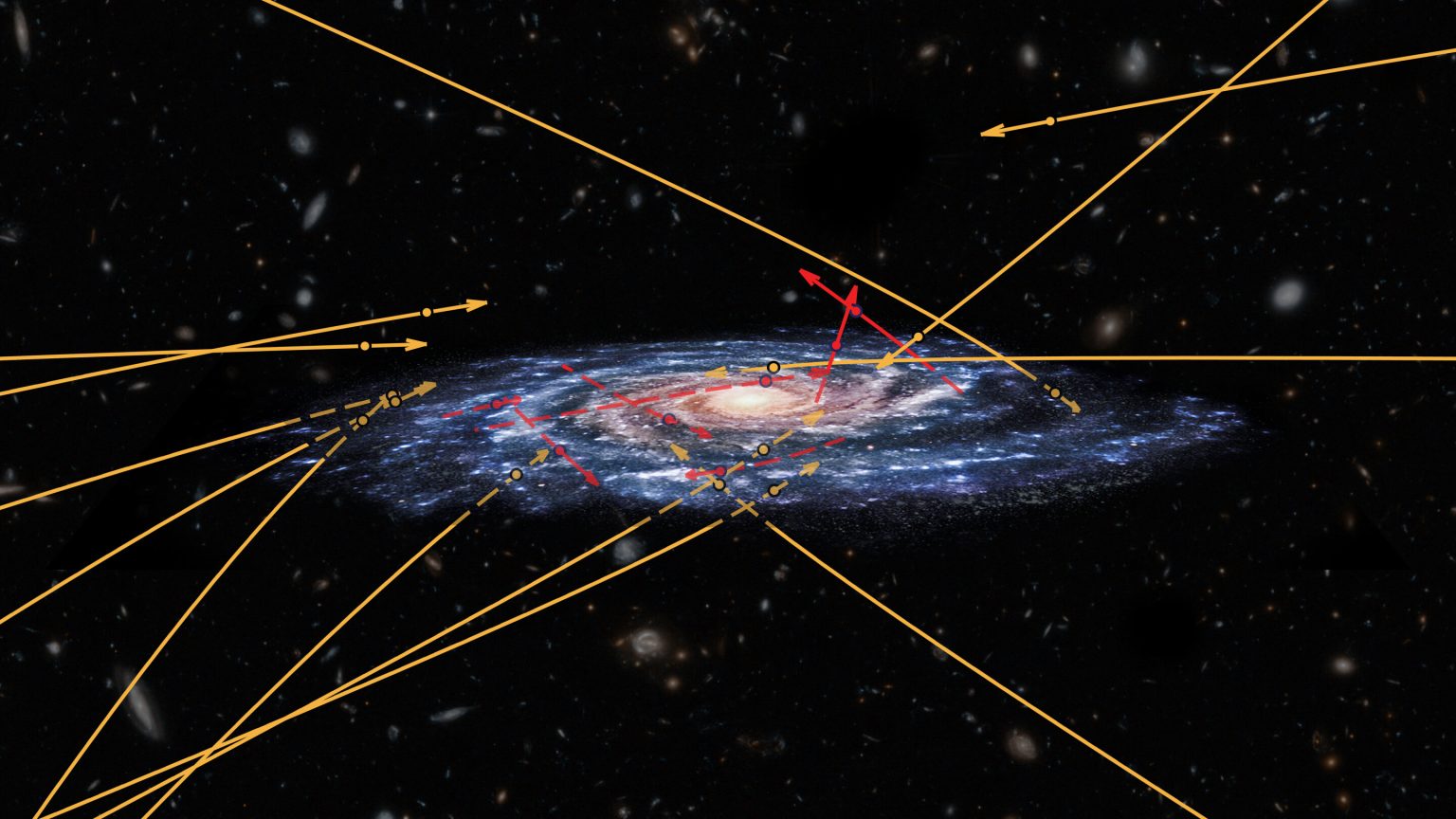
Hypervelocity stars
Hypervelocity stars have, since the 1920s, been an important tool that allows astronomers to study the properties of the Milky Way galaxy, such as its gravitational potential and the distribution of matter. Now, astronomers from China have made a large-volume search for hypervelocity stars by utilizing a special class of stars known for their distinct, regular, predictable pulsation behavior that makes them useful as distance indicators.
The escape velocity of any planet, star, or galaxy is the velocity required for a mass leaving the object’s surface to coast completely and exactly out of the planet’s gravitational well, going to infinity. Earth’s escape velocity is 11.2 kilometers per second (km/s).
Any mass that leaves the surface having that immediate initial speed will, without further energy, leave Earth’s gravitational grasp. Examples are rocks ejected from Earth by a colliding incoming asteroid (as happened with rocks exchanged between Earth and Mars) or the possible escape of a steel lid covering a blast hole from a 1957 underground nuclear explosion in Nevada.
The escape velocity from the sun is 618 km/s (but only 42 km/s from Earth’s position), and about 550 km/s from the sun’s position in the Milky Way. Hypervelocity stars (HVSs) have tangential speeds of 1,000 km/s or more, making them gravitationally unbound from the Milky Way.
The formation of runaway stars
A prominent way HVSs come about is from a gravitational slingshot interaction with the supermassive black hole, Sagittarius A*, at the Milky Way’s center.
The Hills mechanism, first proposed by astronomer Jack Hills in 1988, has one star of a binary pair captured by a black hole while the other is flung away from the black hole at a high speed.
Such a jettisoned star was first observed in 2019, traveling away from the core of the Milky Way at 1,755 km/s – 0.6% the speed of light – which is greater than the escape velocity of the galactic center. Such stars also provide direct evidence for the supermassive black holes in galactic centers and their properties.
Moreover, by tracing back the trajectories of the runaway stars, scientists can map the gravitational potential of the Milky Way – how masses interact within the galaxy – including the distribution of dark matter in the halo, the huge spherical volume that surrounds a galaxy’s disk.
Search among RR Lyrae stars
With these motivations, three astronomers from Beijing scientific institutions, with lead author Haozhu Fu of Peking University, looked for HVSs by starting with RR Lyrae stars (RRLs). These are old, giant stars that pulse with periods of 0.2 to one day, found in the thick disk and halo of the Milky Way galaxy and often in globular clusters. (The Milky Way contains more than 150 globular clusters, with about a third of them arranged in a nearly spherical halo around the Milky Way’s center.)
The intrinsic luminosity of these RRLs – their total energy output – is relatively well-determined from a relationship that connects their pulsing period, their absolute magnitude, and their metallicity (the abundance of elements heavier than hydrogen and helium, which to astronomers are “metals”). Knowing their absolute energy output and their energy received at Earth enables their distance to be calculated from the inverse-square distance relationship.
Looking for hypervelocity RRLs, they eliminated almost all that did not have properties needed for their search, especially spectroscopic measurements that gave radial velocities (away from the galactic center) with sufficiently low uncertainties. This reduced the relevant dataset drastically to 165 hypervelocity RRLs.
The location of runaway stars and dark matter
The group then looked at each star’s light curve, selecting Doppler shifts for 87 such stars that were the most reliable hypervelocity stars. (Of these, seven had a tangential velocity above 800 km/s.) These are divided into two groups: one that was concentrated towards the Milky Way’s galactic center, and the other localized around the Magellanic Clouds, Large and Small, two irregular dwarf galaxies located near the Milky Way.
Their locations and concentrations suggested they had reached hypervelocity status through the Hills (or similar) mechanism. Many had movements that exceeded the Milky Way’s escape velocity, probably ejected from their host systems.
The team suspects that future Gaia satellite observations and spectroscopic analysis will shed light on the origins of these ejections. Identifying runaway stars in this way allows the properties of the Milky Way halo to be studied further, hopefully shedding light on its dark matter, still one of the deepest mysteries in all of modern physics.
Provided by: phys.org

