

The first public summit of the Giant Magellan Telescope consortium took place on April 14, 2026, and brought two pieces of news at once. Good news: The Giant Magellan Telescope (GMT) is in the final design phase—a crucial step before submitting documentation to the U.S. Congress. Not so good: Without federal budget approval, construction cannot be completed.
What is the Giant Magellan Telescope?
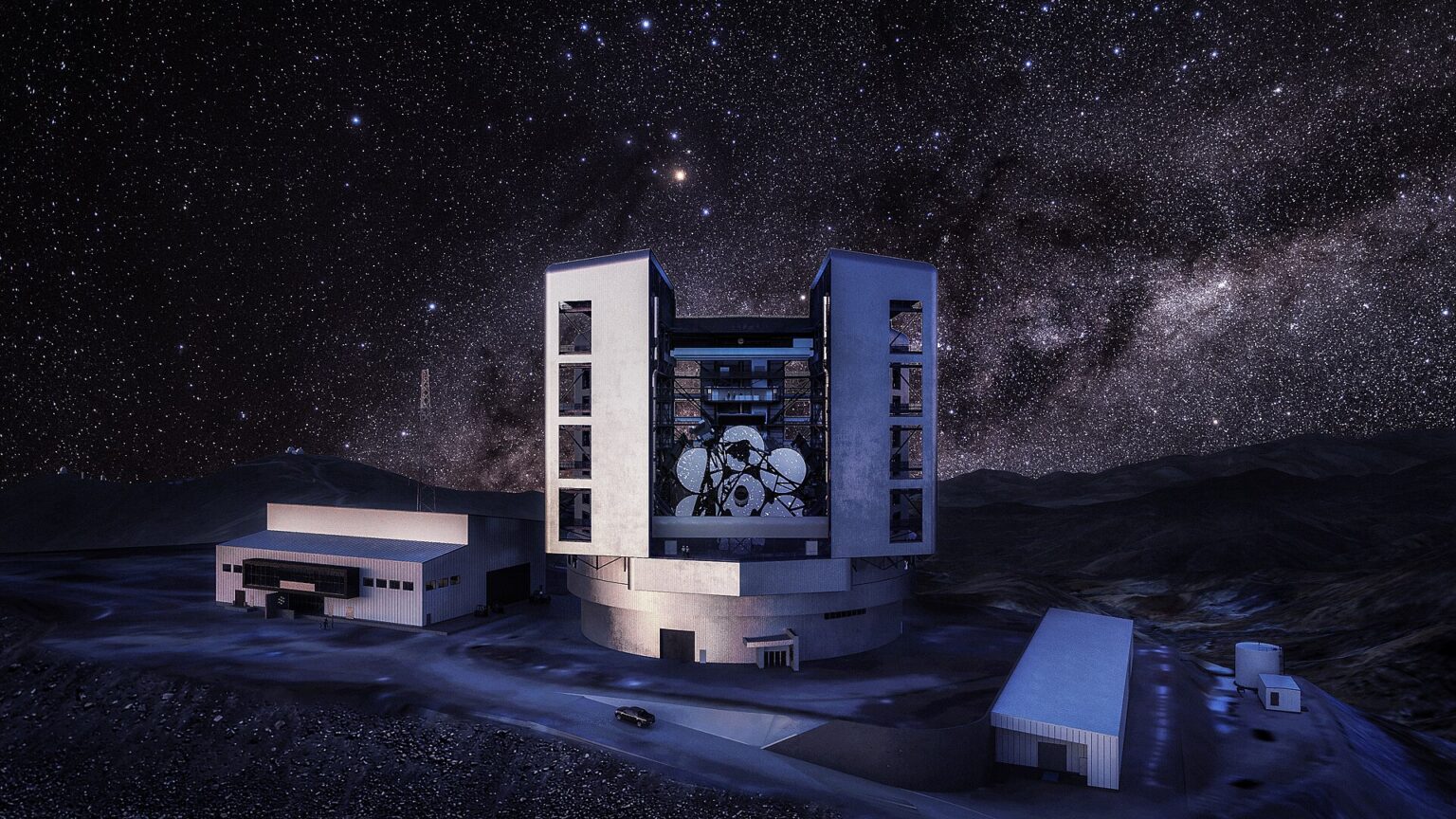
GMT is being built in Chile’s Atacama Desert at an altitude of 2,400 meters. At the heart of the observatory are seven individual mirrors that together form a light-collecting surface 25.4 meters wide: the largest of any telescope ever built. But the real highlight is the adaptive optics. The Earth’s atmosphere constantly distorts the image, and the GMT corrects for this using seven secondary mirrors: each is just 2 millimeters thick and one meter in diameter. Behind it are about 700 micromagnets that adjust the shape of the mirror thousands of times per second to compensate for atmospheric turbulence.
Among the main scientific objectives are the direct observation of exoplanets in the habitable zone and the analysis of their atmospheres for the presence of biosignatures: oxygen, methane, and so on. A separate objective is to study galaxies that formed 10 to 11 billion years ago and, for the first time, map the gas clouds surrounding them.
What’s going on right now?
Construction is already underway. The observatory’s foundation has been laid, and a 39-meter structure is being assembled in Rockford, Illinois. The partners have invested over a billion dollars, and 40% of the components are currently in production. The final phase of the design is scheduled to be completed by mid-2027—after which the matter will be up to Congress.
If the NSF and lawmakers approve the funding, full-scale construction will begin in fiscal year 2028, with the first scientific observations taking place in the 2030s. The total budget exceeds $2 billion, while the federal cap is set at $1.6 billion for several competing projects. A consortium of 16 universities and research institutions is seeking additional private and international partners.
According to space.com

