

AeroVironment has unveiled the Skyfall mission concept, developed in collaboration with NASA’s Jet Propulsion Laboratory (JPL). It involves landing a fleet of research drones on Mars.
In March 2021, the Ingenuity rover landed on the Martian surface. Ingenuity is the first unmanned aircraft in history designed to fly in the atmosphere of another planet. The vehicle, created by JPL engineers, had demonstrator status and was designed for five flights over a period of 30 days. In reality, Ingenuity worked for almost three years. During this time, it made 72 flights, flying over 17 km.
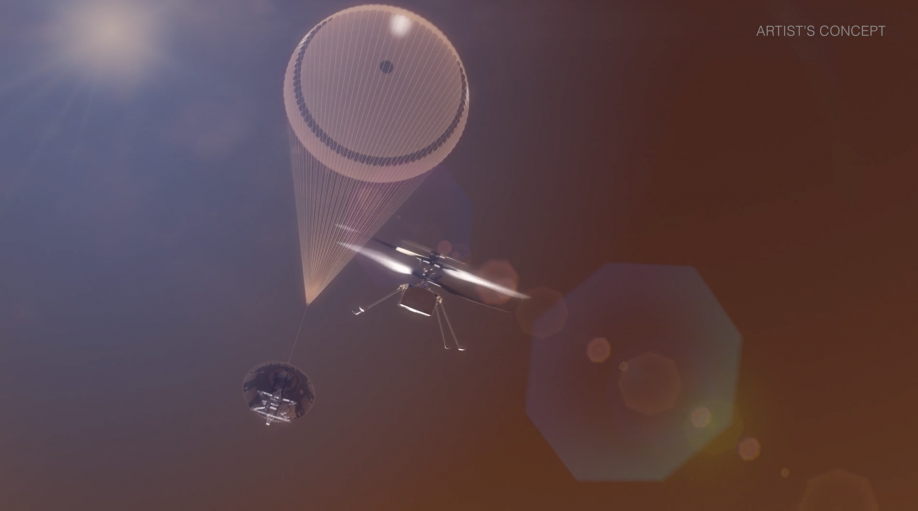
This success clearly demonstrated the potential of exploring Mars using rotary-wing aircraft, inspiring the authors of the Skyfall project. They propose to deliver an entire fleet consisting of six helicopters to the Red Planet. Innovative technology will be used to deploy them, involving drones flying out of the capsule during its descent. This will eliminate the need for a landing platform — traditionally one of the most expensive, complex, and risky elements of any mission to Mars.
After landing, the helicopters will explore sites identified by private companies and NASA as possible candidates for landing the first astronauts on Mars. Each helicopter can operate independently, transmitting high-resolution surface images and subsurface radar data to Earth for analysis, which will help ensure the safe landing of manned vehicles in areas with the maximum amount of water ice and other resources. The data collected by Skyfall may also help scientists answer the question about Mars’ past habitability.
According to AeroVironmen representatives, the use of six helicopters at once will significantly increase the area under investigation and the volume of data collected, which in turn will stimulate the first manned mission to Mars. The company hopes that if a positive decision is made, the Skyfall mission will be able to launch as early as 2028.
According to AeroVironmen

