

There are several dozen known icy moons in the Solar System. However, evidence of subglacial oceans exists only for a few of the largest ones. Scientists say that the same should be true for smaller moons.
Icy moons of the Solar System
The outer planets of the Solar System are surrounded by icy moons. Some of them, such as Saturn’s moon Enceladus, are known to have oceans of liquid water between their icy shells and rocky cores, and may be the best places in our Solar System to search for extraterrestrial life. New research sheds light on what may be happening beneath the surface of these worlds and provides insight into how their diverse geological features may have formed.
“We don’t know if all of these moons have oceans, but we know that some of them do,” said Max Rudolph, associate professor of Earth and Planetary Sciences at the University of California, Davis, and lead author of the paper. “We are interested in the processes that shape their evolution over millions of years, and this allows us to think about what the surface of an ocean world might look like.”
Geology of icy moons
From mountains to earthquakes, the geology of the Earth’s surface is determined by the movement and melting of rocks deep within the planet. On icy moons, geology is determined by the action of water and ice.
These worlds are heated by tidal forces from the planet around which they orbit. Moons orbiting a planet can interact with each other, leading to periods of higher and lower heating. Higher heating can melt and thin the ice layer; when heating decreases, the ice becomes thicker.
Rudolph and his colleagues previously investigated what happens when the ice shell becomes thicker. They found that because ice has a greater volume than liquid water, freezing puts pressure on the ice shell, which can lead to features such as “tiger stripes” on Enceladus.
But what happens when the opposite occurs and the ice shell melts from below? Researchers have concluded that this could cause the ocean to boil.
The ocean boils as ice sheets melt
This is because when ice melts and turns into less dense liquid water, the pressure drops. Rudolph and his colleagues calculated that at least on the smallest icy moons, such as Saturn’s Mimas and Enceladus or Uranus’s Miranda, the pressure could drop so low that it would reach the triple point, where ice, liquid water, and water vapor can coexist.
Images of Miranda taken by the Voyager 2 space probe show clearly defined areas of ridges and cliffs called coronas. The boiling ocean may explain how these features were formed.
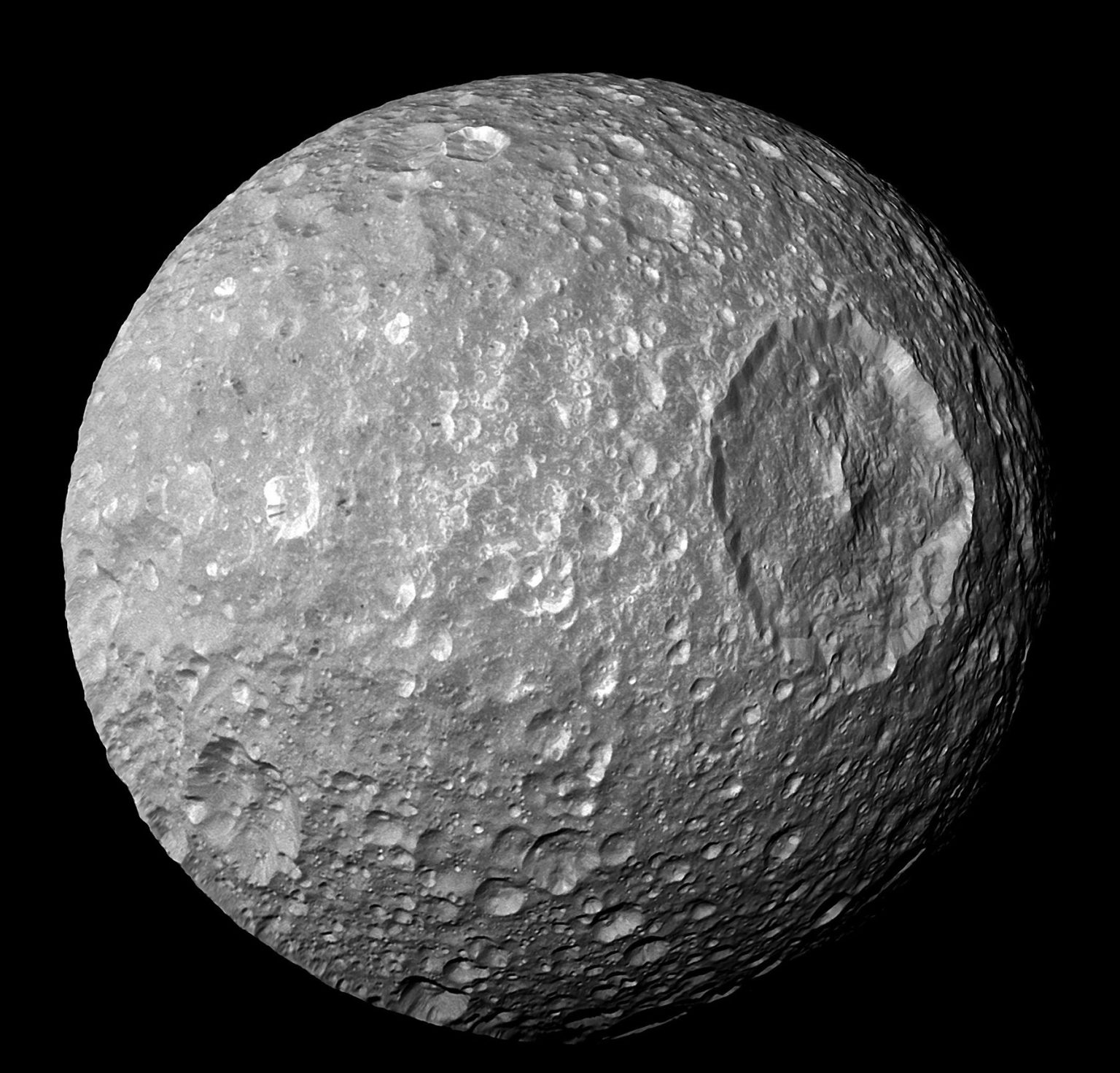
Mimas is less than 250 miles in diameter and covered with craters, including a very large crater that earned it the nickname “Death Star.” According to Rudolph, it appears geologically dead, but fluctuations in its motion indicate the presence of an ocean. Since Mimas’ icy shell is not expected to rupture as a result of its thinning, the presence of an ocean can be reconciled with a geologically dead surface.
Size of the moon and its effect on the ice shell
The size of these moons is important. On large icy moons such as Titania, another moon of Uranus, the drop in pressure from melting ice would cause the icy shell to crack before reaching the triple point of water, the team calculated. The authors believe that Titania’s geology may be the result of a period of ice shell thinning followed by thickening.
Rudolf says that just as Earth’s geology helps us understand why our planet looks the way it does after billions of years of change, understanding the geological processes on these moons can help us understand why they have the features they do.
According to phys.org

