

Magnets can greatly simplify oxygen production in space. An international team from the University of Warwick, ZARM (Bremen), and Georgia Tech has demonstrated that a conventional neodymium magnet can passively separate oxygen bubbles during water electrolysis in microgravity conditions — without centrifuges, moving parts, or additional energy consumption. In tests, magnetically induced convection improved the performance of PEM electrolyzer cells: an increase in current density of up to ~240% was recorded in microgravity, and passive gas-liquid separation was achieved, approximating Earth conditions. This paves the way for lighter and more reliable life support systems for long-term missions.

The key to the effect is the interaction of electric current and magnetic field (magnetohydrodynamic force) together with the magnetic buoyancy of the electrolyte, which directs gas bubbles to collection areas and detaches them from the electrodes. The current OGA system on the ISS relies on an energy-intensive RSA centrifuge and consumes up to ~1.5 kW, therefore a passive magnet-based design has the potential to reduce the mass and energy budget, as well as the number of failures. The next stage is testing in suborbital flights. The research was supported by DLR, ESA, and NASA.
The team emphasizes that off-the-shelf magnets are used, which simplifies the scaling of the technology. The project builds on previous ideas of magnetic phase separation in zero gravity and demonstrates their practicality in real electrolysers.
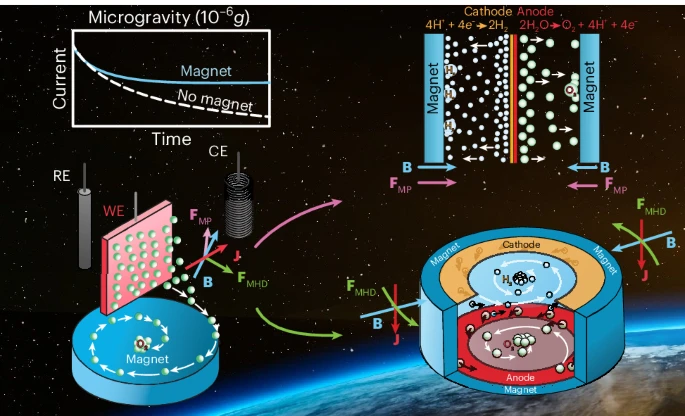
Simplified, economical oxygen production from water is critically important for long-term expeditions, lunar/Martian bases, and autonomous orbital observatories. Passive magnetic separation reduces the weight, energy consumption, and complexity of ECLSS, while increasing reliability and maintainability. In addition to providing breathable air for the crew, electrolysis produces hydrogen as a by-product, which can be used in fuel cells to power instruments and thermally stabilize telescopes, or as a component of rocket fuel within the ISRU framework, reducing dependence on resource delivery from Earth.
Oxygen in the atmosphere of an exoplanet is not always a sign of life: such signals can be created by geological processes, ultraviolet radiation, and even “dead” chemical reactions. Interested in learning how astronomers filter out false leads and what is truly considered a reliable biomarker? Learn about common pitfalls and modern verification methods in the article “Misleading biomarkers: how to discover life beyond Earth.”
According to nature, warwick, interestingengineering

