

For the first time in history, the European Solar Orbiter probe has captured the drift of the Sun’s magnetic field at its South Pole. It has managed to discover previously unknown details about the activity of our star.
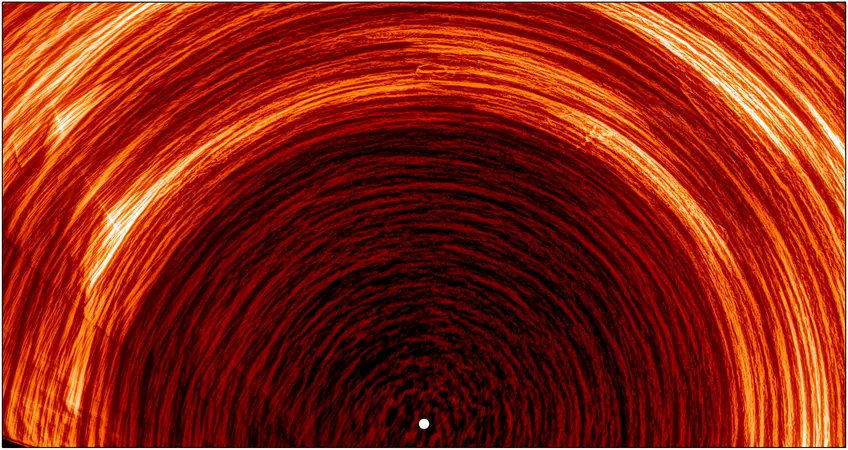
The Sun follows a strict rhythm. The Sun’s magnetic activity is cyclical, reaching a maximum approximately every eleven years. Two huge plasma circulations, one in each hemisphere of the Sun, set the pace for this rhythm. Near the surface, plasma flows carry magnetic field lines from the equator to the poles. In the interior of the Sun, plasma returns to the equator in a huge cycle that spans the entire hemisphere.
Important details of this solar “conveyor belt” are still poorly understood. The processes occurring at the Sun’s poles are likely to be of crucial importance. They cannot be seen from Earth. Therefore, scientists have only a superficial understanding of this area, which prevents them from determining the properties of the magnetic field. A similar limitation applies to the vast majority of space probes. However, there is one important exception: Solar Orbiter.
Solar Orbiter was launched in 2020 to study the Sun and the processes occurring on it. In 2024, the spacecraft performed an important maneuver that increased the inclination of its orbit to 17°. This gave it the best view of the Sun’s poles in the entire Solar System.
Researchers from the Max Planck Institute analyzed data collected by Solar Orbiter instruments in March 2025, when the spacecraft approached the perihelion of its orbit (43.4 million km from the Sun). It measured the direction of plasma flows and the magnetic field on the surface of our star.
The data provided the first detailed picture of supergranulation and the magnetic network at the Sun’s South Pole. Supergranules are cells of hot plasma, approximately two to three times the size of Earth, which densely cover the Sun’s surface. Their horizontal surface flows shift the magnetic field lines toward their edges, creating a kind of web.
To the surprise of researchers, it turned out that the magnetic field drifts toward the poles at an average speed of about 10–20 meters per second, which is almost as fast as at lower latitudes. Previous studies based on observations in the ecliptic plane suggested a much slower drift of the magnetic field near high polar latitudes. Its movement provides important clues about the global circulation of solar plasma.
The authors of the study figuratively compared the supergranules at the poles to a kind of tracer. They are the first to make visible the polar component of the Sun’s global 11-year circulation.
According to scientists, it is still unclear whether the Sun’s global magnetic conveyor belt is actually slowing down near the poles. The available data only shows a brief cross-section of the entire solar cycle. Additional observational data is needed, ideally covering longer periods of time.
According to mps.mpg.de

