

South Korean company Innospace carried out the first launch of its small rocket, HANBIT-NANO. It was unsuccessful. The rocket crashed shortly after launch.
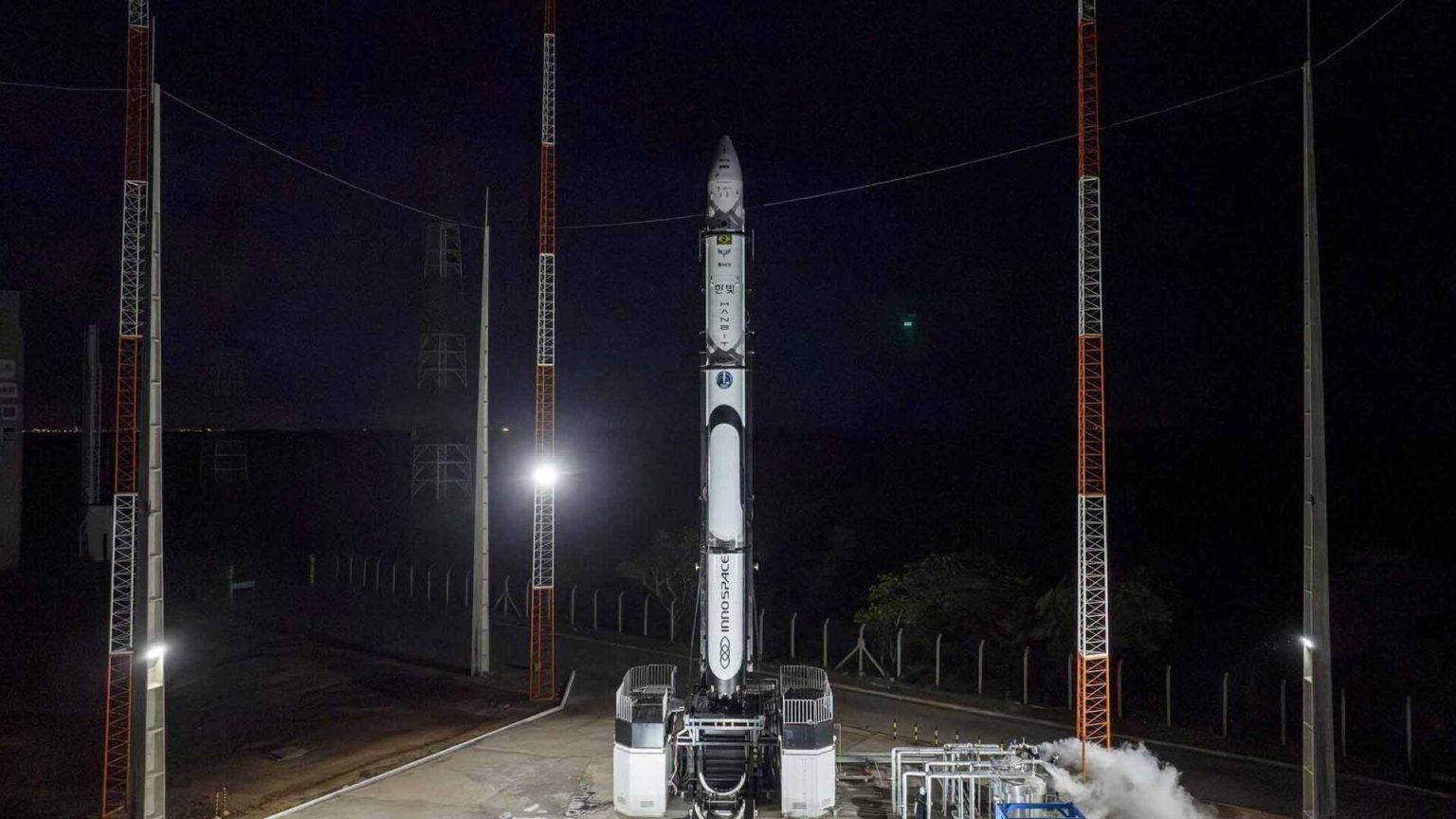
Innospace was founded in 2017. Like many other “new space” companies, it focused on developing a small launch vehicle designed to deliver small payloads into low Earth orbit. It was named HANBIT-NANO.
HANBIT-NANO has a two-stage design. It is 21.8 meters high and 1.4 meters in diameter, and can carry up to 90 kg of payload into a 500-kilometer sun-synchronous orbit.
The first stage of HANBIT-NANO is equipped with a hybrid engine running on a mixture of liquid oxygen and paraffin. The upper stage can be equipped with either a hybrid engine running on the same combination or a power unit using a methane-oxygen mixture. According to the company, this flexibility allows the rocket to be more effectively adapted to different tasks.
Innospace chose the Alcântara Space Center in Brazil as the launch site for its maiden flight. Its proximity to the equator allows rockets launched from there to be used as efficiently as possible, increasing their payload capacity. The payload consisted of five CubeSats, as well as several non-separable instruments and demonstrators.
Unfortunately, the first flight of HANBIT-NANO failed. Thirty seconds after launch, a fire was detected in the first stage. Shortly thereafter, the rocket crashed. There were no casualties or damage.
At this point, it is unknown what caused the accident. Despite the setback, Innospace has already stated that the first flight provided valuable data that will help improve the control system, engines, and overall reliability of the rocket.
We would like to remind you that the launch of the Japanese H3 rocket failed the day before. It resulted in the loss of an expensive navigation satellite.

