

Astronomers from the NOIRLab research center reported on a discovery made by the Gemini North telescope. It discovered a galaxy cluster significantly larger than previously thought.
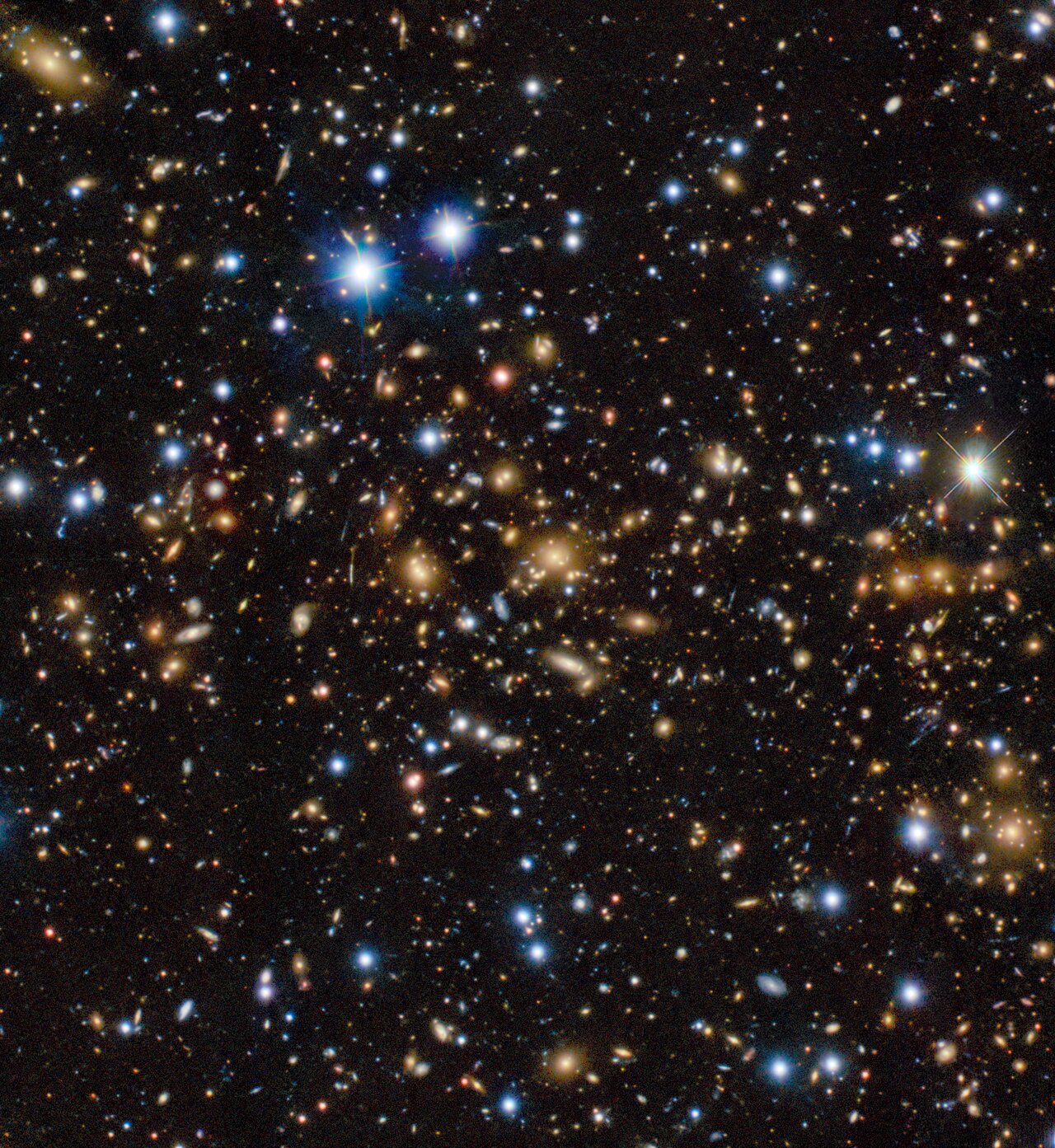
We are talking about the galaxy cluster MACS J0060.1-2008 (MACS0060). It is well known for its strong gravitational lensing. This means that the cluster has sufficient mass to warp space-time around itself and bend light rays from more distant objects.
Astronomers love to use such gravitational lenses in their work. Acting like a giant magnifying glass, they allow us to observe very distant and dim objects that would otherwise escape the attention of telescopes.
However, when researchers analyzed an image of the cluster obtained by the Hubble Space Telescope, they realized that the mass of the cluster determined from the image was too small to explain the strength of its gravitational lensing. To solve this mystery, they used the GMOS spectrograph mounted on the 8.1-meter Gemini North telescope.
During observations of the area near the region photographed by Hubble, astronomers concluded that MACS0060 is much larger than previously thought.What used to be considered the whole cluster is actually only a small part of it. As a result, astronomers gave it the unofficial nickname “the anglerfish” — in honor of the deep-sea creature that is often only partially visible, with most of its body remaining hidden.
Additional research will be required to determine the spatial boundaries of the cluster’s mass. But astronomers are already planning to use the gravitational lens they are creating to study galaxies in the early universe.
Earlier, we reported on a structure discovered by astronomers, which connects 14 galaxies like a rope.
According to NOIRLab

