

The James Webb Space Telescope (JWST) has discovered a young star that ejects crystals into the surrounding space. This explains a long-standing astronomical mystery.
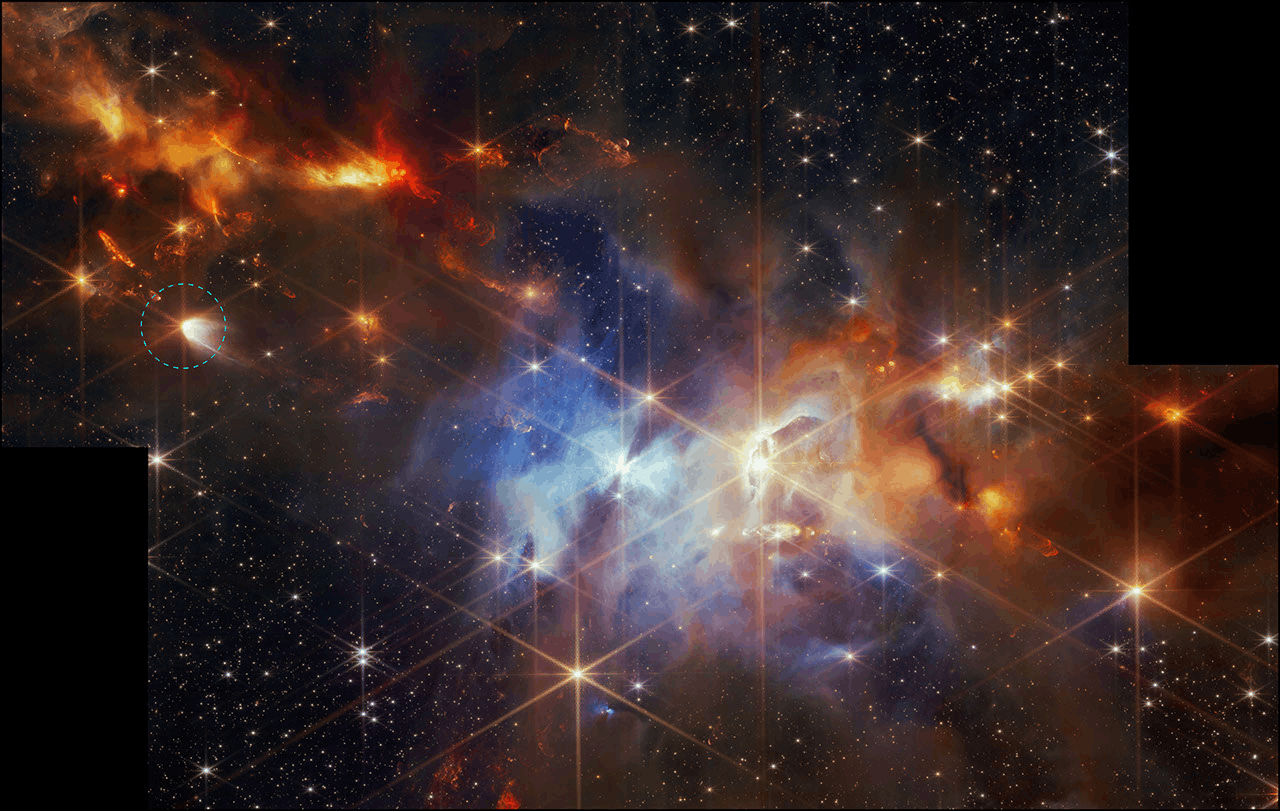
Astronomers have long sought to answer the question of why comets at the edge of our Solar System contain crystalline silicates. The fact is that intense heat is required for their formation, while these “dirty snowballs” spend most of their lives in the ultra-cold Kuiper Belt and Oort Cloud.
The answer to this question was obtained by JWST during observations of the protostar EC 53. This is a young, actively forming system located 1,300 light-years from Earth and part of the Serpens Nebula. Unlike other protostars, whose periods of activity are irregular or last for hundreds of years, EC 53 “lives” on a clear schedule. Approximately every 18 months, EC 53 enters a 100-day phase of powerful flares, completely absorbing nearby gas and dust while ejecting some of the absorbed material in the form of powerful jets and streams.
During JWST’s highly sensitive infrared observations, astronomers first identified specific elements and molecules in the protoplanetary disk around EC 53. They discovered that its hot inner region serves as a site for the formation of crystalline silicates.
After that, scientists waited for the next series of EC 53 flares. When they began, JWST detected narrow, high-speed jets of hot gas near the star’s poles and slightly cooler, slower streams emanating from the innermost and hottest region of the disk. Along this peculiar “highway,” crystalline silicates are transported to the cold edge of the protoplanetary disk, where comets will eventually form.
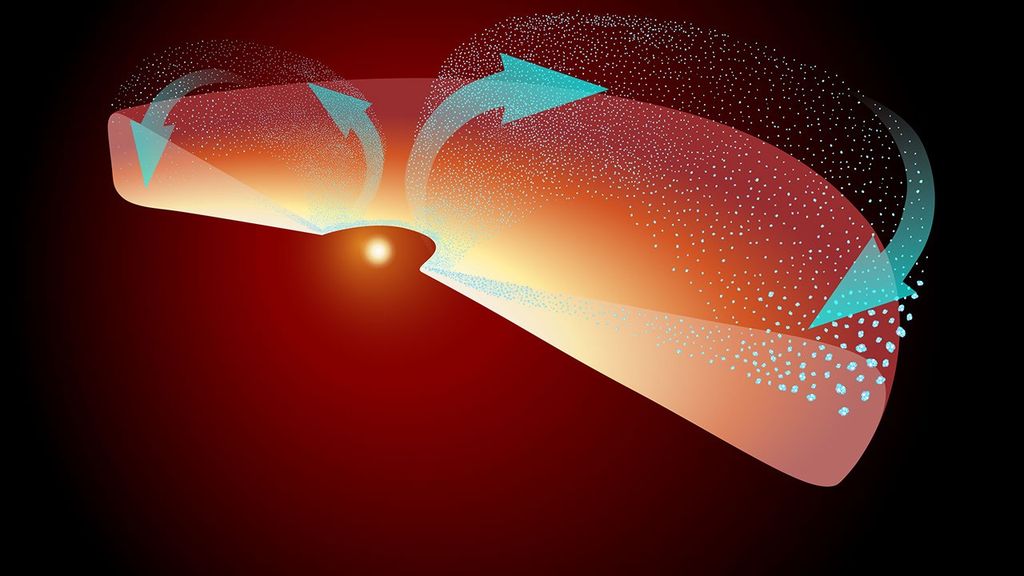
EC 53 is still “shrouded” in dust and will likely remain in this state for another 100,000 years. Over millions of years, while the disk of a young star is densely populated with tiny grains of dust and pebbles, countless collisions will occur, which may gradually form a series of larger rocks, ultimately leading to the formation of rocky and gaseous planets. As the disk settles, the dust will mostly dissipate, leaving a sun-like star at the center of a cleared planetary system, “littered” with crystalline silicates.
According to NASA

