

Astronomers working with the Hubble Telescope have published a new image. It shows the galaxy NGC 2835, which is relatively close to the Milky Way.
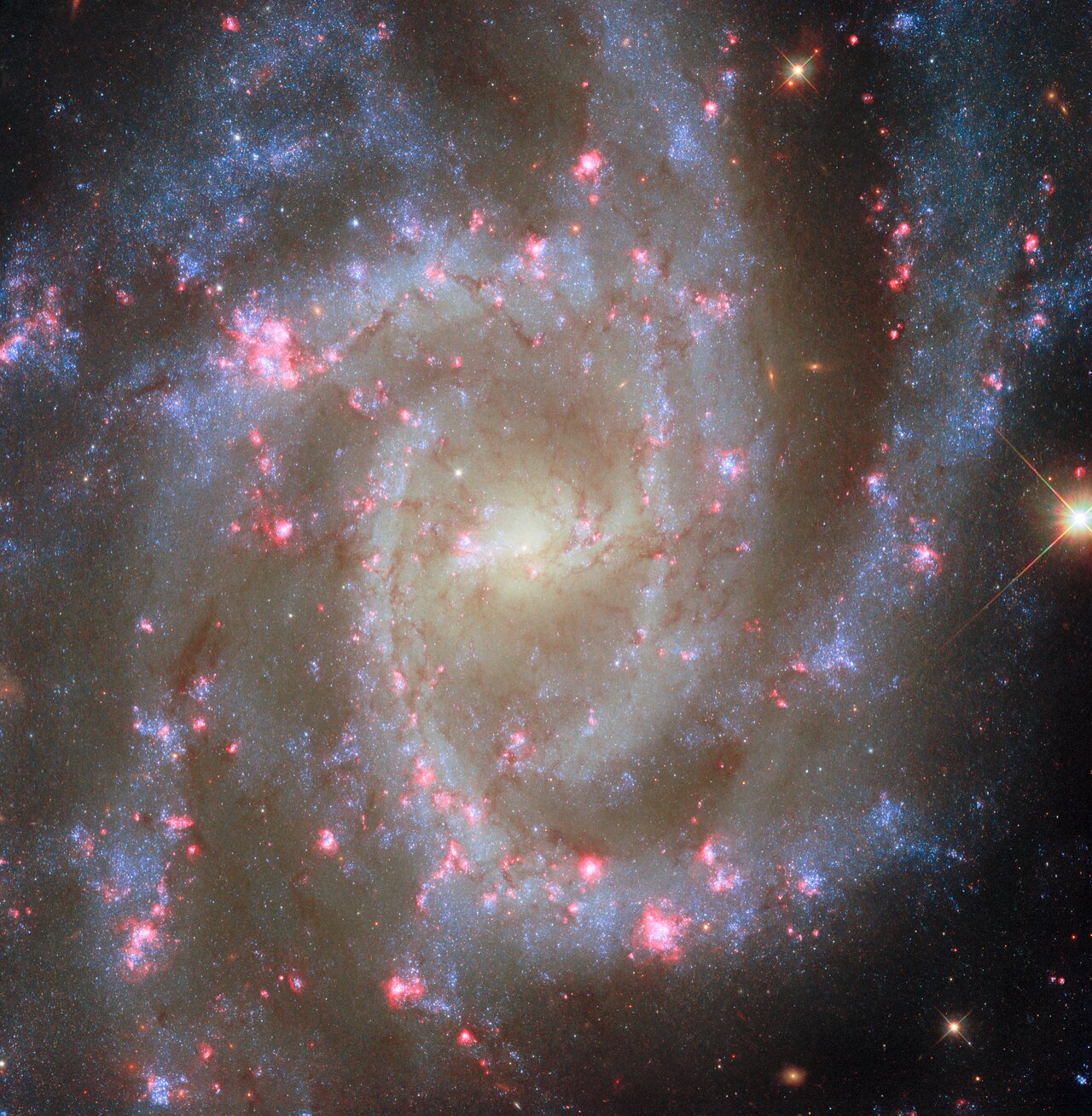
NGC 2835 is located 35 million light-years from Earth in the direction of the constellation Hydra. It is classified as a transitional spiral galaxy: such objects occupy an intermediate position between galaxies with a bar, such as our own, and galaxies without it. Its diameter is 65,000 light-years. Thus, NGC 2835 is significantly smaller than the Milky Way.
NGC 2835 has already been captured by space telescopes in the past: in 2020, it was photographed by Hubble, and a few years later by James Webb. The new image differs from previous ones in that it includes data at a wavelength of 656.28 nm, also known as H-alpha. It corresponds to the red light emitted by ionized hydrogen atoms.
In the Hubble photo, you can see dozens of bright pink regions scattered across the spiral arms of NGC 2835, resembling blooming flowers. Most of them correspond to regions of active star formation, where new stars are being born right now. However, H-alpha radiation can also occur during the final stages of a star’s life cycle. Its sources include planetary nebulae and supernova remnants.
According to astronomers, a supermassive black hole is hidden at the center of NGC 2835. Its mass is comparable to that of the black hole at the center of the Milky Way and ranges from 3 to 10 million solar masses.
Earlier, we reported on how Hubble photographed a low-luminosity galaxy.
According to Esahubble

