

Today, we take for granted the ability to take the perfect selfie or capture a breathtaking sunset video that conveys every detail and color. But few people know that the quality of modern mobile photography is based on technology that originated far beyond Earth. The story of how an innovation created for deep space exploration ended up in everyone’s pocket is a fascinating journey from the limitations of the legendary Hubble to a breakthrough at the Jet Propulsion Laboratory.
For decades, the main instrument of the Hubble Space Observatory was CCD sensors (charge-coupled devices). The principle of their operation resembled a conveyor belt: each pixel accumulated an electrical charge from the incident light, after which this charge was transferred from pixel to pixel, like a baton, to a single amplifier at the edge of the matrix. There it was transformed into voltage, forming an image.
Despite its effectiveness, CCD technology had significant drawbacks for space exploration. It was extremely vulnerable to radiation — harsh radiation created noise and defects in the images. In addition, these sensors consumed a lot of energy and cost a fortune, which limited their use in long-term missions.
Invention that changed the present
The situation changed when engineer Eric Fossum joined NASA’s Jet Propulsion Laboratory. He was tasked with improving existing CCD matrices. Instead, Fossum took a bold step: he turned his attention to an alternative technology — CMOS sensors (complementary metal-oxide-semiconductor), which at the time were considered too “noisy” for high-quality photography.
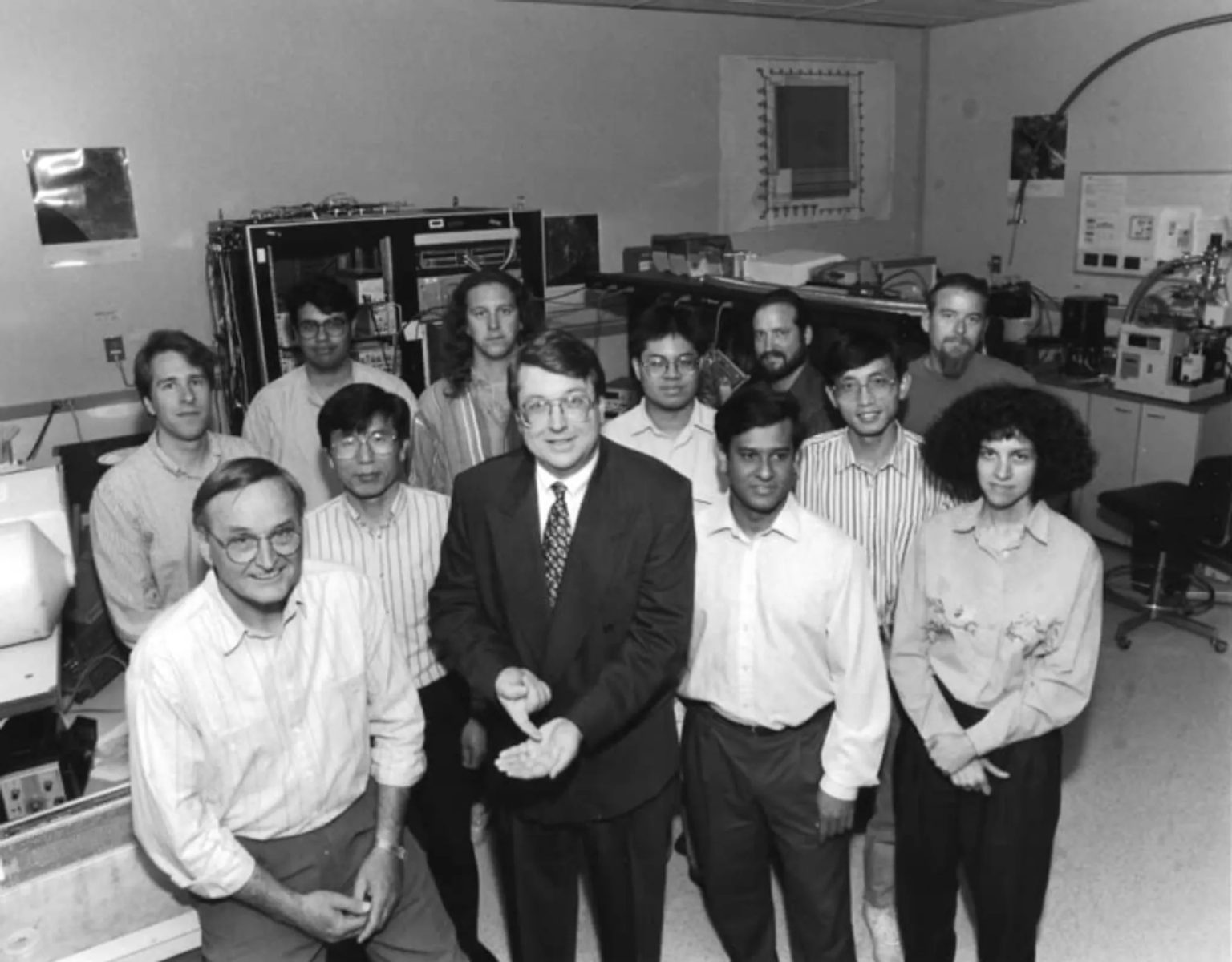
The engineer borrowed a brilliant idea from the world of CCDs — the method of intra-pixel charge transfer with correlated double sampling. This approach made it possible to measure the noise level directly in each pixel and instantly subtract it from the useful signal. The noise disappeared, giving way to a clear, high-contrast image with a high signal-to-noise ratio.
This is how the active pixel sensor based on CMOS was born — a true “camera on a chip.” Unlike CCDs, each pixel here has its own amplifier, which allows information to be read in parallel and at lightning speed.
From satellites to smartphones
The technology proved so revolutionary that it went far beyond space programs. CMOS sensors were more compact, energy efficient, and significantly cheaper to mass produce than their predecessors. NASA did not keep the development secret — on the contrary, the agency actively collaborated with commercial companies, licensing the technology.
This partnership changed the world. Today, the descendants of Fossum’s space invention are working everywhere:
- In the cameras of smartphones, which we use to take photos every day;
- In automotive night vision and parking systems;
- Video surveillance systems;
- In medicine — in the form of tiny capsule pills that patients swallow for intestinal diagnosis;
- In laptop webcams;
- In professional photography equipment.
What was once created to capture distant galaxies now helps us see the world around us in the highest quality. The history of the CMOS sensor is a striking example of how solving complex space problems can unexpectedly improve the daily lives of billions of people, proving that space is indeed much closer than it seems.
Earlier, we talked about the Top 7 space technologies of 2026 that could change the future.
According to NASA

