

For two decades, astronomers have puzzled over how supermassive black holes—some of the brightest objects in the Universe—could have existed less than a billion years after the Big Bang. Ordinary stars simply could not create such massive black holes quickly enough.
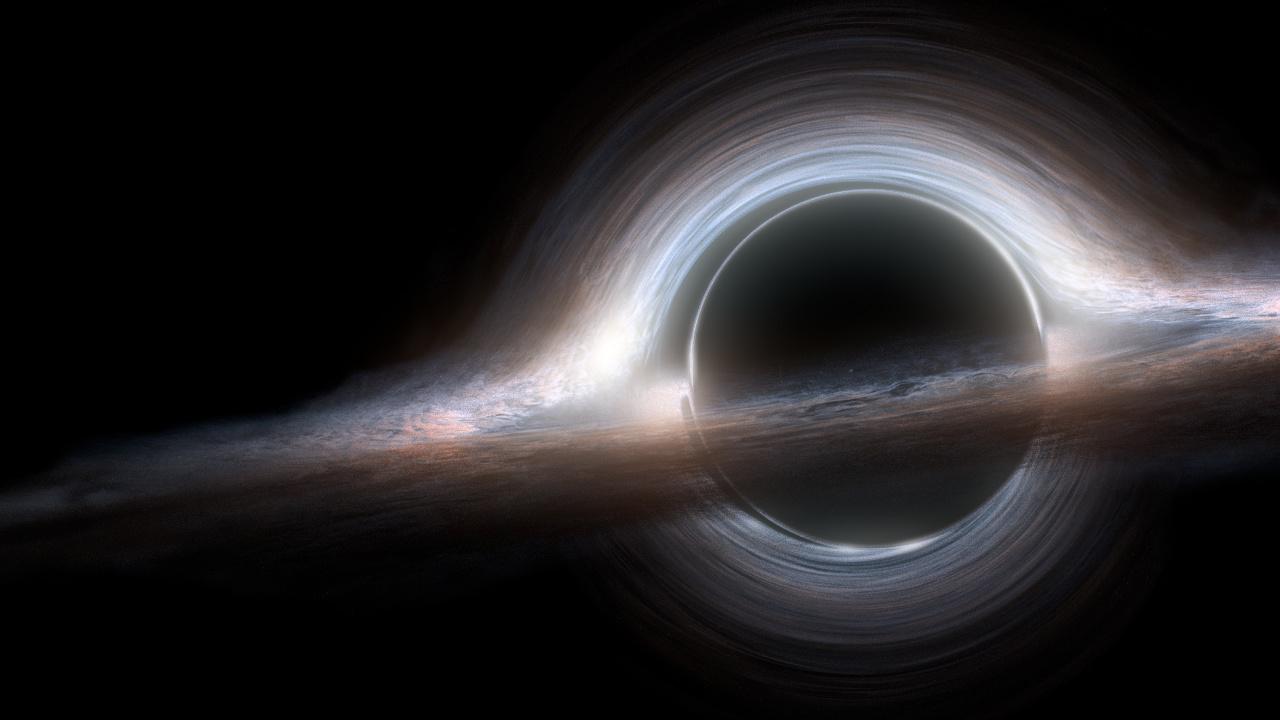
Now, using the James Webb Space Telescope (JWST), an international team of scientists has found the first convincing evidence that solves this cosmic mystery: in the early Universe, there were “monster stars” whose mass was 1,000 to 10,000 times greater than that of our Sun.
Discovery in a distant galaxy
The breakthrough came thanks to the study of chemical traces in the galaxy GS 3073. The international team of scientists discovered an extreme imbalance of nitrogen and oxygen that cannot be explained by any known type of star.
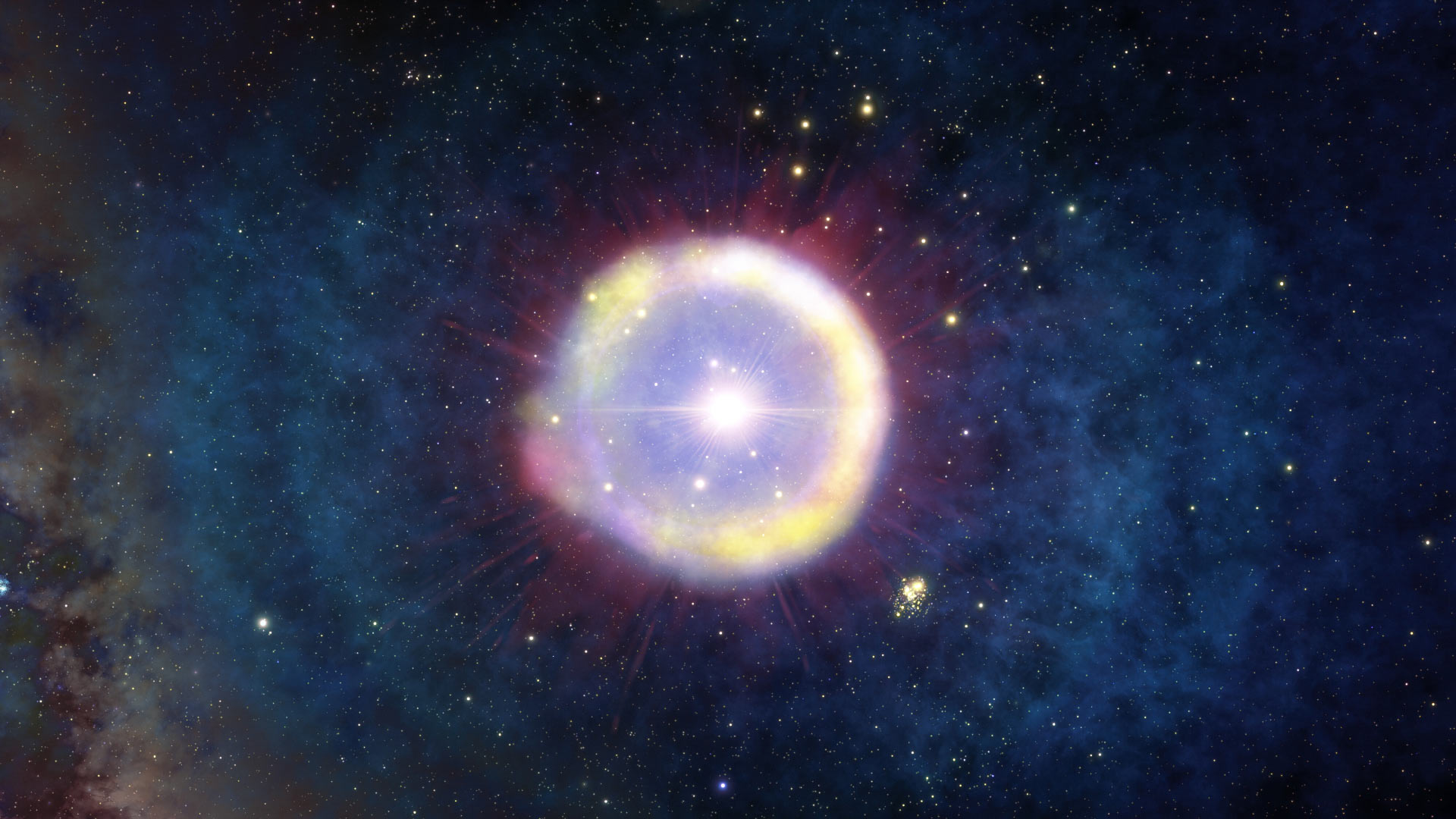
In 2022, researchers published a paper in Nature predicting that supermassive stars formed naturally in rare turbulent flows of cold gas in the early Universe, explaining how quasars (extraordinarily bright black holes) could have existed less than a billion years after the Big Bang.
These cosmic giants probably shone brightly for a short time before collapsing into massive black holes, leaving behind chemical traces that we can detect billions of years later. By astronomical standards, they lived for just a moment—a mere quarter of a million years.
The key to the discovery was measuring the ratio of nitrogen to oxygen in GS 3073. In the galaxy, the ratio of nitrogen to oxygen is 0.46, which is much higher than can be explained by any known type of star or stellar explosion.
According to scientists, the ratio of elements observed in GS3073 is completely unlike anything that ordinary stars can produce. Its extreme nitrogen content corresponds to only one source known to us—primordial stars that were thousands of times more massive than our Sun. This tells us that the first generation of stars included truly supermassive objects that helped form early galaxies and may have given rise to today’s supermassive black holes.
Life and death of giant stars
Researchers simulated how stars with masses ranging from 1,000 to 10,000 solar masses would evolve and what elements they would produce. They discovered a specific mechanism that creates enormous amounts of nitrogen:
- Huge stars burn helium in their cores, producing carbon.
- Carbon penetrates the surrounding shell, where hydrogen is burned.
- Carbon combines with hydrogen to form nitrogen as a result of the carbon/nitrogen/oxygen (CNO) cycle.
- Convective flows distribute nitrogen throughout the star.
- Eventually, this nitrogen-rich material is ejected into space, enriching the surrounding gas.
This process continued for millions of years during the star’s helium burning phase, creating the excess nitrogen observed in GS 3073.
The first supermassive black holes
The models created by researchers also predict what happens when these giant stars die. They do not explode, but collapse directly into massive black holes weighing thousands of times the mass of the Sun. Interestingly, GS 3073 contains an actively feeding black hole at its center — possibly the remnant of one of these supermassive first stars. If this is confirmed, two mysteries will be solved at once — where the nitrogen came from and how the black hole formed.
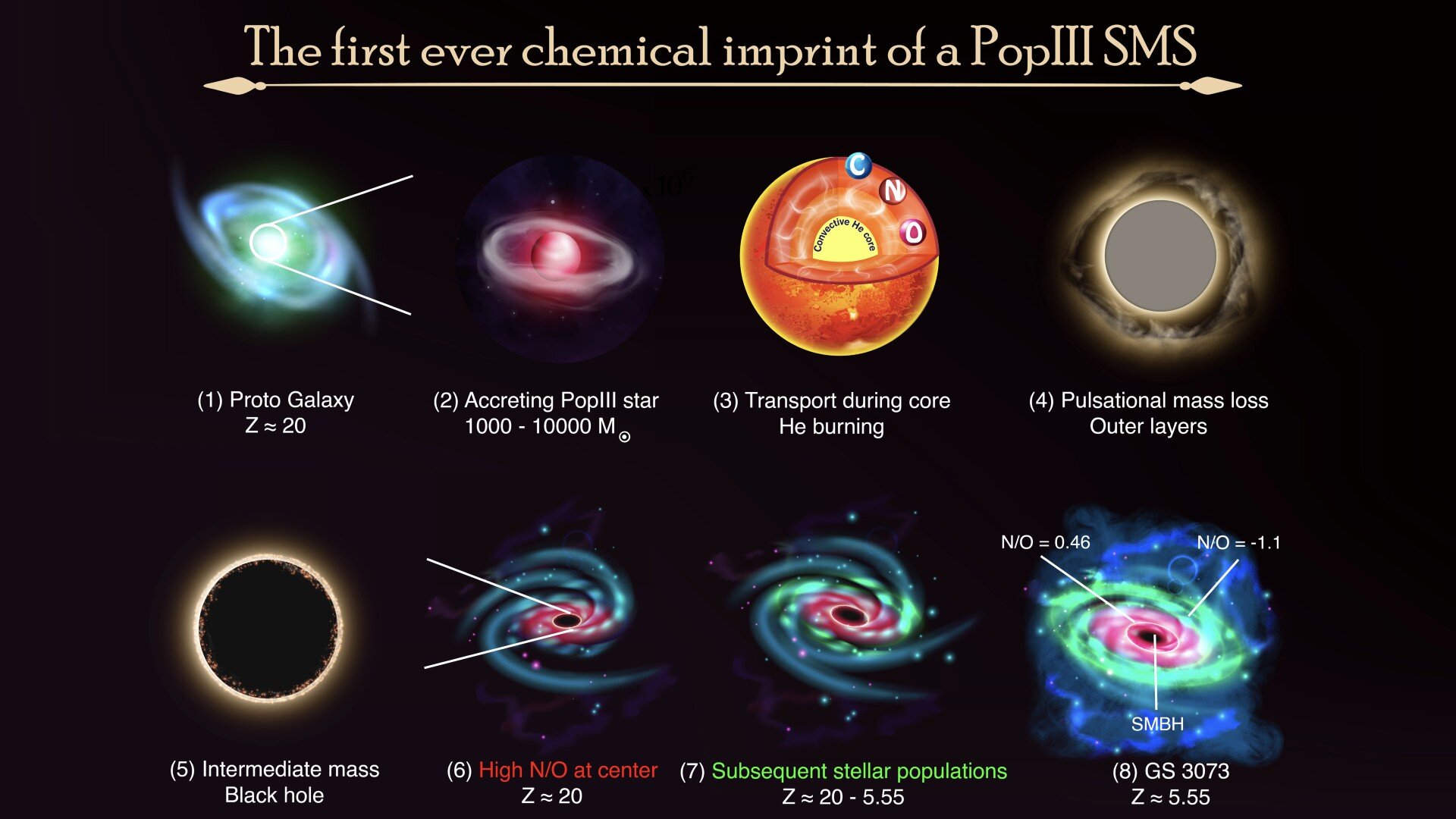
The study also showed that this nitrogen signature only appears in a certain mass range. Stars with masses less than 1,000 solar masses or greater than 10,000 solar masses do not produce the right chemical composition for this signature.
The discovery sheds light on the first few hundred million years of the Universe’s existence — a period astronomers call the “dark ages,” when the first stars lit up and began transforming the simple chemistry of the early Universe into the rich variety of elements we see today.
Researchers predict that JWST will discover more galaxies with similar nitrogen excesses as it continues to explore the early Universe. Each new discovery will strengthen the case for the existence of these supermassive first stars.
According to port.ac.uk

