

Astronomers at the University of Warwick have announced the discovery of an unusual star system. It has a structure that turns our understanding of planet formation upside down.
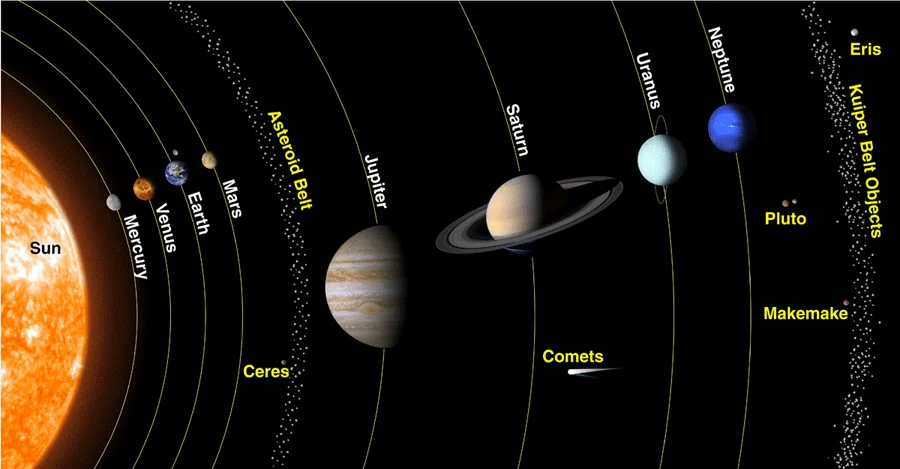
The Solar System has a clear hierarchy: rocky planets (from Mercury to Mars) are located in its inner part, while gas giants (from Jupiter to Neptune) are located in its outer part. This planetary structure — rock first, then gas — is observed throughout the Milky Way. That was the case until an international group of scientists took a closer look at a red dwarf star called LHS 1903. Their observations revealed a system of four planets that broke this pattern.
Four planets of LHS 1903
The planets around LHS 1903 are in the following order: first a rocky planet located at a short distance from the star, followed by two gas planets, which corresponds to the expected planetary structure. However, with the help of the CHEOPS satellite, astronomers have discovered a fourth planet at the outer edge of the system. It is rocky, not gaseous.
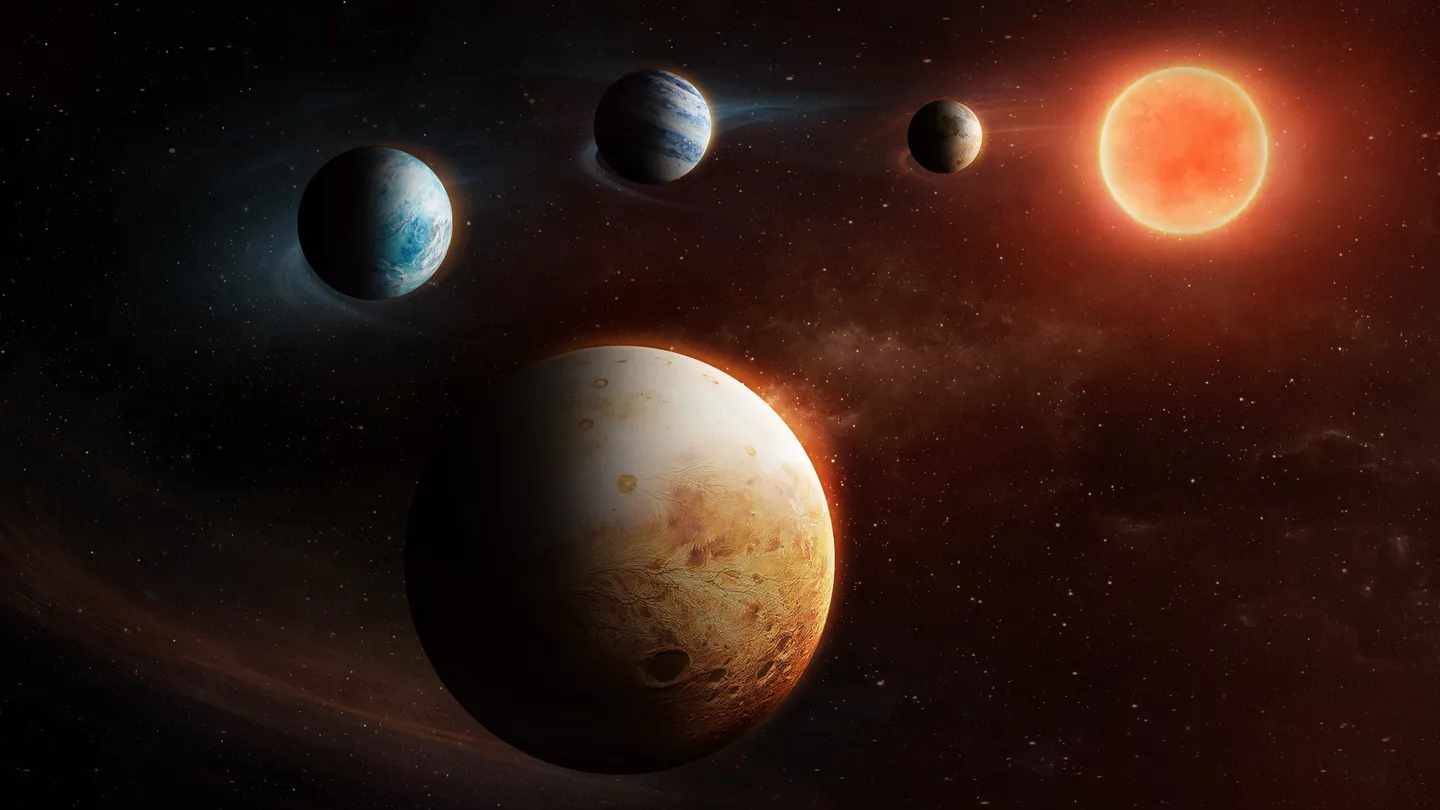
“This strange disorder makes it a unique inside-out system,” said one of the study’s authors, Dr. Thomas Wilson, associate professor of physics at the University of Warwick. “Rocky planets don’t usually form far away from their home star, on the outside of the gaseous worlds.”
Traditional models suggest that planets closest to stars are rocky because stellar radiation strips away their gaseous atmospheres, leaving dense, solid cores. Gas giants form further out, in colder regions where gas can accumulate and planets can retain it. However, the distant rocky world orbiting LHS 1903 appears to have either lost its gaseous atmosphere or never formed one.
Forming one by one
After this amazing discovery, scientists began searching for explanations of how this lonely rocky planet was formed. Could it have switched places with another planet? Or did it lose its atmosphere as a result of a collision?
Scientists have ruled out these theories. Instead, they found evidence that the four planets did not form simultaneously, as might be expected, but one after another in a process called “inward planet formation.”
If LHS 1903 formed its four planets one after another, from the inside to the outside, rather than simultaneously, then each of them developed in sequence, sweeping away nearby dust and gas and leaving more distant worlds to wait their turn. In this case, by the time the last planet was born, there was no gas left in the system, which is considered vital for the formation of planets.
This small, rocky outer planet could be either a strange exception or the first key to a new understanding of the evolution of planetary systems. In any case, the discovery requires an explanation that goes beyond existing ideas about how planets form.
Earlier, we reported on how artificial intelligence found 7,000 candidate planets.
According to University of Warwick

