

In June, a burning fireball appeared over Atlanta, Georgia, USA — it was a meteor weighing about a ton. It exploded in the air, and one of its fragments, the size of a cherry, pierced the roof of a house in the town of McDonough.
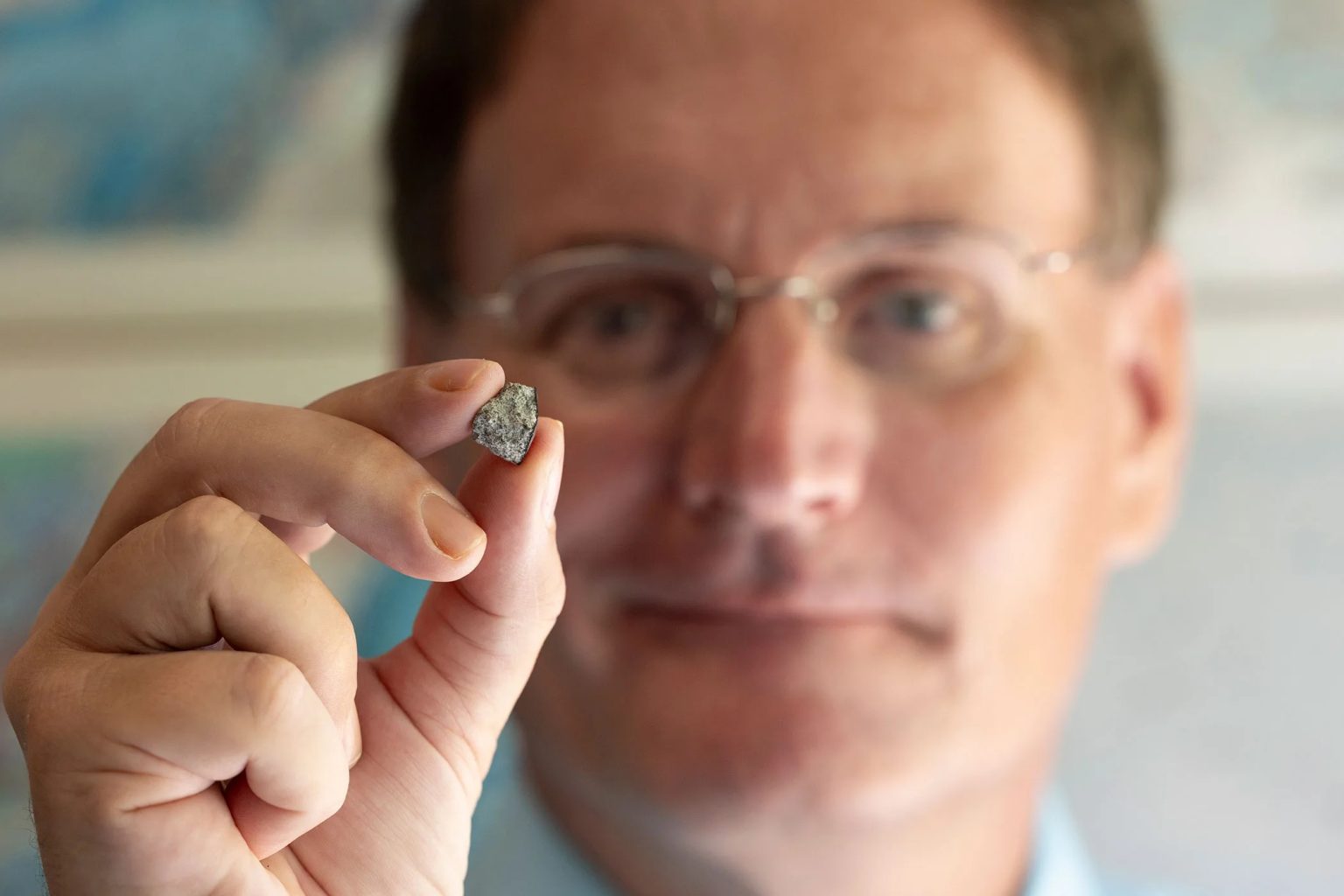
Researchers from the University of Georgia have discovered that this space rock is more than 4.56 billion years old — 20 million years older than the Earth.
Geologists analyzed 23 grams of debris using electron microscopes. It turns out that the meteorite belongs to a group of ordinary chondrites with low metal content. It probably broke off from a large asteroid in the main belt between Mars and Jupiter about 470 million years ago.
“This space rock traveled a long way before it ended up on Earth,” explained geologist Scott Harris.

The meteor entered the atmosphere at supersonic speed, causing powerful sonic booms. At an altitude of 50 km, it exploded with a force equivalent to 20 tons of TNT and broke into many small pieces. The fragment that fell on the residential building could have made three sounds at once: the impact on the roof, the sound wave, and the fall to the floor. The owner of the house said that he still found cosmic dust in his living room.
Rare phenomenon
The McDonough meteorite was Georgia’s 27th find and only the sixth documented fall. According to Harris, this used to happen once every few decades, but thanks to modern technology and people’s attentiveness, meteorites are now found more often.
Studying the meteorite will help scientists better understand the risks posed by larger asteroids. “One day, something big could fall and cause a catastrophe. We want to be prepared,” Harris noted.
The meteorite will remain at the University of Georgia for further study, and the results of the research will be published in scientific journals.
We previously reported that death from an asteroid fall was more likely than death from a lightning strike.
According to uga.edu

