

NASA has published the first infrared map made by the SPHEREx telescope. It shows the sky in 102 colors.
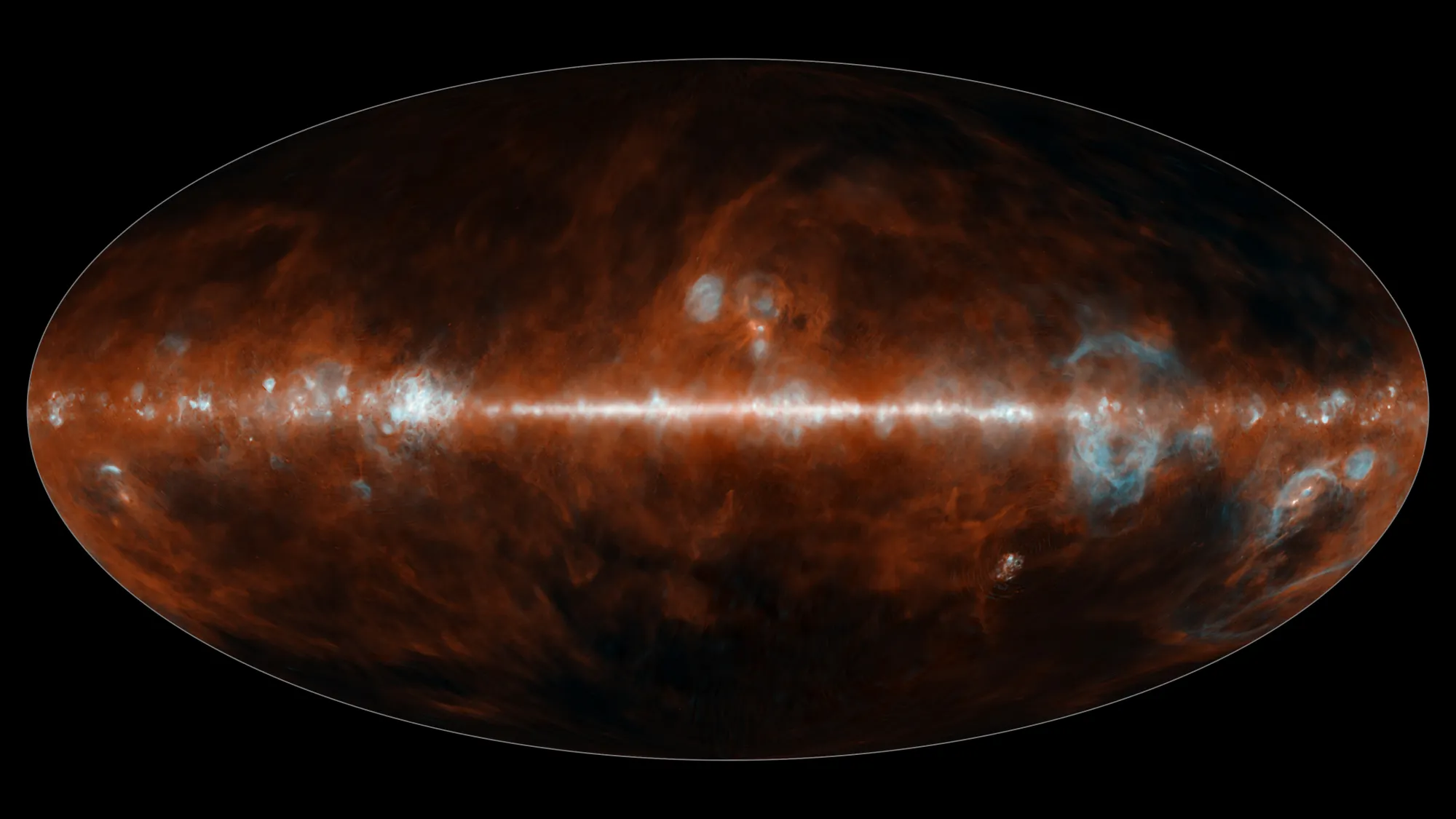
SPHEREx was launched on March 11, 2025. The spacecraft is equipped with an infrared telescope with a 20-centimeter mirror. Its key difference from the James Webb Telescope, which has a mirror that is orders of magnitude larger, is its field of view. SPHEREx is capable of observing an area of the sky equivalent to 20 full moons.
The spacecraft is in a polar orbit around Earth. Every day, it takes about 3,600 images along a single circular strip of sky. As the Earth moves around the Sun, SPHEREx’s field of view shifts. As a result, over six months, the observatory surveyed space in all directions, capturing the entire sky in 360 degrees. The result is an infrared map in 102 colors.
Each of these 102 colors represents a wavelength of infrared light containing unique information about galaxies, stars, star-forming regions, and other cosmic objects. For example, dense dust clouds in our galaxy, where stars and planets are formed, emit light brightly at certain wavelengths but do not emit light at others.
In the past, NASA missions have already conducted infrared surveys of the entire sky, but none of them have done so in as many colors as SPHEREx. And although James Webb sees many more wavelengths of light, it has a field of view that is thousands of times smaller and is unable to map the entire sky.
During its two-year primary mission, SPHEREx will perform three more scans of the entire sky. Combining its maps will increase the sensitivity of the measurements. Scientists plan to use the mission’s data to measure the distance to hundreds of millions of galaxies. Although the positions of most of them have already been mapped in two dimensions by other observatories, the SPHEREx map will be three-dimensional, allowing scientists to measure subtle variations in the ways galaxies are grouped and distributed throughout the Universe.
This data will provide insight into the event that occurred in the first fraction of a second after the Big Bang. At that moment, known as inflation, the Universe expanded a trillion times. Nothing like this has happened in the Universe since then, and scientists want to better understand this phenomenon.
SPHEREx will also explore our Milky Way galaxy in search of hidden reservoirs of frozen water ice and other molecules, such as carbon dioxide, that are essential for life as we know it. In addition, astronomers hope to learn more about the icy objects lurking at the edge of our Solar System. This could shed light on how water came to Earth.
According to NASA

