

The red dwarf LHS 1903, located not far from the star, has four planets. Scientists were intrigued by the fact that the outermost one is rocky rather than a gas giant. This contradicts established theories of star system formation.
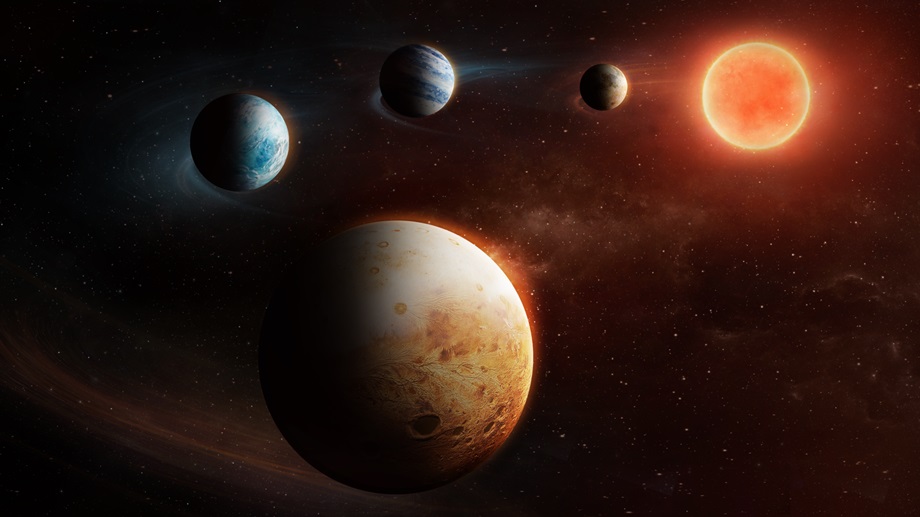
Star LHS 1903
LHS 1903 is a red dwarf located 116 light-years from Earth in the constellation Lynx. It is a tiny star several times smaller and lighter than the Sun. Recently, it has been the subject of research by a team led by Professor Ryan Cloutier of McMaster University and Professor Thomas Wilson of the University of Warwick.
The fact is that, according to the generally accepted theory, the formation of planetary systems should occur in the same way for all stars — both the Sun and LHS 1903 in particular. First, there is a gas and dust disk in which collisions and growth of bodies occur. At the same time, the star’s radiation “blows” gases from the inner to the outer part of the system.
The example of the Solar System clearly shows what this leads to: closer to the sun are rocky planets such as Earth and Mars, while gas giants such as Saturn and Uranus are located on the outskirts.
Other star systems also generally confirm this theory, although they quite often contradict it. They contain “hot Jupiters” — gas giants located close to their stars — but a theory has long been developed to explain their existence: the migration of worlds in the early stages of development.
Interestingly, the LHS 1903 system has been considered until now as a case confirming the generally accepted theory. Of its three planets, the closest to the star was rocky, followed by two gas giants. At first glance, everything seemed fine.
The fourth planet
But then new research from the CHEOPS satellite appeared, and they found LHS 1903 e. Being farther from the star than the previous three, it was rocky. In other words, its very existence challenged conventional wisdom.
Furthermore, explaining the outward migration of a light planet is much more difficult than explaining the inward migration of a gas giant. In a new study, scientists have proposed a way to resolve this contradiction: it is quite possible that the worlds of LHS 1903 formed differently than in most systems.
The general scheme remains familiar — a gas and dust disk, from whose inner regions the star’s radiation removes volatile substances. The difference is that the particles do not stick together simultaneously throughout the entire volume, but are delayed at the periphery. As a result, the second and third planets could have formed when there was still a lot of gas around, while the fourth formed after it had disappeared.
According to phys.org

