

The American company BRINC has unveiled Guardian—a new drone for 911 services equipped with integrated Starlink connectivity, a robotic battery replacement system, and the ability to operate with virtually no downtime between missions. The company is positioning it as the next step in the “Drone as First Responder” concept—that is, a drone being the first to arrive at the scene of an incident.
Guardian features the Starlink satellite service. BRINC calls it the first drone of its kind with built-in Starlink connectivity, which enables a data link in areas where there is no reliable cellular or ground-based infrastructure. The system will also be integrated into the Motorola Solutions ecosystem: command center software will be able to more quickly identify the type of incident and determine whether to send a drone carrying medical or other supplies even before ground crews arrive.
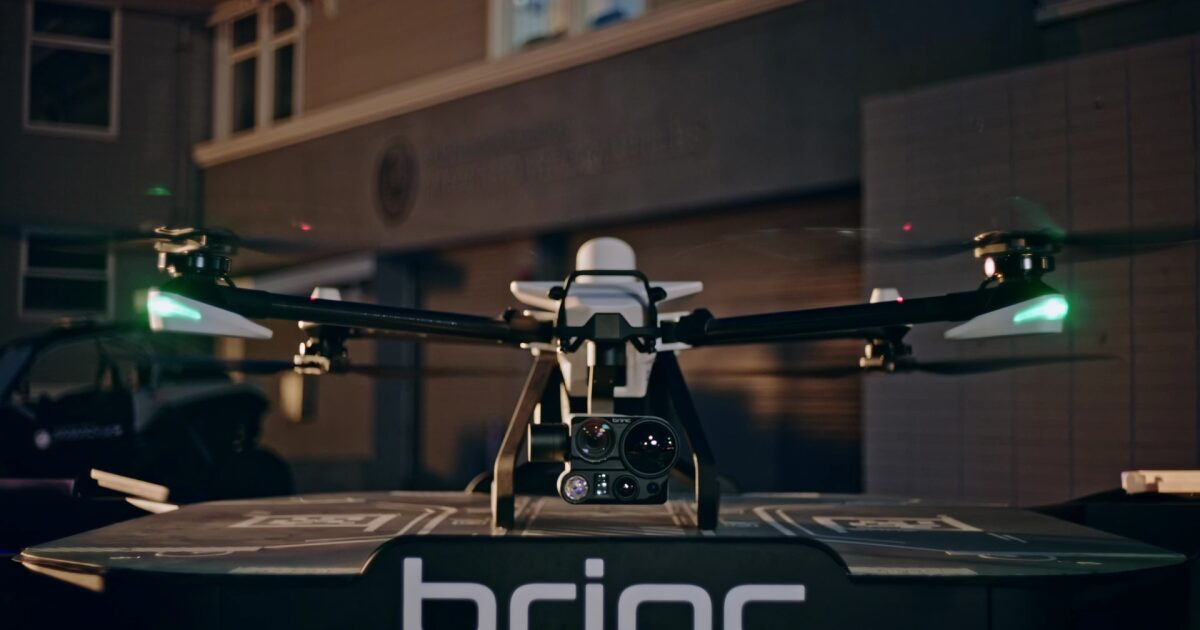
According to BRINC, the Guardian can respond to calls from a distance of up to 8 miles—or approximately 12.9 km—stay in the air for up to 62 minutes, and reach speeds of up to 60 miles per hour, or about 97 km/h. It’s not just about speed: the device features a 4K camera, thermal imaging modules, a laser rangefinder, a spotlight, and a loudspeaker. Its key feature is that it works in tandem with the Guardian Station, which automatically replaces batteries and selects the appropriate medical device, such as a defibrillator, a water rescue device, or Narcan. According to the company, this enables virtually round-the-clock availability without the need for constant human intervention.
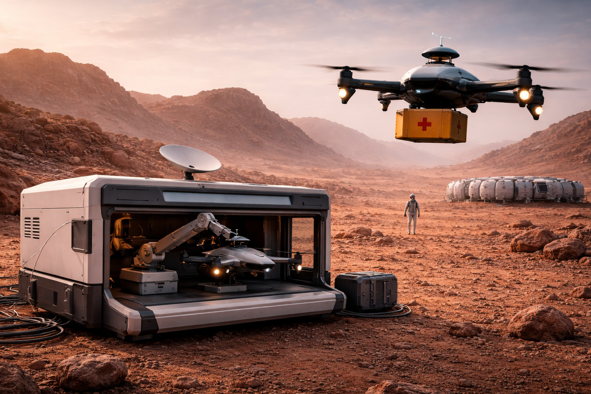
How does it work? Simply put, it’s a drone in a box. It is kept in a special station on the roof or near the base, receives a command, takes off on a mission, transmits video via standard mobile networks or Starlink, and upon its return, the station quickly replaces the battery and prepares the drone for its next flight. If necessary, the system can load the required equipment onto the drone before takeoff—for example, a defibrillator or a life buoy.
Why is this important? Although Guardian was designed for emergency services on Earth, it clearly demonstrates the principles underlying future space systems: autonomous operation, modular payloads, redundant communication channels, and the ability to operate in remote areas. These are precisely the principles needed for robotic platforms near lunar bases, Martian stations, or ground-based astronomical observatories in hard-to-reach locations, where the vehicle has to recharge itself, take on new equipment, and head out on another mission.

