

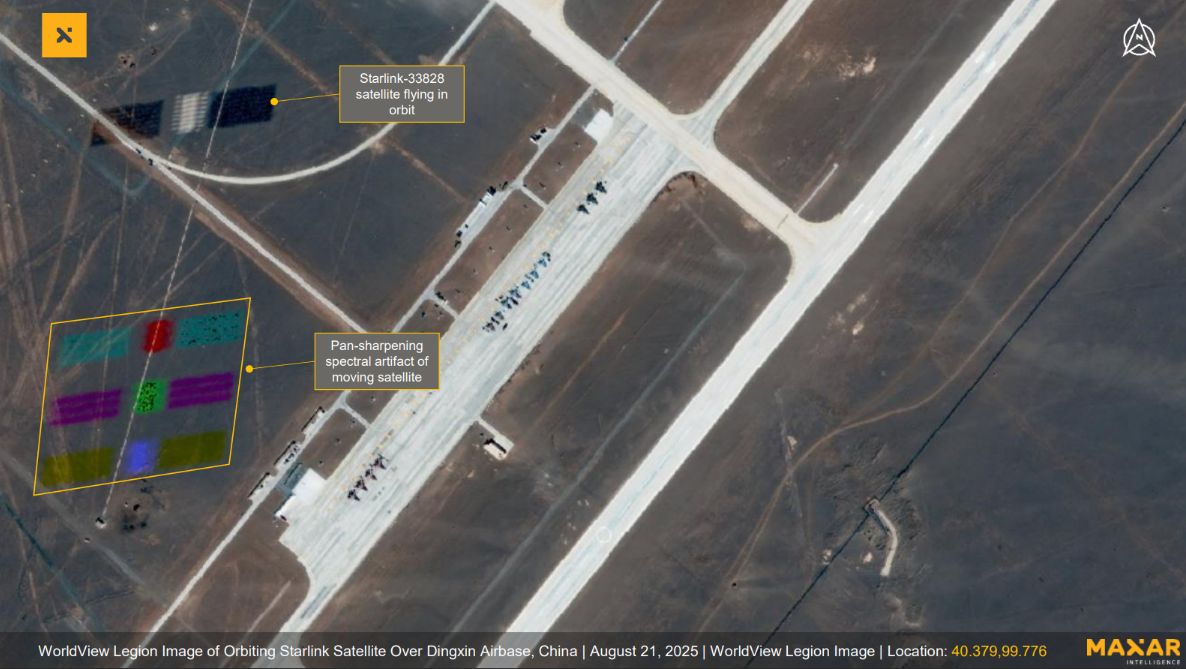
Maxar General Manager Susanne HakeSusanne Hake published an interesting photo taken by one of the company’s satellites. It may seem that the rainbow spots on it are an image defect. But in reality, it is one of the satellites belonging to the Starlink group, which accidentally appeared in the frame during filming.
Starlink is the largest satellite constellation in history. At present, it consists of more than 8,000 active devices — and continues to grow rapidly. Many astronomers regularly complain about the interference they cause to observations. Starlink satellites are also regularly captured in long-exposure photographs taken by astronauts aboard the ISS.
Now one of the Starlink satellites has been captured in a photo taken by the Maxar satellite. It was taken on August 21, 2025. The target of the shoot was the secret Chinese airbase in Dingxin. It is located in the Gobi Desert and is used as a testing ground for various equipment and pilot training. Because of this, it is sometimes referred to as China’s Area 51.
The Starlink satellite captured in the frame has the serial number 33828. It was launched on April 7, 2025. It is currently in a 480-kilometer orbit with an inclination of 53.2°. At the time of the photograph, it was 71 km away from the Maxar satellite, moving relative to it at a speed of 1.4 km/s.
The image of Starlink-33828 turned into a set of multicolored spots due to the characteristics of the shooting. Essentially, the visualization system combined high-resolution black-and-white data with color data as Starlink flew by at high speed. Physics has transformed a technical problem into what could be called an example of modern art.
At present, such satellite “photobombs” are still quite rare occurrences. As the number of spacecraft increases, they will occur more and more frequently. It is worth noting that such image artifacts are fairly easy to detect in databases and therefore may have practical applications. In the past, Planet used them to search through its satellite images for all high-altitude Chinese spy balloons and track their path to their launch site in China.
Earlier, we reported on how Maxar published a record-breaking detailed photograph of a Chinese spy satellite.

