

SpaceX’s super-heavy Starship rocket successfully completed its twelfth test flight. Overall, it can be considered a success, as the new V3 version was indeed able to launch Starlink satellite mockups into orbit. However, the mission did not go entirely according to plan.
Successful launch
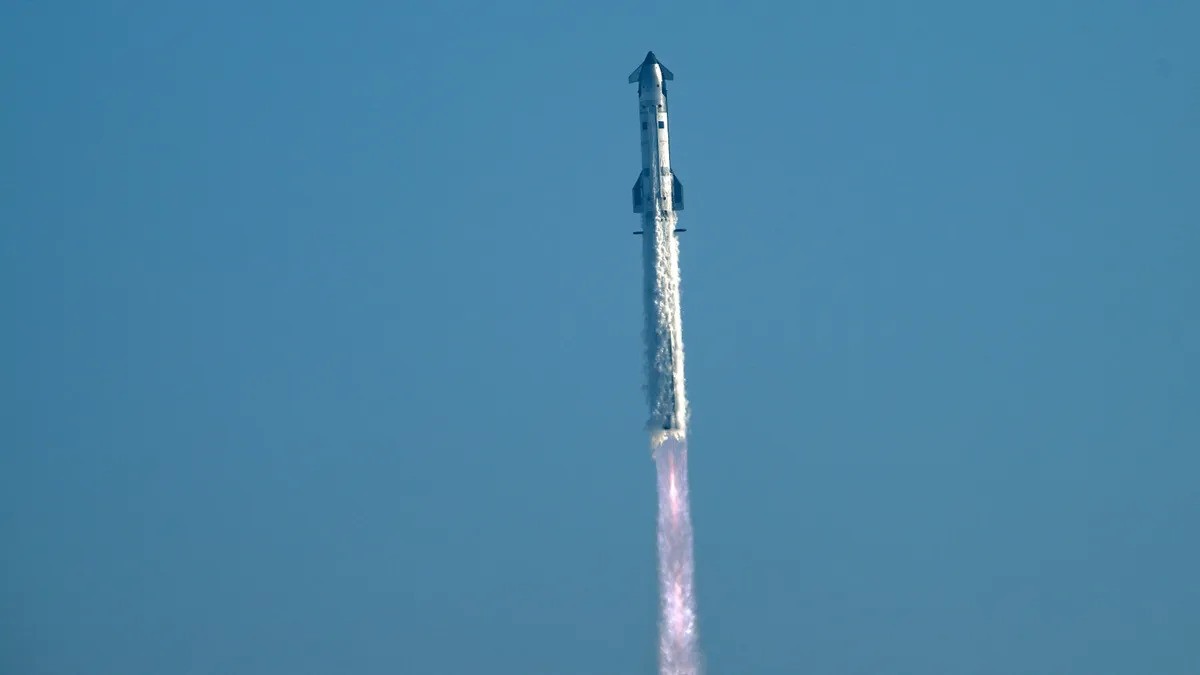
The launch of Starship V3, which had been postponed several times since March, finally took place. The massive rocket lifted off from the Starbase launch complex in South Texas at 6:30 p.m. EDT (2230 GMT) on May 22.
The new version of the 124-meter-tall rocket is the world’s largest launch vehicle. It also differs from its predecessor in its new engines and the design of the joint between the first and second stages. It was precisely this joint that caused several accidents during previous flights.
Overall, the launch—Starship’s twelfth—was a success. Of the 33 first-stage engines, only one shut down, which did not affect the rocket’s ability to reach orbit but prevented it from performing a critical maneuver.
The separation also went smoothly. After reaching orbit, the upper stage deployed, and full-scale mock-ups of Starlink satellites began to be released from it as planned. This indicates that it is already capable of delivering payloads into orbit.
Problems during the launch
However, things didn’t go quite as planned. The original plan had been to test the first stage using a massive manipulator at the spaceport. However, even before launch, that plan had to be abandoned, and a decision was made to try to slow the vehicle down for a soft splashdown.
However, even that attempt failed. Due to a series of errors, the first stage crashed into the water at high speed near the coast of the Gulf of Mexico. Nevertheless, this failure is actually not as significant as another, less noticeable one: engineers were forced to abandon the demonstration of an orbital maneuver using the second-stage engines while the rocket was still in flight. The reason for this was that one of the engines had failed during launch.
What’s next?
Elon Musk called the launch a success and congratulated the company’s team. However, this did not dispel all doubts about its future prospects. The fact is that he had already mentioned the launch of Starship V3 a year ago—in March 2025—as being just a week away.
This version has only just taken off. What’s more, this happened a full six months after the previous launch, which inevitably raises the question of when the next one will take place. And whether they’ll be able to demonstrate in space the maneuvers that have failed so far.
What’s more, NASA is eager to see Starship refuel in space and a number of other capabilities in action. After all, the spacecraft will have to demonstrate these capabilities constantly in the future, since its lunar version serves as the landing module for the Artemis missions. And as early as 2027, astronauts are scheduled to dock with it and with Blue Origin’s landing module variant in Earth orbit.
A lunar landing is scheduled to take place as early as 2028. However, NASA requires that by that time, both companies demonstrate how their modules can land on the Moon without a crew. This means that sending humans back to the Moon may be postponed once again.
According to www.space.com

