

Stars’ flares usually pose a threat to life on the planets orbiting them. However, in a new study, scientists have found that these phenomena can have a positive effect by expanding the habitable zone around these stars.
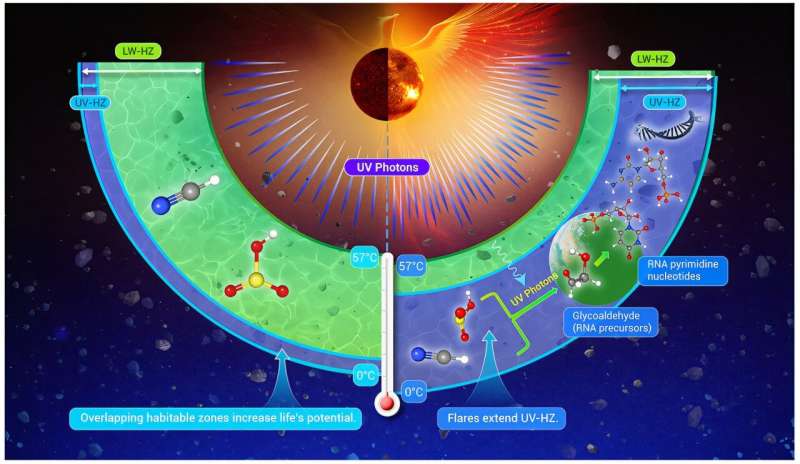
Habitable zone for K- and M-type stars
The search for life beyond Earth has traditionally focused on exoplanets orbiting stars similar to the Sun, that is, G-type stars. However, low-mass stars in the K and M spectral classes quickly became the focus of astrobiologists due to their significantly longer lifespans.
This also means that the habitable zone (HZ)—that is, the distance from the star at which liquid water can exist—is much smaller than in our Solar System, and is called the liquid-water habitable zone (LW-HZ). In contrast, another type of habitable zone, associated with a star’s ultraviolet (UV) radiation, potentially provides conditions conducive to life and is known as the UV-HZ.
Now, a group of scientists from China has refined the definition of UV-HZ. The results of their work were recently published in the journal The Innovation, and they may help us better understand the parameters and conditions for the search for life beyond Earth, particularly in exoplanetary systems.
How do the UV-HZ and LW-HZ habitable zones relate to each other?
In the course of their study, the researchers used a number of models and calculations to assess whether increased solar flare activity could help refine the parameters of the UV-HZ distance. Using these models, the team sought to determine whether it was possible to synthesize RNA precursors—the chemical compounds that form the building blocks of RNA. In addition, they assessed the extent to which the solar activity of low-mass stars influences the UV-HZ and how this correlates with the distance parameters for the LW-HZ. One of the main objectives of the study was to determine whether the UV-HZ and the LW-HZ overlap.
The researchers applied their models to nine confirmed exoplanets orbiting K- and M-type stars: Kepler-1540 b (K-type), KOI-7703.01 (K-type), KOI-8047.01 (M-type), Kepler-155 c (K-type), KOI-5879.01 (M-type), Kepler-1512 b (M-type), Kepler-438 b (M-type), KOI-7706.01 (K-type), and KOI-8012.01 (M-type). All of these exoplanets have been confirmed or are likely to be confirmed as rocky, with the exception of Kepler-1540 b, which has been identified as a Neptune-like exoplanet.
Ultimately, the researchers found that, although the UV-HZ and LW-HZ zones may overlap around low-mass stars, only three of the nine exoplanets examined in the study lie within this overlap zone (KOI-8012.01, KOI-8047.01, and KOI-7703.01). Further observations of Kepler-1540 b, Kepler-438 b, and Kepler-155 c are needed to confirm whether their surface temperatures are suitable for life.
Re-evaluation of theories
Although many exoplanets have already been studied from a statistical perspective, assessing the habitability of individual planets in the habitable zone remains a challenging task—both from an astrobiological and an observational standpoint. Examining habitable zones around stars from different perspectives provides a deeper understanding of the potential habitability of exoplanets.
A reassessment of habitable zones, and the creation of a comprehensive catalog of planets within them suggest that Earth-like planets located both in zones suitable for life with liquid water and in zones with sufficient levels of ultraviolet radiation have a higher potential for sustaining life.
Prospects for the search for life on M- and K-type stars
As noted above, K-type and M-type stars are smaller and cooler than our Sun; their average masses are 0.45–0.8 and 0.08–0.45 solar masses, respectively. Although they are smaller and cooler, interest in the search for exoplanets orbiting both types of stars has grown in recent years. This is particularly true for M-type stars, as they are estimated to account for approximately 70% of the stars in our galaxy. Furthermore, while our Sun’s lifespan is approximately 4.5 billion years, the lifespans of K-type and M-type stars are estimated to be between 15 and 70 billion years and between 100 billion and 14 trillion years, respectively.
Perhaps one of the most interesting M-type exoplanetary systems is TRAPPIST-1, which contains seven rocky worlds. Although all of the exoplanets orbit very close to their star, with orbital periods ranging from one to 12 days, three of them orbit within the habitable zone. Despite these promising findings, astronomers hypothesize that the exoplanets are tied to their star, which also exhibits high stellar activity and solar radiation. This means that the potential habitability of these seven exoplanets remains in question.
According to phys.org

