

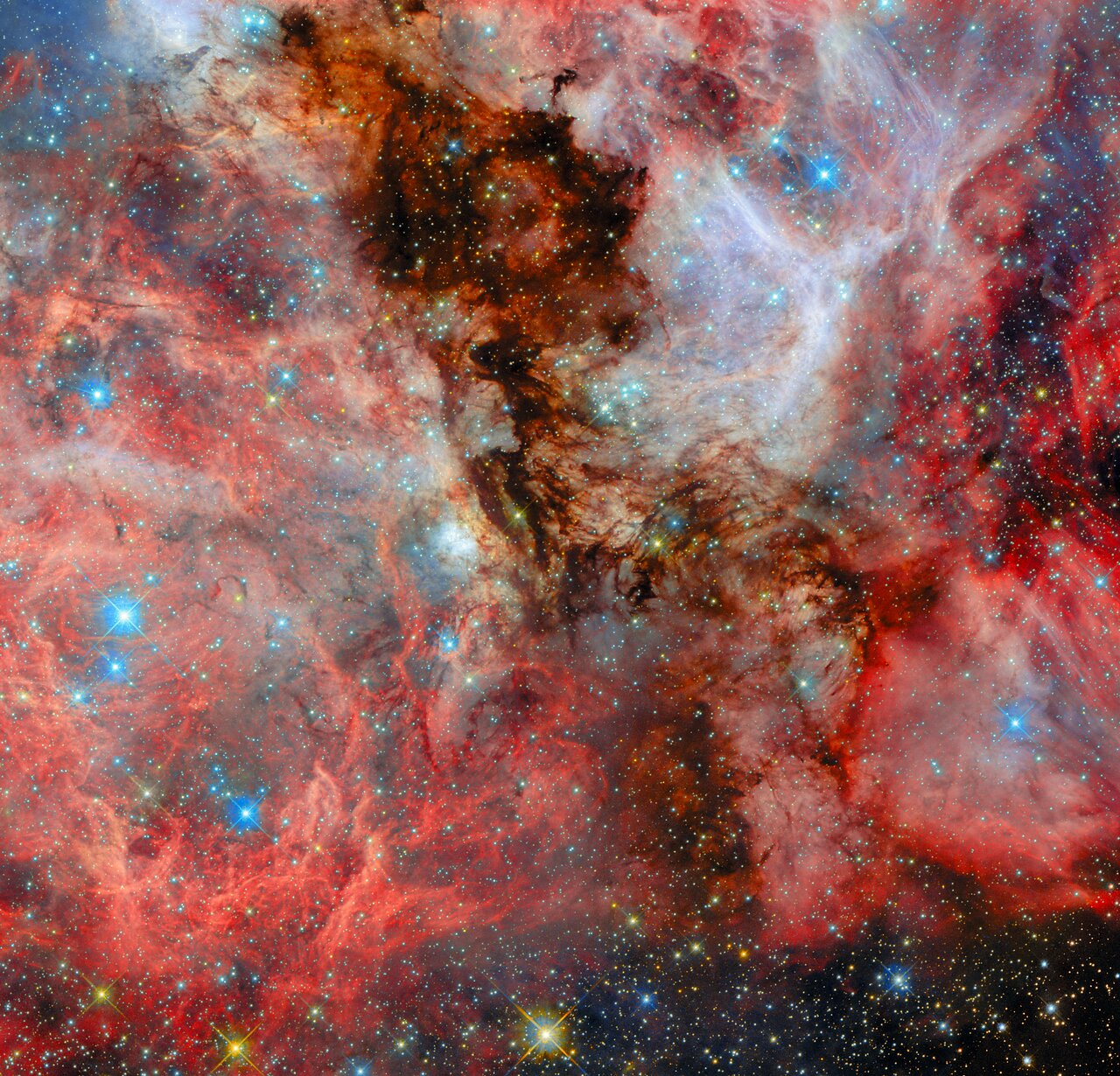
The Hubble mission specialists have once again delighted all astronomy enthusiasts. They have published an image showing a colossal stellar birthplace in a neighbouring galaxy.
Stars form in cold, dense clouds of interstellar gas that collapse due to gravitational instability. During the collapse, they fragment and heat up to such an extent that thermonuclear reactions begin in their cores, synthesizing helium from hydrogen.
This is exactly what is happening in star-forming complex N159. It is located approximately 160,000 light-years away in the Large Magellanic Cloud, a satellite galaxy of our Milky Way.
Although the Large Magellanic Cloud is much smaller than our galaxy, it is much more active in forming stars and is home to the largest stellar nurseries in the local Universe. One of them is N159.
The Hubble image covers only part of N159. Its total length is 150 light-years. The image is dominated by dense clouds of cold hydrogen. They form a complex network of ridges, cavities, and glowing filaments. Newborn stars have already begun to shine in these dense clouds, their intense radiation causing the surrounding hydrogen to glow in deep red tones.
The brightest areas indicate the presence of hot, massive young stars, whose powerful stellar winds and energetic radiation are changing the surrounding environment. These forces carve bubble-like structures and cavities in the gas, which is a clear sign of stellar feedback. The dark clouds in the foreground are illuminated from behind by new stars. Together, the glowing clouds and sculpted bubbles reveal the dynamic interaction between star formation and the material from which stars are born, capturing the continuous cycle of creation and transformation in the Milky Way’s neighbor.
According to Esahubble

