
The Hubble mission support team has published a new impressive image. It depicts a cloudy starry landscape that is part of a neighboring galaxy.
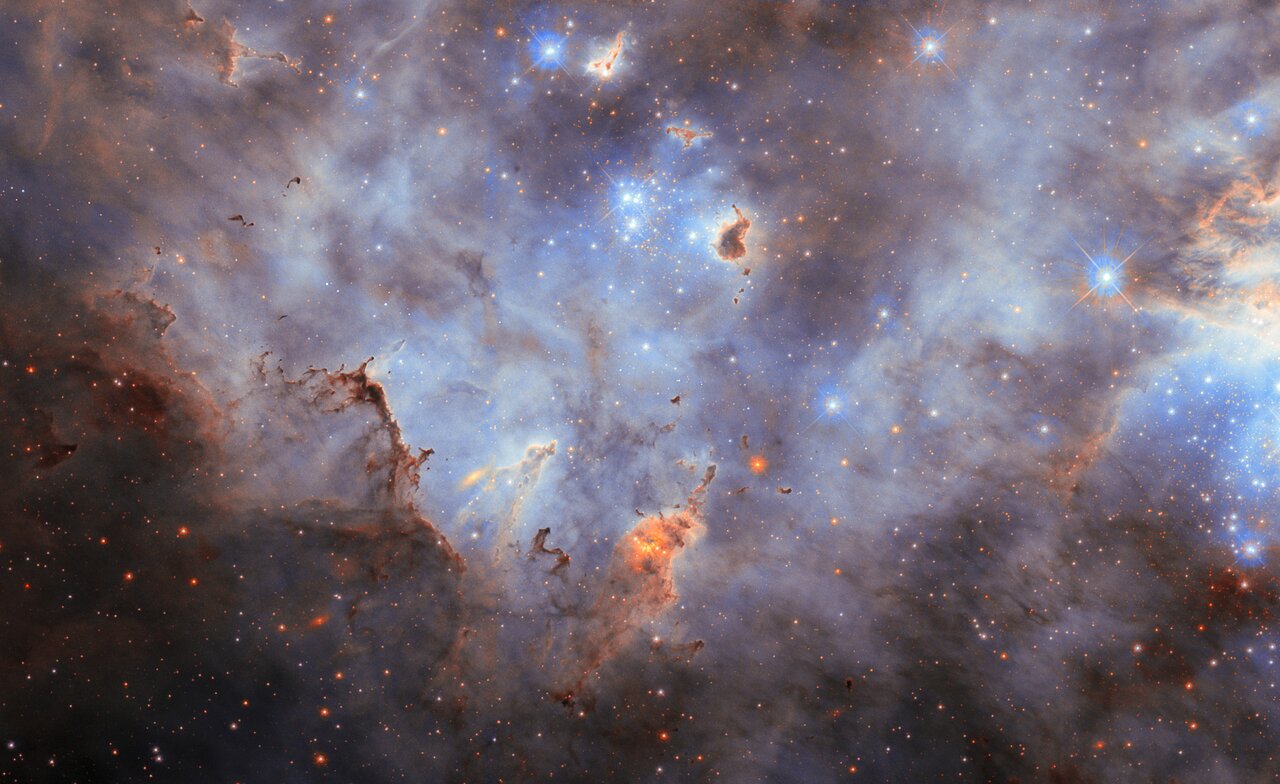
The photographed region is located in the Large Magellanic Cloud, a dwarf galaxy 160,000 light-years from Earth. Its mass is estimated at 10–20% of the mass of the Milky Way. This makes it the largest of dozens of small galaxies that orbit ours.
Although the Large Magellanic Cloud is significantly smaller than our home galaxy, it is home to several of the largest stellar nurseries (regions of active star formation) in the nearby Universe. The largest of these is the Tarantula Nebula, which has often been observed by Hubble in the past. However, this time it has chosen a new target.
The published image shows a nebula known as N11. It ranks second on the list of the largest star-forming regions in the Large Magellanic Cloud. It spans 1,000 light-years. The photo shows bright young stars whose powerful radiation illuminates gas clouds and affects surrounding clusters.
The Hubble image combines observations obtained by the telescope approximately 20 years apart. The first series of observations was conducted in 2002–2003 using the ACS camera, which had been recently installed at that time. Astronomers used it to catalog all the stars in a young cluster with masses ranging from 10% to 100% greater than the mass of the Sun.
The second series of observations was conducted 20 years later using the WFC3 camera, which was installed on Hubble during the last servicing mission in 2009. Its target was the dust clouds that penetrate N11.
Earlier, we reported on how Hubble discovered a rare star system consisting of a white dwarf and a blue straggler.
According to Esahubble

