

Using the Hubble Space Telescope, astronomers have discovered a very rare star system. It consists of a white dwarf and a so-called blue straggler.
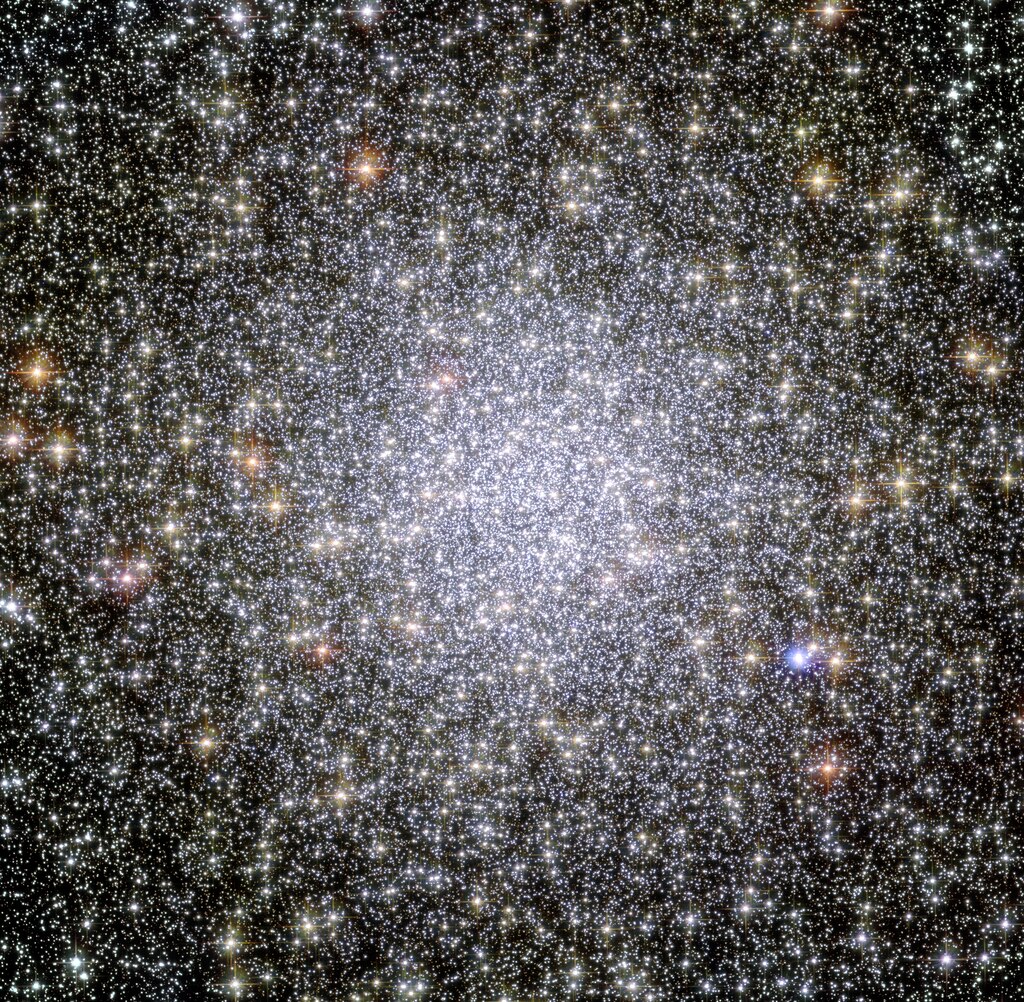
In astronomy, blue stragglers are stars in globular clusters that are located above and to the left of the main sequence turning point on the Hertzsprung–Russell diagram. They appear hotter, heavier, and brighter than their neighbors. This contradicts the modern theory that all stars in clusters are born at roughly the same time and should evolve in a similar manner.
The nature of blue stragglers is not entirely clear. Scientists suggest that they may form during star mergers or during mass exchange between stars. This occurs when one of the stars expands, turning into a red giant, after which its neighbor begins to pull matter toward it. The process results in the “thief” star rejuvenating itself, turning into a blue straggler, while its unlucky companion becomes a white dwarf.
To test this hypothesis, astronomers used the Hubble Telescope to study five blue stragglers in the Tucana globular cluster. Observations have shown that their masses range from 1.06 to 1.2 times the mass of the Sun, their luminosities range from 3.6 to 5.2 times the luminosity of the Sun, and their radii range from 1.45 to 2.18 times the radius of the Sun.
One of the blue stragglers caught the attention of astronomers with its unusual spectrum. Analysis showed that this can be explained by the presence of a companion in the form of a hot white dwarf. Apparently, the transfer of mass in this system is almost complete, and the blue straggler has already pulled in almost all the available substances.
According to scientists, the discovery is of great importance. It became the first serious confirmation of the idea that blue stragglers can form as a result of mass transfer.
Earlier, we reported on how astronomers uncovered the origin of hypervelocity white dwarfs.
According to arXiv.org

