

China successfully conducted the first flight of the world’s largest air wind turbine, the S1500, in Hami (Xinjiang). The flying turbine measures 60×40×40 m and is built according to an aerostat + ring wing design, forming a giant air duct. Inside, there are 12 turbo generators, each with a capacity of 100 kW (a total of 1.2 MW). The energy is transmitted to the ground via a cable, and the complex has undergone installation in the desert, overpressure testing, and multiple launches in high wind conditions. The air wind turbine was developed by Beijing SAWES Energy Technology in collaboration with Chinese research institutes.
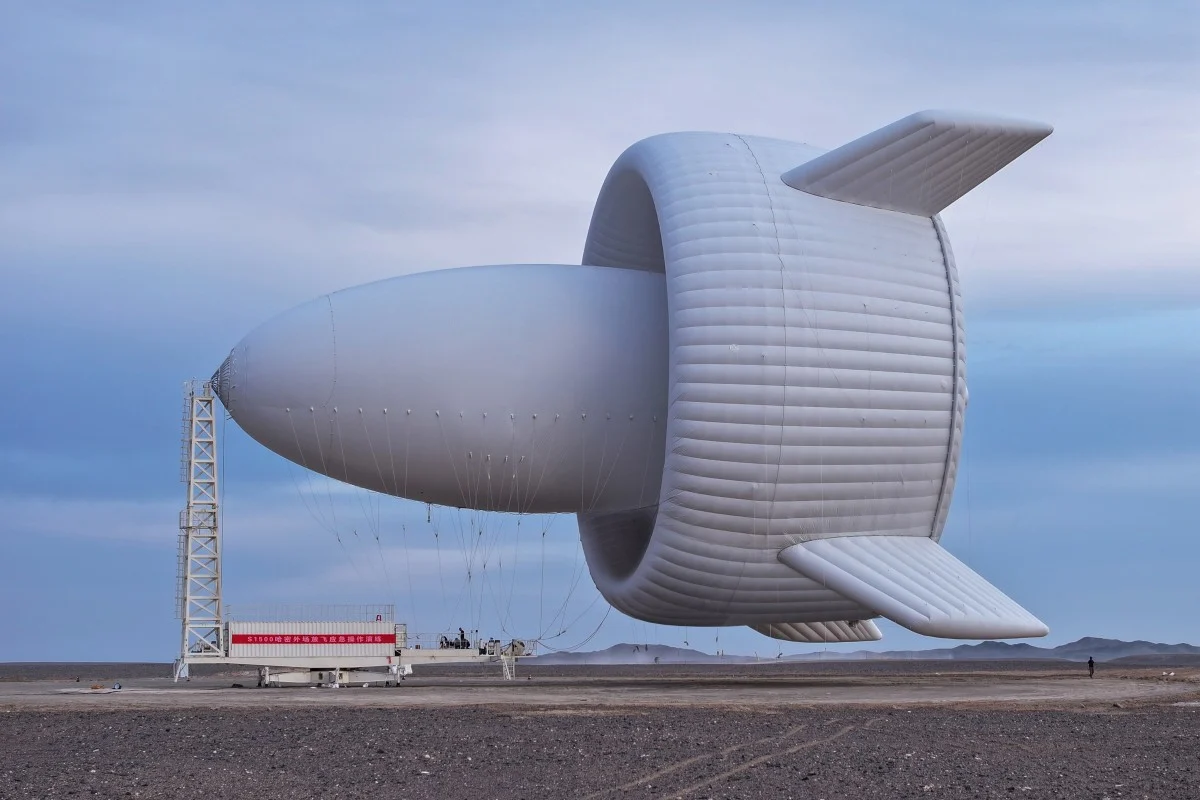
The S1500 is designed to operate at heights of up to 1,500 meters, where winds are faster and more stable than at the level of traditional towers (≈200 meters). Following the tests, the company announced that it had achieved all of its planned objectives, and it is preparing further tests in various regions of the country with a view to mass production.
Simply put, it is an air power plant. A gas-filled balloon lifts the installation to where the wind is stronger and more stable than at ground level. The ring-shaped casing functions as an air duct: it captures the flow and directs it to several smaller turbines inside. The turbines turn the generators, and the electricity flows down the cable directly to the ground station. The secret to its efficiency lies in its height (better wind), ring shape (increases flow), and distribution across several turbines (stable operation and easier maintenance). The automatic system turns the installation to face the wind and keeps it at the required height, allowing it to operate almost continuously.
Why is this important? Flying wind turbines can become autonomous energy beacons for remote observatories, high-altitude radio telescopes, or temporary field expeditions — without power grids or diesel generators that create vibrations and radio interference. In addition, technologies for controlling balloons and cable power lines in the stratosphere are directly useful for high-altitude platform satellites (HAPS), whose platforms are also used for astronomical observations in near space.
Would you like more examples of how yesterday’s science fiction is becoming commonplace? From jetpacks and flexible displays to space elevators, the selection “The wonders of science. Five technologies from science fiction films that have become reality” will show how ideas from movies are transferred to laboratories and the market. After the Chinese airborne wind turbine, it’s time to dive into the world of technological debuts that seemed impossible just yesterday!

